Bowie's tenth album and took place in his 'Thin White Duke' arc. I've heard this one before but I'm not sure I've ever gone back to it after the first time. The Thin White Duke is a character of Bowie's I'm the least interested in. Most of the interest I feel in this arc is more about Bowie himself than his art from this era. There's a lot of different genres in here. Funk, soul, electronic, and rock. Overall it's that classic 'art rock,' electronic 70's R&B,' and 'space rock' that Bowie was so well known for. I always find this era's R&B nostalgic in a way. While I never grew up with it, my Grandad was so into it. Especially Bowie. Perhaps that's why I've never enjoyed R&B from the 00's onwards that I actually grew up with. The musical history makes sense when you listen to it as a through like but sharing a bunch of it through Grandad and then growing up with the 00's onwards' style of it. I dunno. So much of the album is fueled by and is about a drugs and the hallucinations that came from it that. Primarily cocaine. This was the Thin White Duke arc after all. But, perhaps with hindsight and reading over lyrics & interviews, it makes the album fascinating, frenetic, aloof, emotional, but dull. The emotion feels so earnest and I believe Bowie's words about the feelings he has but cocaine has such a elative emotion feeling to it that it that even with the emotions that come with the crash, it's a limited range of emotions. The stories in these songs are deceptive, full of passion, courage, dispair, and joy but through the filter of cocaine highs. Honestly most of the reflection and bredth of emotion you can find that came about during the making of this album came about afterwards, sometimes even well after the Thin White Duke character had ended. Bowie says far more looking back than he ever did in the haze. It might be why the Thin White Duke is the least interesting character Bowie had in my opinion. After writing that, I wonder if that's why "Stay" was the song I liked the most off this album. While I love the Jazz stylings in the guitar and drums cause I'm a sucker for Jazz, the song seems so careless in its desire. Directing it AT a person but framing it as a need for something but it being unknown if it's worth anything or even shared. Is there projection in there? I feel like no but you never can be sure in intpretation. Another reason I say no is, in an interview Bowie mentioned the song was written while he was struggling with the monotany of his cocaine addiction. Is this too much to write? Who knows. This is the first album in this series and perhaps it's a testament to Bowie's talent that it's so easy to ramble about it his work in it's meaning and the emotions felt.
1001 Albums Summary
Rating Distribution
Rating Timeline
Breakdown
By Genre
Tap a bar to see the albums behind it
Top Styles
Tap a bar to see the albums behind it
By Decade
By Origin
Albums
You Love More Than Most
| Album | You | Global | Diff |
|---|---|---|---|
|
Home Is Where The Music Is
Hugh Masekela
|
5 | 3.35 | +1.65 |
You Love Less Than Most
| Album | You | Global | Diff |
|---|---|---|---|
|
Music for the Masses
Depeche Mode
|
2 | 3.38 | -1.38 |
5-Star Albums (1)
View Album Wall
4-Star Albums (3)


All Ratings (10)
The debut album from The Strokes, an American Garage Rock band from New York City. 2001. Fun fact: the ablum released in Australia first apparently because they got some buzz while being a supporting act for "You Am I"'s tour. I tried reading some critical reviews from the time, retrospective opinons by fans, and the lyrics while I was listening to this one. Both critics of the time and retrospective fans have a beloved feeling towards this album. Descriptions you can find both have to say about the album is "Timeless classic," "formative," and "influential." It's interesting to see people echo the same praise they said back when it first released. Is that truly a testament to the album? Based on my own music history knowledge and experience, this style did become very popular in the early 00's. You can find earlier instances of this style but with any aesthetic taste, it's origin is irrelevant to its popularity. People will like it when they like it. It's kind of stereotypical teen/young adult album. Its tales are about the problems people so often face in young love and trying to find their place in the world as they emerge from the inbetween of child and adult. The song writer feeling anxiety, directionless, and lonely in their life. Even some of the frustration voiced in songs like "Alone, Together," feel like there's a lack of conviction/action behind it. At least to me. And all this so say, it feels so very stereotypically Millenial from top to bottom. If someone other than me ends up reading this and they happen to like The Strokes or this album in particular then do not take offense to me saying I didn't like this one. I didn't hate it either. Perhaps we can blame the fact I'm not in the inbetween of child and adult, unsure and anxious with life where this might speak to me. Or perhaps we blame the highsight from which I get to hear this album through. If it was so influential then so many other albums that came after it have surpassed it both musically, lyrically, and emotionally that I can't give it more than a 5/10.
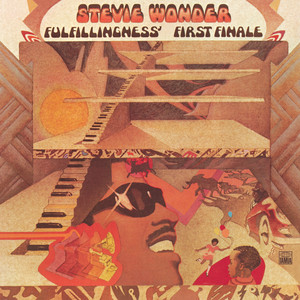
Stevie Wonder's 17th studio album, released in 1974. Stevie Wonder is an artist I've never really sat down and gone through the discography of or even chunks of. I've heard a few songs here and there as the man's music is still beloved to this day. But he is on the list. (A phrase I feel like I'm always repeating about music/books/movies/shows/games/etc.) Reading some of the day critiques and from today retrospectives, it's very highly praised. Seems the album is about a more personal reflection that came off the back of another album (Innervisions) that was a socially consiousness critique of the time. Perhaps there's a fuller picture of this album's messages that would be better served by listening to that first but that's not really what this "One Album A Day" thing is about. After listening to this feel like some of the critiques and retrospectives were exaggerating a litttle. The songs are all good but not many of them have a message. I'd say a good half are just good songs that are intended to be bops. And there's nothing wrong with that but to use one example to represent the whole: "Fulfillingness' First Finale, in contrast, projected a more reflective, personal, and somber tone." I wouldn't describe the whole album like this. There's some sombre and/or reflective songs featured on this album but it's not indicative of the whole album to say that. There's some grooves for the moves too. 'They Won't Go When I Go' is probably the most moving (as in emotionally) as the song was created after the car accident in 1973 that left Stevie Wonder comatose. Overall I liked the album however none of these songs made it into any of my playlists. None quite hit the desire to hear again. That doesn't take away from the craft of this album. It is well made and does display in part why Stevie Wonder is such a legend.
In The Court Of The Crimson King by King Crimson, a band out of London, was released in 1969. While the album is Progressive Rock, the band themselves are known for blending many styles into their music. This album is no exception with jazz and classical music blending into their rock stylings to create something to talk about the devastating effects of war, alienation, disillusionment with the ruling government, and the percieved powerlessness of human efforts to stop corrupt forces in leadership and governig authorities. There's quite the legacy to this album. While I've still yet to go through King Crimson's work or this album at least, I've seen it on so many 'masterpiece' lists and the album art itself is iconic both in reference to and in speration to the album. The art, dubbed 'Schizoid Man' was created by a programmer called Barry Godber, who was a friend of Peter Sinfield. A co-founder of the band and the former lyricist. Godber used his own face as the model but would tragically pass soon after the album's release by a heart attack at the age of 24. It was his only painting to ever be released. With the perspective of hindsight, you can hear the band's influence. So many bands have referenced certain lines, repeated specific notes, sampled whole lines and sections, and even some prog rock that came after was clearly inspired by King Crimson, especially this album. 'I Talk To The Wind' is one of the more curious songs I've heard in a while that are about religious doubts and of god. The wind being an analogy for god to refer to how god appears ignorant to us, cannot be seen, but its effects can be felt. While a very sombre song, it also is quite repetitive while I feel like undercuts any wider introspection or message the song might have had. If the song ever intended to do either to begin with. I like the analogy but that's kind of where the interesting part of the song ends for me. Epitaph is a beautiful song made under the threat of nuclear winter during the . The song is inherently fatalistic, made no more obvious by the title and the most repeated line, "I fear tomorrow I'll be crying." I feel like so few songs nowadays are cynical. Perhaps that's indicative of the time we live in or just fear on the part of artists as cynicism doesn't sell like positivity but it's a refreshing tone to hear in a song. It might be the song I enjoyed most out of the album which stand in direct contrast to the song that came after it, "Moonchild." A song I not only disliked the most from the album but actually had a hard time listening to. From jump the song is obviously going for an abstract angle. I would not be surprised to be told the instrumental section was improvised in the studio recording. And the song's lyrics bolster the idea that there's intend to create a discomfort and unease in the listener. Unfortunately I do really like experimental songs, abstract melodies, and improvised instrumentals. I want to enjoy this one too but I cannot articulate just how much I hated Moonchild. Thankfully the next and titular song, "The Court of the Crimson King," is such a beautiful soundscape. The atmosphere is the most beautiful out of the entire album, using common medieval motifs in the verse to build to a strong drone in a repeating refrain/bridge. The refrain substitutes a chorus as the verses have a narrative to them which might be undercut by even a catchy 4 line chorus. The narrative is analogous to common players in a medieval fantasy court being echoes of our own political government system. The Crimson King, Black Queen, Fire Witch, Yellow Jester, Purple Piper, and more are all easy stand ins for figures of authority of the time yet can easily be repeated to use the analogy again in my own time. Overall it's a fun analogy, even if bleak, that I really enjoyed as much as I would hope that this analogy's continues aptness would end. The version I listened to was the original. I was tempted to listen to the remaster as I tend to prefer those versions, when I saw there were multiple with changed and added track-listings I decided not to bother and went to the original. Trying to work out which is considered the true definitive edition is a waste of time for something I've never heard and need to listen to in a day. Anyway, to my overall feelings. I liked it a lot. "21st Century Schizoid Man" is a hell of an ear worm I may end up muttering to myself over the next few days like a crazy person, "Epitaph" was a beautiful bit of cynacism that will still with me, and the titular "The Court Of The Crimson King" is one I'm finding myself struggling to decide which playlist to put on. (It could fit in so many yet there's none it fits into more than the others). A great album I would recommend for anybody who likes prog rock or albums with a clear message. Though I will always forwarn people to skip Moonchild.
"At Newport 1960" is a live performance album by Muddy Waters. Waters is still to this day a legend in Blues you'll find recommended when looking for iconic Blues musicians. Personally I'm not really a fan of live recordings. You lose the crisp clarity of a studio recording and you lose the feeling and emotion of hearing music live. It's a worse of both worlds in my opinion but this is the specific album recommended through "1001 Albums You Must Hear Before You Die." I think the reason this was included on the was both because Muddy Waters is a legend but also for a piece of this album's history. The day before Waters was set to perform, Ray Charles performed with Lambert, Hendricks, & Ross. Allegedly the drunken crowd of around 300 were so bad the police resorted to tear gas and water hosing before calling in the National Guard. Waters and his band were planning to leave but were told the USIA (United States Information Agency) were recording the festival as a means of propaganda to play in foreign countries. Seeing the opportunity this could, Waters and his band decided to play after all. I've heard Muddy Waters before but my aversion to live recordings meant I never heard this album before. Many of these songs are the kinds of songs you'll often hear covered over and over by many different Blues artists. (I've always wondered if this is why some people say Blues or Jazz all sound the same, is they don't realise they might be hearing different renditions of songs you'll hear every Blues/Jazz play try their hand at.) I Got My Brand On You, I'm Your Hoochie Coochie Man, and I Feel So Good are timeless classics to me. No matter who does these songs, they're good.
Superunknown by Soundgarden was released 1994, their fourth studio album. It's a classic in the grunge genre. I've heard most of these songs before as the album was very quickly a global success soon after release. The songs "Black Hole Sun," "Fell on Black Days," "The Day I Tried To Live," and "Let Me Drown," are probably the most well known that people might know already. And if not, are definitely the four I would recommend most for someone to listen to. There's some fun backstories for a few of the songs like "Black Hole Sun," was written in roughly 40 minutes while not fully listening to the news, taking a few overheard words and then building the lyrics as a stream of conciousness. The song was intended to create a surreal dreamscape atmosphere as such, the lyrics are nonsense. They wanted it to sound like it meant something but it doesn't. I didn't have the time today to go through of the day critiques, retrospectives, and lyrics as I listen like I normally do. Having heard most of these songs means I didn't feel like I was losing too much by not going through that stuff like I had been up until now. Instead I listened to the album as I did some chores like grocery shopping. I quite like the album's atmosphere it builds throughout itself. "The Day I Tried to Live," and "Let Me Drown," are the songs that I'd say resonated with me the most, lyrically. All that to say, I quite enjoyed the album.
Risqué by Chic was release in 1979. It's a disco album with soul and funk mixed in. This is one of those albums that iconic outside it's own genres. R&B, Pop, and Hip Hop still sample songs from this album to this day. It's unsurprising for a band as well beloved as Chic to have both glowing reviews of the time and in the retrospect. It's a testament to Chic's success that they had as much success as it did with a disco album in the late 70's. The time considered the rise of Pop and the death of Disco. Though I imagine it's more due to the cultural elements of disco dying under the weight of it's excess and hedonism rather than the music not being relevant anymore. As Pop, R&B, and Hip Hop's disco inspirations are still evident. This album's a groovey one. I think it would be hard for most people to sit still while listening to it. You can find the cultural excesses and free-spirit energy all over the lyrics of this album. All in all, it's a good album but I don't think it contains much substance being a series of bops that endured.
Depeche Mode's sixth studio album. Released in 1987. "Music For The Masses" is a series of synth-pop songs. Critiques of the time seem pretty mixed, none really giving it a negative score. They instead seemed to feel it was fine yet missing something while other give it an incredibly glowing review. This felt quite new for the album reccs up till now as either critics or retrospectives had been mostly or overwhelmingly glowing. Retrospectives seem to agree with the critics of the day who view it as fine though often highlight its legacy. I did come across a retrospective review that talked about how it did get negative perception in the press for being too depressing. Which felt surprising as I listening to the album. It's not positive but it's not THAT depressing to my ear. Though in saying that, I couldn't find more than one interview by the French and that was it. I'll probably keep this one brief for how I feel. It was fine. Nothing really moved me. It feels like a pretty stock standard synth-pop album from the 80's. Perhaps the lens of hindsight is cruel but there is no other lens on which I can view it from. Perhaps I could play a mental contrarianism in my mind for its benefit, yet I feel no drive there because of how little moved I was by the album. We got a song about drugs, a song about driving, and the rest are about some kind of sad love song in some way, shape, or form. Little 15 is probably the only song that stands out however and not for a good reason. Listen/read the lyrics and you'll see what I mean. The songwriter himself even mentions the song was partially inspired by a classmate he once had, who had an affair with a middle-aged woman when he was 15. The song doesn't glorify or condemn the relationship. It instead simply has the middle-aged woman telling the 15 year old about how much life will suck in future for him. So you're left with a strange context to a song that doesn't have much of a message other than life is hard. And after typing that out, I think I know what my conclusion for that song and this album are. It's directionless. The songwriter was in this limbo state emotionally and mentally, while that can be fun to explore I do not think this album actually explores those feelings or state. Instead it sadly declares them in this listless and low energy way that leaves me feeling bored of the album the longer it goes on.
Hugh Masekela's "Home Is Where The Music Is," is a Jazz, Soul, & Folk music studio album released in 1972. Masekela is praised as "the father of South African Jazz," and I find pretty interesting that I had never heard of the guy until now. Perhaps for his history of being a pretty outspoken political activist and several anti-apartheid songs. Right off the bat with "Part of a whole," I knew I was in for a treat as someone who really enjoys Jazz. So much so that I'm not so sure how well this one would resonate with people who haven't heard a variety of Jazz stylings and sub-genres. The different influences of many different Jazz styles in evident in this album so far. It's clear Masekela was a great lover of the genre but he makes it own as he blends them into the soul & folk music I've heard modern African Jazz players emulate. I'm not being so snobby as to say "you wouldn't get it unless you're a true Jazz listener," or whatever else the elitist modern Jazz enthusiasts have a habbit of saying. I'm trying to emphasise that this was made by a Jazz lover who loved many different styles. And with this album being overwhelmingly instrumental, it feels impossible to describe in what way you can hear that love. I wish I could share that somehow. Now this one is a difficult one what with Hugh Masekela's legacy seems to mainly be as the father of South African Jazz and also being a big influence in Africa's Jazz scene. It's nigh impossible to find critics of the time in Africa I could read over. I thought I found one through online-translators but nope. I did find a journalist who talks about what reactions in Africa of the time were to Hugh Masekela but it never cites anything, references any particular outlets, or brings up a person's name. All very vague and hard to go off. American critics of the time and retrospectives seem to be in abundance however that all equally gush and glow over Masekela's fusion and style. There's a bredth of emotion throughout this album. Upbeat and dancy numbers, somber and soulful contemplations, triumphant and heart-rendering outpours, haunting melodies, and parts that build to more drawn out emotion. It's a long album with many long songs; 5:29 at the shortest and 10:29 at the longest. I think on contemplation, this would be a good album for people who haven't really heard or may think they do not like Jazz but this is a sit down and give it some time kind of album. Which I know isn't everyone's cup of tea.
Let England Shake is a folk rock album and the 8th studio album by PJ Harvey, released on 14 February 2011. Admittedly, I'd never heard of PJ Harvey before. It seems this album was written over the course of two and a half years then recorded in five weeks inside a church. Reviews from critics and retrospectives have quite the high praise for this one. It even one quite a five acolades in a series of "best ofs" and placing high in five others. The album's lyrics were inspired by the poetry of Harold Pinter and T.S. Eliot, then the music of The Doors, The Pogues, and The Velvet Underground, along with the films of Stanley Kubrick, Ken Loach, and Ari Polman. The singer-songwriter, PJ Harvey, also said she spoke to and read testimonies of soldiers in Iraq, Afghanistan, and the Gallipoli Campaign of WW1. This all sounds like quite the hodge-podge of ideas but the lyrics themselves are quite pointed. Directly criticising the love/hate relationship PJ Harvey feels towards her motherland, the UK, feeling the claimed glory of its past is an illusion. The blood and lies create a disonnance that PJ struggles to reconcile because she still loves her country and all the good it has done and the people in it. It also discusses the scars and wounds that the psyche of a counry itself has to battle with due to the wars its people have experienced. Even those who were not in those wars still have to contend with the trauma and carry the scars of those before them. This is an album where you'll need to listen to the lyrics. While the instrumentals are quite fun at times and beautifully somber at other times, the message is the point of the album. And its highlight. If you're unsure then pick one of the three: On Battleship Hill, The Glorious Land, and the titular Let England Shake. These three are the most emblematic of what the album is going for. If they don't get you then maybe come back to it another time. As for me, I quite enjoyed it. It's not an album I think I'll come back to personally but I'm glad I heard it. In The Dark Places and Bitter Branches are probably the ones I enjoyed the most is probably my favourite of this one. Both are simple songs lyrics but it was the melody of The Dark Places and the vocals of Bitter Branches that I liked most.