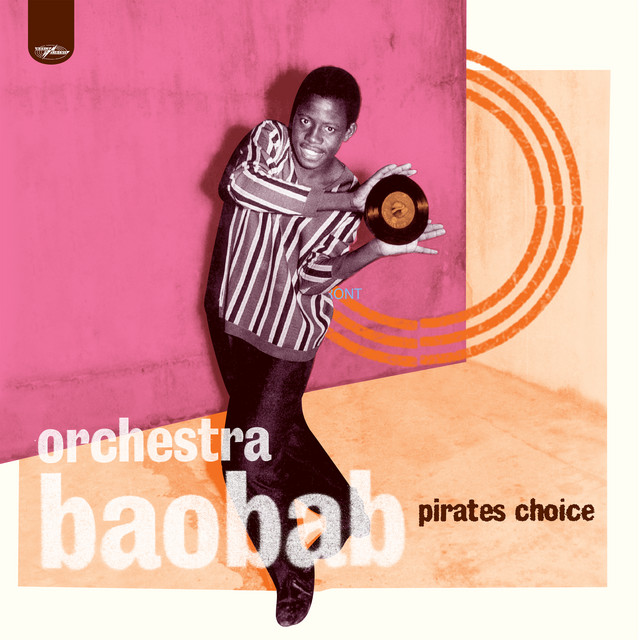
User Submitted Album
View Submitter's ProfileAlbum Summary
Orchestra Baobab is a Senegalese band established in 1970 as the house band of the Baobab Club in Dakar. Many of the band's original members had previously played with Star Band de Dakar in the 1960s. Directed by timbalero and vocalist Balla Sidibé, the group featured saxophonists Issa Cissoko and Thierno Koité, two singers, two guitarists and a rhythm section with drums, congas and bass guitar. Since their formation, the band has predominantly played a mix of son cubano, Wolof music, and to a lesser extent Mande musical traditions. Following the deaths of Cissoko in 2019 and Sidibé in 2020, Thierno Koité has become the leader of the band. Orchestra Baobab became one of the dominant African bands of the 1970s, recording 20 albums before their breakup in 1987, which occurred as a result of the increase in popularity of mbalax, a more contemporary genre of Senegalese music. In the years following their disbandment, World Circuit released several of their albums on CD, making the band very popular among world music fans in the UK and the rest of Europe. This prompted their reformation in 2001, which was followed by the recording of a new album, Specialist in All Styles. The group continues to tour extensively and has released two more studio albums, Made in Dakar (2007) and Tribute to Ndiouga Dieng (2017).
 Read more on Wikipedia
Reviews
Pirates Choice is an album from the 1980s of Senegalese band Orchestra Baobab. If I wouldn't know better, I'd think it was Cuban. It only goes to show that the origins of this Cuban sound (think of The Buena Vista Social Club) are from Africa. Great happy and cheerful melodies.
Dealing with an absolutely toxic boss at work and this is exactly what I need. So soothing and calming.
Fuck And I cannot emphasize this enough Yes
This is what I hoped for when I entered the user generated albums section. I was missing music from Africa and Asia on the original list.
I don't really know what's going on here, but I love the vibe and I love the sound. Sometimes that's enough.
It's a bit repetitive, but it deserves my 5 only for presenting me with such a different kind of album that I did not even know I needed to listen to.
Really nice choice
# In-Depth Review: Orchestra Baobab — *Pirates Choice* **A landmark of Afro-Cuban fusion, *Pirates Choice* is both a document of a vanished era and a living, breathing record that helped reshape global perceptions of African music.** Recorded in Dakar in 1982 and originally released only as a cassette in Senegal, *Pirates Choice* became the stuff of legend after British label World Circuit issued it internationally in 1989. Its 2001 double-disc reissue—adding six previously unreleased tracks from the same sessions—sparked a full-scale reunion of the band and introduced this music to a new generation . --- ## 1. Background and Context Orchestra Baobab formed in Dakar in 1970 as the house band at the Baobab Club. The group was deliberately multi-ethnic and multi-national, drawing members from across Senegal's diverse regions—Wolof griots, Mandinka singers, Casamance percussionists—as well as from Togo and beyond . By the late 1970s, the core lineup included vocalists Balla Sidibé, Thione Seck, and Ndiouga Dieng, saxophonist Issa Cissoko, and Togolese guitarist Barthélémy Attisso. The music they played was a distinctive fusion: Cuban son, rumba, and charanga—genres that had been enormously popular in West Africa since the 1940s—reinterpreted through a West African sensibility. As the Chicago Tribune put it, Baobab's innovation was to merge Cuban sounds with "Senegal's indigenous folk musics—the percussive Wolof grooves of the North and the string-band harmonics of the South—as well as jazz and rock" . The result was something entirely new: Latin music that sounded, unmistakably, African. By 1982, when *Pirates Choice* was recorded, Orchestra Baobab was at its creative peak, but the commercial landscape was shifting. Youssou N'Dour's mbalax—more percussive, more funk-influenced, more youth-oriented—was beginning to eclipse the older band's mellow sophistication. *Pirates Choice* was recorded just as this transition was underway, making it both a summation of a decade of musical exploration and a document of a moment about to pass . --- ## 2. Lyrics and Vocals One of the defining features of *Pirates Choice* is its multilingualism. The songs are sung in Wolof, French, Mandinka, and Spanish . This isn't mere eclecticism for its own sake—it reflects the band's cosmopolitan makeup and the cultural reality of Dakar as a port city where diverse traditions met and mingled. **Language and meaning.** The album's opening track, "Utrus Horas," comes from Guinea-Bissau, while "Soldadi" has Senegalese origins . Three of the tracks are reworkings of Cuban songs . The lyrics often deal with themes of homesickness, love, and social observation, though precise meanings are sometimes elusive to non-Wolof or non-Mandinka speakers. "Toumaranke," for instance, has a carnival-like atmosphere but its Mandinka lyrics address homesickness . This tension between joyful sound and wistful content is characteristic of the album as a whole. **Vocal style.** The singing on *Pirates Choice* is a study in contrasts. Balla Sidibé brings a gruff, barrel-chested tenacity to his leads; Rudy Gomis offers a clucking, popping ebullience that evokes traditional Cuban soneros; and the various griot singers bring a declamatory, speak-singing quality rooted in West African oral tradition . Robert Christgau noted that there is "no Iberian schmaltz in their singers rough or smooth"—a crucial point . The vocals are African in phrasing and timbre even when the melodic contours echo Cuban models. **The pros:** The multilingualism and vocal variety give the album a richness and depth that rewards repeated listening. The harmonies—particularly on tracks like "Werente Serigne"—are described as "magical" . **The cons:** For listeners without knowledge of the languages, the lyrics can remain opaque, and the album's liner notes (at least in some editions) offer limited translation or context. The vocal style is also relatively restrained compared to some African traditions—there are no virtuosic displays of extended technique here, but rather a collective, ensemble-oriented approach. --- ## 3. Music and Arrangements The musical foundation of *Pirates Choice* is the interplay between Cuban rhythms and West African melodic sensibilities. This is not pastiche or imitation—Orchestra Baobab had internalized Cuban music so deeply that they could use it as a starting point for something new . **Rhythm section.** The percussion—congas, timbales, drums—lays down a groove that is unmistakably Cuban in its syncopation, but the feel is different. One critic described it as "positively sedate" compared to Baobab's earlier album *Bamba* . The tempo is relaxed; the groove is deep and patient. This is music that trusts the listener to lean in rather than shouting for attention. **Guitars.** Barthélémy Attisso's guitar work is one of the album's greatest pleasures. His solos on tracks like "Ray M'bele" are melodic and restrained—he seems to have "left his wah-wah and fuzz box at home" —tracing "silvery, spiraling patterns with a touch so delicate that aficionados of psychedelia, Curtis Mayfield and Wes Montgomery all might have appreciated it" . The rhythm guitar, often played by Latfi Ben Geloune, provides a "clip-clop galloping" foundation that is central to the band's distinctive sound . **Saxophone.** Issa Cissoko's tenor sax is the album's other primary voice. Christgau called him a "drolly doleful individualist" . His playing on "Utrus Horas" and "Coumba" is lyrical and unhurried, painting what one writer described as "a picture of a tropical night sky" . The saxophone provides a foil for Attisso's guitar, creating a dialogue between the two lead instruments that is central to the album's emotional arc. **The pros:** The musicianship is impeccable. The interplay between guitar and saxophone, the subtle rhythmic shifts, and the overall ensemble cohesion are the work of a band that had been playing together for over a decade. The music is sophisticated without being showy, accessible without being simplistic. **The cons:** Some listeners may find the pace too slow and the arrangements too uniform. As one reviewer put it, the album is "basically... just too restrained to fully justify all the fuss surrounding it" . The tracks are long—most run between seven and nine minutes—and while this allows for development, it also demands patience. Those expecting the "hell-for-leather energy" of some African pop may be disappointed . --- ## 4. Production and Sound *Pirates Choice* was recorded in Dakar in 1982 on what were likely modest studio facilities. The 1989 World Circuit CD and the 2001 double-disc reissue were remastered from the original session tapes, with "improved sound" . The production is functional rather than lush—this is a document of a working band playing together, not a multi-tracked studio creation. **The mix.** The instruments are balanced in a way that emphasizes the ensemble rather than any single element. The vocals sit comfortably within the mix, neither buried nor over-prominent. The percussion has warmth and depth without being overly reverberant. The overall sound is clean, slightly dry, and very present. **The pros:** The production serves the music. It doesn't impose a contemporary aesthetic onto recordings that are decades old. The remastering has presumably improved clarity and dynamic range without sacrificing the original character. **The cons:** The sound is somewhat thin by modern standards, particularly in the low end. Some listeners might find the drums lacking in punch and the overall sonic picture less immersive than contemporary productions. The 2001 reissue's inclusion of six additional tracks from the same sessions is welcome, though critics noted that these "extra tracks are solid but none of them stand out enough to make you wonder why they weren't on the original LP" . There is also a noted quirk: the original 1989 CD issue included alternate takes of "Utrus Horas" and "Coumba" that are not included on the 2001 deluxe edition, leaving some completists frustrated . --- ## 5. Themes Several themes run through *Pirates Choice*, both in its lyrical content and its broader cultural significance. **Hybridity and return.** The album is a testament to the circularity of musical influence. Cuban music was itself shaped by African rhythms brought to the Caribbean through the slave trade. Orchestra Baobab's music represents a "return" of those rhythms to Africa, filtered through decades of Cuban development and reinterpreted through Senegalese ears . As one French critic put it, Baobab "invests canonical bolero and rumba as if these genres could only have been born in Africa" . **Urban cosmopolitanism.** This is dance music made in a port city, for an audience that was itself diverse and outward-looking. The multilingualism, the mix of Cuban and West African elements, the sophisticated arrangements—all speak to a vision of African modernity that was cosmopolitan rather than insular. **Nostalgia and loss.** There is a pervasive melancholy beneath the surface of even the most upbeat tracks. This is partly a function of the music's slow tempos and minor keys, but it also reflects the album's historical moment: recorded just as the band's era was ending, it captures a sound and a scene that would soon be displaced by mbalax. The title itself—referring to the album's widespread piracy across West Africa—speaks to both the music's popularity and the informal, precarious nature of the West African music industry at the time . --- ## 6. Influence and Legacy The influence of *Pirates Choice* operates on multiple levels. **On African music.** Orchestra Baobab were, as Baaba Maal has said, "the first modern band, singing African songs with electric guitars, drums and bass... the first true Senegalese music" . Their success paved the way for the generation of Senegalese musicians—Youssou N'Dour, Baaba Maal, and others—who would go on to international fame. Even N'Dour himself acknowledged Baobab's importance, supporting their 2001 reunion and describing them as an inspiration . **On world music.** The 1989 release of *Pirates Choice* was a key moment in the development of the "world music" market. Championed by BBC DJs Charlie Gillett and John Peel, it reached audiences far beyond the African music cognoscenti . World Circuit's Nick Gold has said that Baobab's "mellow arrangements of Cuba's dance rhythms" first inspired him to research Cuban music—a path that eventually led to the Buena Vista Social Club, the most commercially successful world music album ever released . In this sense, *Pirates Choice* was a direct ancestor of the entire Buena Vista phenomenon. **On the band's own trajectory.** The album's international success led directly to Orchestra Baobab's reunion in 2001 and their subsequent creative renaissance. Their comeback album, *Specialist in All Styles* (2002), won two BBC Radio 3 Awards for World Music—the only band to have done so . Without *Pirates Choice*, there would likely have been no reunion, no new music, and no global touring career for this remarkable group. --- ## 7. Pros and Cons Summary ### Pros - **Timeless musicianship:** The interplay between Attisso's guitar and Cissoko's saxophone is consistently inventive and emotionally resonant. - **Cultural synthesis:** The album represents a genuine fusion—not a gimmick, but a deep and organic blending of Cuban and West African traditions. - **Vocal richness:** Four vocalists singing in multiple languages create a textured, layered sound that rewards close listening. - **Historical significance:** This is a document of a pivotal moment in African music history, capturing a band at its peak just before the mbalax revolution changed everything. - **Influence:** Its impact on world music, on Cuban music's global revival, and on the band's own second act is difficult to overstate. ### Cons - **Restrained energy:** Compared to some African dance music, the tempos are slow and the arrangements are patient. Listeners seeking high-energy grooves may find it sedate. - **Length and uniformity:** Twelve tracks (on the 2001 reissue) of seven to nine minutes each can feel monotonous without careful attention to the subtle variations between them. - **Production limitations:** The 1982 recordings sound thin by contemporary standards, and the remastering can only do so much. - **Language barrier:** For non-speakers of Wolof, Mandinka, French, or Spanish, the lyrics remain largely inaccessible without supplementary materials. - **Reissue quirks:** The 2001 edition omits the alternate takes included in the 1989 CD, frustrating completists . --- ## 8. Conclusion *Pirates Choice* is not an album that grabs you by the throat. It is an album that invites you in, slowly, with patience and grace. Its pleasures are subtle: the way Attisso's guitar lines curl around Cissoko's saxophone, the gentle swing of the percussion, the warm blend of voices singing in languages that carry histories of migration and exchange. Its weaknesses are real—the pace is unhurried, the sound is dated, and the lyrics are opaque to outsiders. But these are the weaknesses of a record that refuses to pander, that trusts its listeners to meet it on its own terms. For those willing to make that effort, *Pirates Choice* offers something increasingly rare in any genre: music that sounds like a place, a time, and a community, captured in amber but still alive with the breath of the people who made it.
Very nice find in a music genre I don't know well at all. What impresses me the most here is how both the gentle artistry and straightforward production values sound timeless for a record released in 1982. Ironically, the wikipedia blurb up there informed me that Orchestra Baobab would soon fall out of favor for their Seganalese audience because of the irruption of the mbalax style (Youssou N'dour and the likes) -- a style which probably didn't age as well decades later. Whether in Africa as elsewhere in the world, the eighties aesthetics sometimes did a lot of damage to authentic-sounding artistry. At least, it's a strong opinion I have about them. I recognized the very distinctive son cubano influences right away, and was surprised to find them in a fully "African" context. I don't know the first thing about Wolof and Mande music traditions, but I guess they bring the variety of influences I sense listening to this album. Apart from that, I enjoyed the guitar licks on "Utrus Horas" - some of them surprisingly atonal -- and "Werente Serigne"'s guitar and vocal hooks were very catchy. "Coumba" is also a memorable, bittersweet break-up song. Its French lyrics are very naive, but also very endearing. The rest tags along as excellent background music to relax and unwind by the pool this Sunday, with cool sax tones and cool vocal performances. Maybe I'll get a little more familiar with those other tracks later on. I only wish some of the songs weren't as long as they are for active listening. But the extended duration works pretty well for cuts showing subtle and interesting progressions, such as "Ray M'bele", or the odd meters at the end of the lively "Toumaranke" (from the second CD of outtakes taken from the recording sessions used for the original album, which is the first six tracks of the double-CD version, if I understood correctly). As usual for this sort of suggestion shedding a light outside of the Western Anglo sphere, I am left wondering if some supplementary lists of 1001 albums should be dedicated to that type of record so as to give justice to music traditions from all over the world. But of course, it goes without saying, there's absolutely nothing wrong with submitting this album in the generator's user list. So thank you, anonymous user. 3.5/5 for the purposes of this list dedicated to essential albums, rounded up to 4 8.5/10 for more general purposes (5 for the musicianship and production values + 3.5 for the artistry) ---- Number of albums from the original list I find relevant enough to be mandatory listens: 465 Albums from the original list I *might* include in mine later on: 288 Albums from the original list I won't include in mine: 336 ---- Number of albums from the users list I find relevant enough to be mandatory listens: 122 Albums from the users list I *might* select for mine later on: 140 (including this one) Albums from the users list I won't select for mine: 309 ---- Salut Émile, Tu pourras lire ma dernière réponse sous le *Little Criminals* de Randy Newman. A+.
Fun album. Would listen again when having a BBQ with friends.
Went on long enough that it juuuuust started testing my patience, but this is the kind of pleasant mellow music that can go on for a long time without getting tiring.
Though the album length was excessive, the song lengths gave the album a good flow. I’d never heard of this band and liked them
Ça serait mon choix aussi
A very welcome burst of joyful sound. Hard not to like
each track is a straight shot of afro carribean goodness. Though languid at times, very good and cool vibey times await
Very nice
So the day before I had a Japanese Rock band as a selection and I did not enjoy that. This I did. When an album is in a language I don’t speak I shift my attention to other attributes. I loved listening to all parts of this. The music, the sound of the vocals, the overall feel. I feel I got a good intro a music I never would have stumbled across otherwise.
Rating: 7/10 Best songs: Ledi ndieme m’bodj, Werente serigne, Foire internationale
Quite laid back and oozing integrity. These guys are the real thing and I could listen all day.
What a cool collection of 70s'-era Senegalese dance music. Even though the extended runtime wore on me a bit near the end, the expressive yet chill instrumentals on this LP made for some great listening. Big fan of the chorus-drenched guitar lines meandering in over the excellent melodic backing – this whole LP had an air of slacker coolness that has aged like a fine wine. Cool add, always great to get some more international music onto the user list.
Yeah this is the stuff. Make sure to listen to the correct version since the original was only 45 minutes long versus the spotify version which is over 90 minutes. Really interesting stuff and interesting to learn the influences of Cuban and Senegalese music on each other. This is what the book should have been all about. My personal rating: 4/5 My rating relative to the list: 4.5/5 Should this have been included on the original list? Yes
Relaxing, fun album
I love when interesting World options get added. I've never heard Ethiopian music and the African / French feel is so classic. 4/5
Vet inte riktigt vad det här var för något? Bra är det i alla fall om än något för lång. Här blir det minsann en stabil fyra.
Seems to not only be a compilation album, but an extended re-release of a compilation album. Good thing I'm actually very much in the mood for something like this right now. From my two minutes of research, this is a Senegalese band playing music heavily inspired by Cuban music, which itself is heavily inspired by Senegalese music. Very chill and enjoyable, but as is very often the case for compilation albums, I was mostly done with it about 4 songs before the album was done with itself. Happy I listened to it though. Cool suggestion.
You know I'm absolutely here for this shit
Album Cover: 5/5 (Reminiscent of a 1950s or 1960s album) There isn't a Wikipedia page for the album so I am trusting that I listened to right album/songs on YouTube. What I head was good. "1989 UK release of legendary 1982 recordings by the Senegalese band Orchestra Baobab. It captures the group's smooth mix of Afro-Cuban rhythms and West African styles, becoming a classic item for world music fans." AI Search results for info on the Album. Track List: www.discogs.com -------------------------------------------------- 1 Utru Horas 8:38 2 Coumba 7:36 3 Ledi Ndieme M'bodj 8:49 4 Werente Serigne 6:39 5 Ray Mbele 6:51 6 Soldadi 7:57 7 Utru Horas (Alternate Take) 7:02 8 Coumba (Alternate Take) 7:38 Rating: 4/5
Interesting and catchy album.
Pretty dope
Son cubano, Wolof music, Mande music, Afro-Cuban jazz. Ni fu ni fa.
It’s ok but too long.
Very enjoyable sort of background music
I got behind and then mixed up, and left my review for this album on Prince Daddy & The Hyena page. Whoops. No undo button so I guess Ill tell you how I felt about Prince Daddy & The Hyena here? Sorry about fucking up. Though, probably small potatoes given global warming is real and we're all watching billionaires race to contribute the most to an unprecedented fossil fuel energy surge in service of a technology designed to steal and the usurp the value of human creation, which may possibly also start trying to directly kill us all. Anyway PD&tH is fine kind of late era sound emo punk. Little bit oversaturated on the punk lately on this list.
Cheerful enough and something different. Not my jam but worth a listen.
Cold tunes
A bit tricky to research, but this album was first released in 1982 (under a different name), released in the UK in 1989 and then reissued on cd in 2001, which is the version available on streaming services. The first 6 tracks are the original album material, and the rest are the remaining songs recorded during the album sessions. With all that being said: This is some nice, light Senegalese dance music.
Way too long, but pretty good
I can appreciate the skill and 45 minutes of this would have been decent. 95 minutes is too much.
Cuban influencing? Fine as a short listen. Wouldn't return to this.
The first track I didn’t like The second track I rather enjoyed I switched off after that because I was late for work. But ultimately I think too much jazz