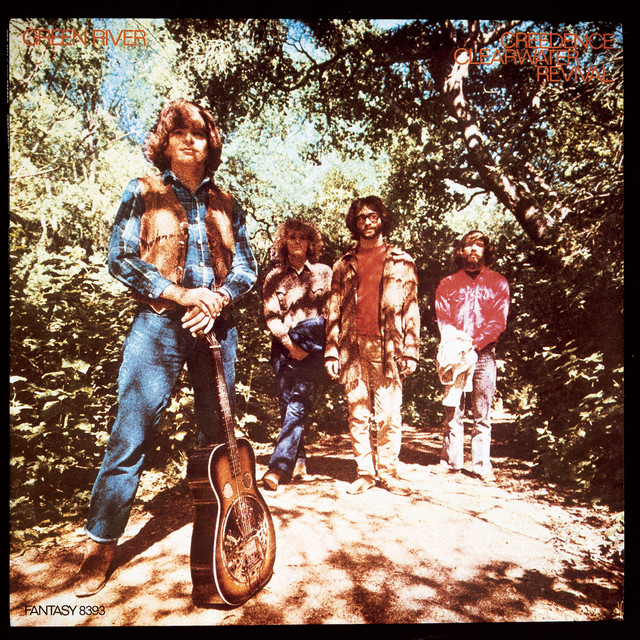
Album Summary
Green River is the third studio album by American rock and roll band Creedence Clearwater Revival, released in August 1969. It was the second of three albums they released in that year, preceded by Bayou Country in January and followed by Willy and the Poor Boys in November.
 Read more on Wikipedia
Keywords from Reviews
Rating Over Time
Reviews
I think you need to own a motorbike to enjoy this. I do not own a motorbike.
I never thought that this would be my first 5/5 album, but I mean no surprise cuz I don’t think I’d ever given them a chance despite loving some of their adjacent bands. Well today’s the day it seems and I loveeeeee it
Was slightly more familiar with this album than their previous one I've gotten on here, Bayou Country. "Bad Moon Rising" obviously kicks ass, and I've heard references to "Lodi" but not sure if I had listened to it before? I also really enjoyed "Green River" "Commotion" and "Sinister Purpose" but pretty much everything on here was enjoyable!
Creedence is one of those vans that I think doesn't get the respect they deserved. This is great music. Every song is a good one. Some are absolutely legendary. I saw John Fogarty at Glastonbury last year. After a patch of someone else "owning" his songs he was performing them again. A friend with me was amazed he knew so many of them. I think there is enough here to make this a 5/5
Good and bad songs. One legendary of course.
I rated the other CCR albums higher, but this one is still good. 4/5
CCR is great, but this album is just ok. Nothing really wrong but not a whole lot of shine either. Maybe I just wasnt in the mood today.
As blues rock goes, it was fine (as many similar ones are) but again, not a great deal to stand out. Interesting reading about the critique of them as trying to sound they are from the bayou whilst being city boys themselves. I didn’t get a sense of that necessarily from the music but could imagine a lack of authenticity might piss others off.
Poor man's Cream, bad moon rising a great single, the rest of the album ok but wont be rushing to listening to again...
An undeniable record in a largely excellent discography
GOD
Fine album, but maybe a bit too much of the same after a while.
savrseno uvek
1. I like the changes in the song; reverb in the audio mixing makes it sound like a live performance. 2. very up beat movie lock-in music 3. not sure what these changes are but they sound very familiar; potentially typical rock changes 4. sad song, let it be vibes 5. rock changes 6. growing up b-roll 7. I like the changes in the chorus 8.I like the drum breaks starting at 2:40 9. blues changes
It’s Creedence. I’m familiar with them. It all kind of blends together for me, though. I like the title track, I like the jamming that there is, but at times it sounds so much like Creedence that it’s almost a self parody. Added to liked list: Green River and Bad Moon Rising.
Jeg overlever Gubberock på under en halvtime.
Classic, fun stuff, good lyrical work
Favorite songs: Green River, Bad Moon Rising, Lodi, Cross-Tie Walker, Sinister Purpose
6.5/10
pretty good!
Creedence show up in (almost) full force on this album. Though the third one in their catalogue to this point, it was the first one to present a band fully formed and ready to become one of the biggest in the world. This was also the first of 3(!) albums the band released in the year 1969 alone; CCR's deal with Fantasy Records was notoriously awful even for the time. Somehow, John Fogerty stayed sharp throughout the band's existence and penned one of the most consistent discographies in rock history within only 5 years. Green River is usually considered the first "great" CCR album, mostly because it stays remarkably consistent across its all-too-brief 28 minute runtime. It also exists at this strange intersection of the band's history as they transitioned from a small-time act to one of the biggest stars of their era. In this regard, the album almost sounds like it's transforming the band in real time. There's still some residual elements of the old Creedence, but by the time you get to "Bad Moon Rising," the youngins who made the first two records have been all but replaced by the world's oldest and wisest 20-somethings. Creedence next two releases would top this one, refining and honing their signature timeless sound as the 60s became the 70s, but Green River is the genesis point for the Creedence that we still remember today. Key Tracks: Green River, Tombstone Shadow, Bad Moon Rising, Sinister Purpose
Green River is a great 60s rock album with lyrics that delve into the Vietnam war, fame as a touring band, and even the railroad. The album is consistently great across the entire work, and the highs are incredibly high, as Bad Moon Rising an absolutely amazing song. The sound is uniquely great, and you can feel the south emanating from the music. The instrumentation is incredible and there are several dueling moments that are great. The guitar tone is also fantastic throughout.
Um álbum incrível, é completamente o estilo de música que curto ouvir.
Great tunes, a great sound, and the unnecessary jamming that marred Cosmo's Factory for me hasn't started to creep in yet.
closer to the classic rock i like, but i feel like i have to be in a specific mood for this. like it sounds more like summer to me, specifically after i've done a long day of fieldwork or something like that. this album is also another instance of "the songs i like and already knew are the ones that stand out to me". i actually really like the inclusions of the live tracks on this - they add more to that gritty rock and roll sound.
Meh
Pleasant tune after pleasant tune. Not a single bad song on the album.
Да, это очень круто, и я, наверное, даже поставлю пятерку, точно буду еще слушать их! Я обожала Long Cool Woman The Hollies и она ужасно похожа на Green River, хотя если честно Green River похожа на Susie Q, но не настолько, Lodi также одна из лучших песен. Хаха, я надеюсь, я не ставила галочку чтобы мои отзывы были публичными, потому что я пишу никому не нужное личное мнение. Все таки я здесь, чтобы исследовать свой музыкальный вкус
Could be a high 3 or a low 4 for me. Nice album to listen through all the way - maybe not that many stellar standouts, even if Bad Mood Rising is on the album (was never a fave of mine). Prefer Cosmos Factory personally but this album might have better 'songs'.
Pretty good album from CCR. Not my favorite but it has a few hits and a couple of instrumentals from them I've never heard before. Still had that good old CCR twang I love. Favorites were: Green River, Wrote A Song For Everyone, Bad Moon Rising, Broken Spoke Shuffle. The cover of The Night Time Is The Right Time was fun but not amazing.
it all just sounds like CCR
I needed this. Today we had to put our dog down & this is comfort music to me. Which is helpful. Thank You. This is also a perfect autumn album. Just sets the scene so perfectly. Johnny can be a bit of mush-mouth at times with Wrote a Song sounding like Rush On. Of course, The Bathroom On The Right is ever so frightening. 5
4.5
3.5
This is a classic album. The other CCR album we had “Bayou County” was good but this takes the songwriting to another level. The big songs with “Green River”, “Bad Moon Rising”, and “Lodi” are all fantastic but it’s the track “Wrote A Song For Everyone” that touched me with its lyrics and how it’s sung
Temones, tremenda vibe, me encantó
First album of the 1000. For context I haven't heard 99% of anything in this list before in any notable capacity, so It'll be my first time with almost the entire list. I'm like a musical hermit- I like what I like and rarely leave my musical pasture. This both is and isn't too far outside of what I typically listen to in that I like folk but don't care for country. It's not something I'd have in frequent rotation, but I enjoyed it over all and it wasn't a slog to listen through. Nice snappy sound, lively. I'm sure I'd earn grandpa points if I told my grandpapa I listened to this. A more precise rating would be 3.5 / 5 Another review called this genericana and I frankly have to disagree as I haven't heard anything here shilled out to 500 commercials or overplayed on classic radio stations before- though I don't listen to the radio much so maybe im just uninformed. Commotion was my favorite of the album. Fun track.
CCR are one of those rare groups to make albums that are neither a “collection of decent songs that combine to make something greater” nor a “few hit songs plus a bunch of filler” — instead they are making albums that are “a bunch of hit songs plus a little bit of filler.” There are a few tracks that are a bit forgettable to me, but the ratio of great tunes to mediocre ones is pretty incredible. Also, this is a rare album that is very impactful whether you’re listening on a sound system, nice headset, or tiny ear buds.
Strong album. "Wrote a Song For Everyone" prompted me to get up, shut the music off get my guitar to make music of my own. "Cross-Tie Walker" sounds like a demo of "Bad Moon Rising" but that's not really a flaw. I think Black Sabbath would've done a killer cover of "Sinister Purpose". "Lodi" is the track which gets stuck in my head far too often. And it's all topped off with a very well done rendition of "The Night Time Is the Right Time". Throughout every memorable track there is that high treble twang that I love so much. In sum, Green River is a quintessential Swamp Rock album.
I liked ccr in high school, now not so much 2/5
Oh lord, wow
Just some good old fashioned blues rock
Not my favourite CCR album, but still very enjoyable
This record was quite a pleasant experience to listen to. There's interesting melodies here. Favourite Track(s): Bad Moon Rising, Sinister Purpose Least Favourite Track(s): Cross-Tie Walker
CCR gives
Country blues rock but I didn't hate it?
Essential roots rock. Creedence knew how to explore the best aspects of classic rock n' roll and north american rhythms from across the continent, with a particular interest in Louisiana for some reason, since they're technically californian (if I were to guess would be smt related to Lil Richard but idk), and I think Green River is what sums up their quality the most. Anyone knows Bad Moon Rising, but other songs are highlighted here like Sinister Purpose, Commotion, Lodi, Tombstone Shadow, the very title track and a cover of classic R&B Night Time is the Right Time (best version of the song imo)
I don't see the huge appeal in CCR. It's solid southern rock, well written and performed. So it's decent but I won't go back to it.
Overplayed, at least to me, but I still kinda like it
Classic
Great
8.2
Fint country rock album. En skam at de rigtig gode sange (Green River og Bad Moon Rising) er så korte.
Nothing like a rousing round of CCR to kickstart a week. One of the biggest joys I’ve had with this project so far is rolling these 3 albums. Now 400 in, I’ve already exhausted all of them. From 1969-1970, they put out 5 of their 7 studio albums, and 3 of those 5 are on the list. That’s a pretty damn good track record when it comes to music. Even better, not only are they on the list, they all deserve to be on the list to begin with. Going in order, Bayou Country (‘69) is the oldest of the 3, and I mentioned in my review that I wanted to give it 5 stars anyway. It’s disjointed, but unbelievably catchy and has a plethora of bangers that I was singing out loud all day. I gave it a 4, and mentioned I might just rebalance it to a 5 at some point. Next on the list is Green River (‘69), this album, which is also incredible. The big difference though is that it was actually super easy for me this time to pick my favorite song on the album. I selected “Sinister Purpose” because it breaks the regular CCR mould and ends up sounding like something different entirely. Not that the usual mould needed to be broken, it’s just a nice break from the “good old boys” Country vibe that the band usually exudes. Now, I was unfamiliar with a good bit of this album going in to it. Most of the album I’d never heard of in fact. Recency bias is telling me it didn’t have as many catchy hits as Bayou Country, but I may go back to this album later and realize how foolish that statement is. It’s still a 4 star album, but I wasn’t singing as much as I did on the last album. It’s got some classics, “Bad Moon Rising”, which I had heard before, and “Green River”, which is a killer opening and my second favorite song on the album, but I can’t seem to really remember the rest of the album all that well. This may end up being my least favorite of the 3, but compared to most of the other albums on the site, this is a 5 star album. In CCR terms, it’s not as good as the last album in chronological order, Cosmo’s Factory (‘70). That was the only album I gave a 5, and I absolutely don’t regret it. If it was even slightly worse, I might have given all 3 a 5 star review, but comparatively, nothing in their catalogue holds a candle in the wind to it. Every song is catchy, singable, memorable, and just great. They changed up their sound again, and just kill every song. I was hoping this album would kind of feel like a mix of Bayou and Cosmo, but it’s pretty similar to Bayou. Cosmo’s Factory stands in a category of its own, and if I talk any more about it, I’ll risk overtaking the space of the actual album I’m reviewing today, Green River. While still a great album, I don’t mind many of these songs as memorable as the other 2 album, as I’ve already established. It’s still something I’m going to come back to again and again, just not as often. For that reason, it’s a 4. And with that, the trifecta of CCR bangers is done and dusted, and now I’m sad that I won’t get to continue listening to it. But in retrospect, this band surprised me more than most other bands on this project so far in a myriad of different ways. Going in, I only knew the band by name, and didn’t know what to expect. Going out, I became a fan from the very first note, and remain a fan after the last. A pair of 4’s and a 5 is a great score. This month is blessing me with some total bangers so far, let’s see if that continues.
I’ve always maintained that Creedence Clearwater Revival are a band whose records I might not necessarily rush out to buy, but if I encountered them playing in a bar, I’d have to be physically hauled out at closing time. There’s something irresistible about their combination of musical authority, physical exuberance and complete absence of pretension. They sound like a band who have spent years learning how to hold an audience, who know precisely what works, and who have absolutely no interest in making the business more complicated than necessary. Green River reinforces that impression magnificently. But it also reveals something rather more substantial. Beneath the wonderful riffs, muscular rhythms and beautifully economical arrangements is an album preoccupied with the precariousness of American working-class life. It is music about exhaustion, economic insecurity, frustrated ambition, political manipulation, impending catastrophe and the consolations of ordinary pleasure. And it addresses those subjects without ever ceasing to be enormously entertaining. CCR occupy an interesting position in the American music of 1969. While their San Francisco contemporaries were exploring psychedelia, spiritual liberation and alternative ways of living, John Fogerty was writing songs about work, worry and survival. Where others were attempting to transcend the material world, Fogerty seemed particularly interested in what happened to people who couldn’t afford to escape it. It’s the distinction between tie-dye and flannel. Having lived in Springfield, Oregon, I recognise something very particular in Fogerty’s appeal. Springfield was historically a timber and industrial town, sitting immediately beside the university-centred counterculture of Eugene. In my cultural shorthand, the Grateful Dead belonged to Eugene, while CCR belonged to Springfield. Fogerty might have been Californian, but spiritually he was a man in a flannel shirt. His music spoke to people who got their hands dirty all week and frequently did exactly the same thing for pleasure at the weekend. My late wife Heide’s brother Jim was practically the embodiment of that audience: pickup trucks, beer, NASCAR, American football, and an apparently inexhaustible capacity for physical work. He was also thoroughly decent company. Heide once told me that when Fogerty played the local amphitheatre, there would be almost as many people listening outside as there were paying to get in. That struck me as an unusually revealing measure of an artist’s cultural significance. This wasn’t simply music people admired. It was music they considered theirs. There’s a parallel with Bruce Springsteen’s relationship with working-class New Jersey. Neither artist needs to have experienced every circumstance described in his songs to communicate an understanding of the people who have. And importantly, these are Americans talking primarily to Americans. We can certainly find universal experiences in their work, but we shouldn’t erase the particular economic, political and cultural circumstances from which those experiences emerge. That American specificity matters enormously to Green River. The opening title track establishes the album’s musical authority almost immediately. That insistent guitar riff arrives before the rhythm section, as though the song has already begun moving and the rest of the band simply needs to catch up. When the drums and bass enter, they establish the floor beneath it with complete confidence. The countryside described in “Green River” isn’t a psychedelic landscape or an invitation to spiritual enlightenment. It’s somewhere familiar, somewhere you can get away from the pressures of ordinary life. The river offers restoration rather than transformation. It’s escapism for people who are too damn busy to take drugs. And then “Commotion” immediately explains why such escapism is necessary. The song is a wonderfully irritated little machine. Everything buzzes and rattles in the midrange, with Fogerty sounding increasingly exasperated by the demands of simply keeping up with existence. There’s something absurd about a society that encourages people to rush around saving time, only to leave them worrying about what they’ve done with the time they’ve supposedly saved. Musically, the song embodies precisely that frustration. It never quite relaxes, and its emphatic ending reminds us that CCR were fundamentally a working live band. They know how to finish a number with the sort of authority that makes a room full of drinkers cheer. The relationship between the opening two songs is beautifully straightforward. “Green River” is where we escape to. “Commotion” is why we need to go there. “Tombstone Shadow” introduces something darker. Its traditional blues vocabulary describes the persistent anticipation of disaster, the suspicion that whatever security you’ve managed to establish might disappear tomorrow. The repeated, doubled single-note guitar figure becomes almost a musical representation of nagging anxiety. The thought won’t leave you alone. Something is coming, and you don’t know what it is. It’s here that I began thinking about the economic precariousness I encountered in Oregon around the turn of the millennium. There were people who worked hard, who owned cars, who appeared to have reasonably ordinary lives, yet who were only a few missed paycheques away from sleeping in those cars. That insecurity is not exclusively American, of course. But the institutional circumstances matter. The American Dream offers the possibility of extraordinary upward mobility while providing comparatively little assurance that ordinary misfortune won’t send you tumbling in the opposite direction. Hard work may be necessary for success, but it is emphatically not sufficient. And when your material circumstances are precarious, anxiety isn’t necessarily an irrational response. It may be an entirely reasonable assessment of your position. “Wrote a Song for Everyone” is perhaps the album’s most emotionally complicated composition. It begins with images of poverty and the prospect of war, and subsequently moves through historical oppression and the dishonesty of political leadership. Fogerty is conscious of a society in which the people least equipped to withstand catastrophe are frequently those expected to bear its greatest burdens. But the song also contains an extraordinary personal contradiction. Here is a man who can communicate with thousands of strangers, who can articulate social and political truths with apparent confidence, yet who cannot communicate adequately with his own wife and son. And I think there’s something more painful here than the familiar complaint that professional commitments interfere with family life. Fogerty seems to be questioning his own moral authority. Who is he to tell the world what’s wrong when he cannot get the most important relationships in his own life right? The irony is exquisite. He communicates his inability to communicate through the very medium that has helped create the problem. He’s writing another song, because perhaps that’s all he knows how to do. It also complicates the album’s celebration of hard work. CCR released three studio albums in 1969, an astonishing achievement that speaks to their preparation, discipline and sheer productivity. But work has costs, even when the work is creative, rewarding and successful. Being good at something doesn’t necessarily make you good at everything else. Indeed, the commitment required to excel in one area can leave others painfully neglected. Then comes “Bad Moon Rising”, which must be one of the most perfectly constructed pop records of its era. The riff is so simple and so immediately satisfying that it almost seems to have existed before Fogerty discovered it. The rhythm section moves with effortless buoyancy, while his slapback-treated voice announces impending catastrophe with the enthusiasm of a man shouting warnings from a mountaintop. It’s a remarkable contradiction: apocalyptic lyrics attached to music that makes you want to dance. I’ve come to think of Fogerty here as the hedonistic seer of doom. The song’s imagery is broad enough to accommodate all sorts of anxieties. Listeners in 1969 could certainly have heard Vietnam, political violence and social breakdown in its warnings, although I remain wary of assuming that every subsequent political interpretation was necessarily present at the moment of composition. The song’s power partly resides in its refusal to specify exactly which catastrophe is approaching. And its musical response to that uncertainty is wonderfully liberating. I’ve been thinking lately about the relationship between anxiety and our sense of personal agency. There’s a peculiar vanity concealed within the belief that we ought to anticipate every possible disaster. We flatter ourselves that if we worry sufficiently, analyse sufficiently and prepare sufficiently, we can prevent catastrophe altogether. But there comes a point at which responsibility becomes indistinguishable from an impossible demand for omniscience. “Bad Moon Rising” offers a rather attractive alternative. The disaster is coming. You probably can’t prevent it. You might as well enjoy the next two minutes. It’s a little sonic anti-anxiety medicine. There’s a distant relationship here with Country Joe and the Fish’s gleefully fatalistic treatment of the Vietnam War, and even with the British folk fatalism of Richard and Linda Thompson’s I Want to See the Bright Lights Tonight. All recognise that life can be cruel, unpredictable and absurd. But where British folk music often responds with melancholy, Fogerty responds with something brasher and more physically exuberant. It’s a distinction I recognise from my time in Oregon. Heide once spontaneously stripped off and jumped into a river fed by Cascades snowmelt, while I stood there protesting that the water was far too bloody cold. She was considerably more interested in the experience than in calculating its discomforts. There is something of that attitude in CCR. Life is uncertain. Get in the water. “Lodi” brings us back to earth with a particularly cruel examination of the American Dream. Its narrator is a musician who set out in pursuit of success and ended up stranded in a small California town, unable to earn enough money to leave. He’s reduced to singing for his supper, trapped in precisely the sort of life he presumably hoped music would help him escape. The tombstone shadow has fallen on him. I found myself thinking of “Lodi” as an almost perfect answer song to Dire Straits’ “Money for Nothing”, sixteen years before Mark Knopfler wrote it. The glamorous public image of musicians conceals an enormous amount of largely invisible labour. Rehearsals, travelling, arranging equipment, administration, negotiating bookings, finding somewhere to sleep, performing for audiences who may barely be listening, and then discovering that the hundred pounds you’ve earned scarcely covers the expenses. And all of that assumes somebody actually books you. The mythology of artistic success is particularly susceptible to retrospective distortion. Once someone becomes successful, we reconstruct their earlier life as an inevitable progression towards greatness. Their persistence becomes evidence of destiny. Their sacrifices become necessary stages in a heroic narrative. But the unsuccessful musician may possess precisely the same talent, discipline and determination. The difference might simply be timing, circumstance, opportunity or luck. The American Dream is remarkably good at celebrating its winners and remarkably reluctant to acknowledge the people who did everything they were supposed to do and still lost. “Lodi” captures that uncomfortable truth in a few economical verses, without turning its unfortunate protagonist into either a martyr or an object of ridicule. “Cross-Tie Walker” provides an interesting counterpoint. Its loose country-blues construction has an almost skiffle-like quality, and I can easily imagine Lonnie Donegan enjoying it. Here, movement itself becomes a kind of freedom. The narrator is an itinerant figure who can depart without ceremony, without having to explain himself, and perhaps without anybody noticing. There’s something peculiarly American about that romantic conception of liberty. The ability to disappear into the landscape, to travel without an itinerary, to exist without being accounted for. Of course, the historical reality was considerably less romantic. Vagrancy laws, poverty and social suspicion meant that people travelling without obvious means of support were often treated harshly. And the administrative systems that make modern anonymity increasingly difficult also provide important protections. Nevertheless, the attraction remains understandable. There’s an interesting contrast with “Lodi”. One man is trapped because he cannot afford to leave. Another possesses movement as perhaps his last remaining freedom. And unlike the soldier departing for war, the itinerant traveller receives no public farewell. His movement may be an act of survival, but nobody necessarily recognises it as such. “Sinister Purpose” returns us to the album’s atmosphere of approaching catastrophe. Its ominous, descending guitar figure and near-static harmonic structure create a sense of something malevolent gradually asserting itself. Where “Bad Moon Rising” transforms disaster into an excuse for exuberance, “Sinister Purpose” makes the threat itself seductive. I found myself interpreting its promises of freedom, prosperity and wisdom as the voice of a system recruiting the economically vulnerable into its service. The military-industrial establishment offers security and opportunity, but the bargain may ultimately demand your life. It’s a Faustian proposition: surrender yourself to a powerful institution, accept its promises, and discover too late what you’ve actually agreed to. I’m not claiming this as Fogerty’s definitive intention. But the interpretation seems entirely consistent with the album’s broader concerns, particularly the juxtaposition of poverty and impending war in “Wrote a Song for Everyone”. There’s also a chilling logic to the idea that the people with the least economic security might be particularly susceptible to promises of belonging, prosperity and purpose. And then, after all the anxiety, work, frustrated ambition, political danger and approaching doom, CCR conclude with an absolutely thunderous rendition of “The Night Time Is the Right Time”. It’s a magnificent piece of muscular rhythm and blues. The performance is visceral, urgent and gloriously physical. The backing singers repeat their responses with such relentless commitment that they almost become another source of pressure, another set of demands insisting on being heard. Meanwhile, Fogerty’s vocal performance becomes increasingly impassioned, insisting on the importance of sensuality, companionship and intimacy. I found myself hearing those repeated backing voices almost as the nagging demands of ordinary existence, with Fogerty attempting to rise above the racket and reclaim something more immediate. And after everything the album has worried about, its conclusion is remarkably straightforward. The world remains insecure. Work is exhausting. Success isn’t guaranteed. Politicians lie. Institutions manipulate. Tomorrow might bring disaster. But tonight you can be with somebody you love. There’s no grand philosophical resolution. No transcendence, no elaborate conceptual statement, no suggestion that pleasure can abolish the difficulties of life. Just the recognition that pleasure, music and companionship are among the things that make those difficulties bearable. What I find so satisfying about Green River is that this thematic coherence emerges without the apparatus of a concept album. It remains a collection of individual songs, each constructed to work on its own terms. And perhaps that’s worth remembering when we discuss albums as though every worthwhile example must represent a consciously unified artistic statement. The album originally developed as a means of collecting recordings together, long before the LP encouraged musicians and critics to treat the format as an opportunity for grand artistic architecture. CCR retain something of that earlier understanding. These are songs, first and foremost. They don’t need elaborate transitions, recurring musical motifs or a manifesto to justify their proximity to one another. Yet together they suggest an extraordinarily consistent worldview. They also demonstrate how misleading musical complexity can be as a measure of artistic achievement. Fogerty doesn’t appear remotely interested in showing us everything he knows. His arrangements are ruthlessly economical, his riffs memorable without being ostentatious, and his musicians play with a confidence that comes from knowing exactly what each song requires. There’s very little tentative playing here. Nobody sounds as though they’re still working out what the arrangement ought to be. Nobody seems desperate to demonstrate technical virtuosity. Nobody needs to announce that they’re doing something clever. They simply do it. And that is an extraordinarily difficult quality to achieve. It’s worth distinguishing between simplicity and simplification. Simplification removes things until the result becomes inadequate. Musical simplicity, properly understood, is the ability to identify precisely what is necessary and discard everything else. CCR are masters of that distinction. The guitar parts are memorable because they’re appropriate, not because they’re complicated. The rhythms are compelling because they possess an irresistible internal logic. Fogerty’s vocals communicate urgency and character without requiring elaborate theatrical interpretation. And the band’s collective authority is unmistakable. They sound like musicians who have played these kinds of songs hundreds of times, who know how to read an audience, who understand when to push and when to hold back. Their confidence is never an excuse for complacency. Quite the opposite. The discipline required to make music sound this effortless is evidence of an enormous amount of preparation. Three albums in a single year might suggest haste or opportunism in another band. With CCR, it feels like the natural consequence of having accumulated a substantial body of material and knowing exactly how to perform it. There is an important difference between being prolific because you have plenty to say and being prolific because you don’t know when to stop. Green River is a superb example of the former. And the more I think about it, the more appropriate its musical character seems to its subject matter. These are songs about people whose lives contain very little certainty, performed by musicians who sound utterly certain of themselves. That contrast is fundamental to the album’s emotional appeal. The music provides precisely the stability, confidence and physical reassurance that the lyrics repeatedly suggest may be absent from ordinary life. A song about impending disaster becomes something you can dance to. A song about economic failure becomes something you can sing along with. A song about exhausting work becomes a thrilling demonstration of collective musical labour. The band cannot resolve the problems it describes, but it can transform the experience of living with them. And perhaps that explains why CCR’s music became so deeply embedded in the lives of people like those I encountered in Springfield. It wasn’t simply that Fogerty understood their circumstances. He made music that could accompany those circumstances without demanding that listeners escape into an entirely different cultural identity. You didn’t have to become a revolutionary, a mystic, an intellectual or a countercultural adventurer to participate. You could simply remain yourself, have a beer, enjoy the music and get through another day. Five stars, then. Not because Green River is the most ambitious album of 1969, or the most innovative, or the most technically elaborate. Those would be entirely the wrong criteria. It earns five stars for sheer assuredness. Every arrangement knows what it’s doing. Every performance understands its purpose. The album has thematic depth without self-importance, musical discipline without stiffness, and emotional intelligence without sentimentality. It sounds effortless because the people making it have worked extraordinarily hard to reach the point where effort no longer needs to announce itself. And it achieves something I value enormously in music: it makes room for the full complexity of human experience without requiring the music itself to become complicated. An album about insecurity, played with absolute assurance.
A really enjoyable blast from the past! A couple of real classics on this album, and some great instrumentals towards the end. Going in, I though this album might be somewhere in the 3 to 4 range. Well it's a solid 4.
I liked the groove throughout. Ccr always seems like comfort food to me as it'll put a smile on my face. Also the gee-tar tone (on commotion in particular) made me want to dance even though I'm on crutches. Not my first listen to this album, and it no doubt won't be the last. A solid 4
A very American band that aren't that popular outside of the USA. Other than Bad Moon Rising and Fortunate Son, you don't hear them very often. Hence, this was new to me. For an American band from this period, I didn't find them too annoying. I won't seek this album out again, but I didn't want to throw my speaker through the window as often happens with late 60s/early 70s "classic rock" bands. "Not completely terrible" is the verdict from the UK in 2026. Well done, lads!
Wanted to give it a fresh listen even if I didn't really got into it the first time. Even though I love CCR, and Bad Moon Rising is a masterpiece, I stand by my opinion. Sadly the full album does not hold, the songs are too similar, and the instrumentals are really boring.
Songs for everyone 4.4
Almost like old country pop
Cultural appropriation of southern rock never sounded so good Rating: 8/10
Finally, some good fucking music
80
Better than Bayou Country. Still felt like I was in the swamp crawfishin’, which was nice.
Every song sounds the same
CCR best album
Like a Greatest Hits. Much better than their other album on here Every song decent tbh 'Lodi' and 'Sinister Purpose' in particulat are good stuff 3.5
They’re just a great rock band
Amazing swamp rock
Certainly their best
I know a LOT of CCR songs, but I think this is only the second album I've heard from them. I love CCR.
CCR had such a strong greatest hits album that it rendered their albums nonessential. Aside from the omission of "Born on the Bayou," Chronicle 1 captures everything a casual listener truly needs. Much like ABBA or The Carpenters, CCR’s legacy is perfectly consolidated by their greatest hits album. The Green River album is an easy skip so I have to downgrade it one star. You wouldn't want to waste money owning this album.
Classic CCR album. I listened to this one growing up. This is the classic sound to me, including one of their biggest hits “Bad Moon Rising”.
Great album. I’m a CCR fan and this album doesn’t disappoint. Fogerty has a unique vocal delivery and is a musical genius (he notoriously played every instrument on their albums). Great song selection, mostly hard blues rock songs. It’s probably a 4.5 but I’m bumping to 5.
First it's Green Onion now Green River?? What's next, Green Day? *pause for laugh* Anyway I liked this, the melodies were fun and bass was killer. These were all new to me except for Bad Moon Rising which is already a great song. I also liked Commotion and Sinister Purpose. Would give this a 3½ stars! Jojo reference!!!
As someone who was forced to listen to the oldies station in my parents car as a kid, a lot of these feel like they have transporting power, to bring me back to those moments. Green River and Bad Moon Rising especially. It’s good and kinda makes me wanna spend the day at a lake drinking beer, but i dont like beer, so im good. Ya know? Alright Only one i like: Bad moon rising
Green River, Commotion, Bad Moon Rising really good. These are in pop culture. The rest are bland classic rock.
Few classics
an album i am familiar with and do enjoy! was nice to listen to it all the way through, its been awhile
ok guitarrita roll, está bien está entretenido
Good. Enjoyable. Kind of surprising how much more I like Cosmo's Factory than this one, though. CF most of the songs just feel a bit more distinct than here. While the songs are good, they're a bit more streamlined and same-y, in my opinion. I'd go 3.5 stars if I could.
Bit too growling for me
Solid album, love some classic rock, almost a little country flair in there I don't mind that though honestly wasn't expecting to like this band/style as much as I am it's really good
Don’t really listen to CCR that much, but fantastic record.
sympa
Another Cracking album by CCR
Green River and CCR is PURE Americana. And although Tombstone Shadow and Lodi are interesting tunes, as a whole, the album has a similar sound from one track to the next, making it a bit monotone.
What is there to say about CCR. Freaking awesome
Classic. Comfort.
Sympa mais un poil répétitif
The title track and Bad Moon Rising make this a really fun album.
I'm generally not a fan of the southern rock sound, but this album works for me. Perfectly acceptable roots rock. What all the dad bands aspire to be.
Slip the pecker in the meaty hole it is great record.
Creedence always have annoyed me and i used to think it was because they were overplayed in movies, bar jukeboxes, etc. i thought coming to this after such a long time I would change my mind. I did not. Fogerty has some nice riffs but everything follows the riff or the melody, every single time. They should have more backup singers instead if they want to fill out the sound. Its like he (and i say he if Fogerty is to be believed that he did all the writing and work) writes a hooky chorus to get people singing along and builds a song around that but doesnt expand on it or wander too far. Its a bit one dimensional as a result, both the individual songs and the album
One of the most epic rock and roll albums ever made.
The American Beatles.
So good. Some truly timeless songs. Some less good. As an album, it could have been better.
When they get a good riff they are like delicious food - you want to stuff your face with it. However listening to the whole album does reveal the weaknesses of the sound being repetitious on the "album tracks" and while it is clearly blues influenced - it gets a bit overwrought - this might have been less of an issue in 1969 where it was likely much fresher as a sound. Probably because of this band its somewhat endemic to anything that wants to "be that sound."
Solid. Hard to disassociate from every time one of these tracks is used as shorthand in a film to signify Vietnam war angst or average country town but still exceptional and deep.