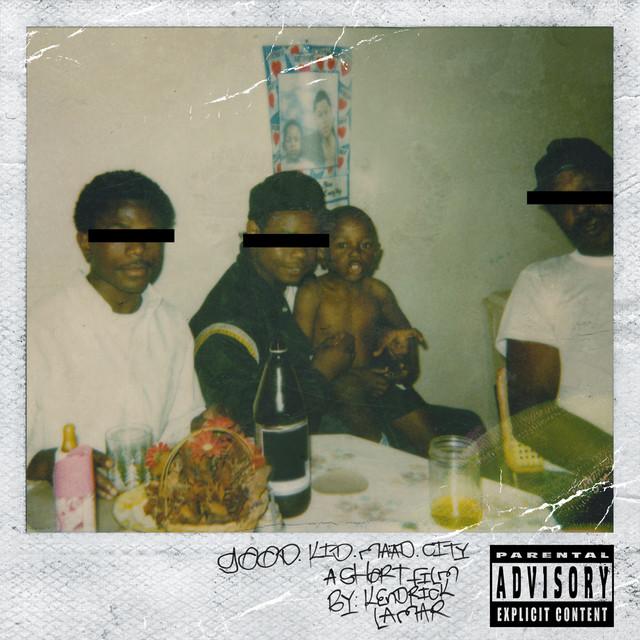
Album Summary
Good Kid, M.A.A.D City (stylized as good kid, m.A.A.d city) is the second studio album by American rapper Kendrick Lamar. It was released on October 22, 2012, through Top Dawg Entertainment, Aftermath Entertainment and Interscope Records. The album features guest appearances from Drake, Dr. Dre, Jay-Z, Jay Rock, Anna Wise, and MC Eiht. It is Lamar's major label debut, after his independently released first album Section.80 in 2011 and his signing to Aftermath and Interscope the following year. Good Kid, M.A.A.D City was recorded mostly at several studios in California, with producers such as Dr. Dre, Just Blaze, Pharrell Williams, Hit-Boy, Scoop DeVille, Jack Splash, and T-Minus, among others, contributing to the album. Billed as a "short film by Kendrick Lamar" on the album cover, the concept album follows the story of Lamar's teenage experiences in the drug-infested streets and gang lifestyle of his native Compton. The album earned Lamar four Grammy Award nominations at the 2014 Grammy Awards, including Album of the Year. The album was supported by five singles – "The Recipe", "Swimming Pools (Drank)", "Backseat Freestyle", "Poetic Justice", and "Bitch, Don't Kill My Vibe". All five singles achieved chart success of varying degrees. Lamar also went on a world tour between May and August 2013, featuring the other members of the hip hop collective, Black Hippy. Good Kid, M.A.A.D City received widespread acclaim from critics, who praised its thematic scope and Lamar's lyrics. The album debuted at number two on the US Billboard 200, selling 242,000 copies in its first week – earning the highest first-week hip hop album sales of 2012 from a male artist. It became Lamar's first album to enter the UK Albums Chart, peaking at number 16, and entering the UK R&B Albums Chart at number two. The album was also named to many end-of-the-year lists, often topping them. It was later certified triple platinum by the Recording Industry Association of America (RIAA). In 2020, the album was ranked 115th on Rolling Stone's updated list of the 500 Greatest Albums of All Time.
 Read more on Wikipedia
Keywords from Reviews
Rating Over Time
Reviews
This one's taken a while to gather my thoughts on and a lot of reading through lyrics, commentary and Wikipedia… it's always a good sign to feel so invested in an album, but the result is usually a pseudo-thesis of a review that, let's face it, nobody has the time to read. Anyway, here goes! Before his instant classic "To Pimp A Butterfly", Kendrick Lamar made "good kid, m.A.A.d city": a tighter, leaner piece which begins by looking inward and gradually shifts focus to create a vivid, intense picture of inner-city living in the hood. Broader than Kendrick's own coming-of-age story, it becomes a social commentary on hip-hop, the culture surrounding it, and the pre-conceptions surrounding that. Lamar explores the origins of gang hostility and violence, covering peer pressure, fear, vulnerability and a vacuum left by the absence of state support or role models. Without a doubt, it's the most immersive hip-hop album I've heard and it's all down to Lamar's excellent storytelling. Using a thoughtfully sequenced non-linear narrative, dynamic and expressive vocal performance, and snippets of conversation with his homies and his parents, Lamar weaves a complex narrative together which has transferred to some school syllabuses alongside James Joyce. Thematically, there's real weight thrown into every song and every line. "The Art of Peer Pressure" explores how gang culture escalated Lamar's teenage life towards crime, drugs and violence. "Money Trees" covers the necessity of material pursuits for survival and the cost it might have on morality. Things reach an apex on the epic "Sing About Me/Dying of Thirst", two tracks drawn together into one twelve minute piece which Lamar uses to remember those he knows who have died. The urgency and despair mingling in "Dying of Thirst" is so potent, and Kendrick's mastery of narrative really comes into its own by personifying his deceased friends. Musically, "good kid, m.A.A.d city" isn't as sprawling and diverse as what I've heard of Lamar's later work. It's also, by nature, mellow and insular, with little to jump out as dance music or hit material. The most played tracks - including "Bitch Don't Kill My Vibe" and "Swimming Pools (Drank)"- are as close as it gets, and they're either a thoughtful musing on the state of the music industry or an ironic take on clubbing and partying. Even in these tracks, the music is consistently cerebral, insular. The beats are mostly low-key, muted, often trap-influenced. Samples include, of all people, Beach House lending an ethereal quality to "Money Trees" and Janet Jackson looped into infinity on the sultry slow-jam "Poetic Justice." Some tracks are refreshingly upbeat to signal a new voice or time within the narrative: for example, "Backseat Freestyle" turns classic braggadocio into a flashback, a young K-Dot using his words as a naïve dream and a survival strategy. "m.A.A.d city" and "Compton" bring the classic 90's hip-hop sounds with hard, bombastic beats, pitch-warped synth leads and a feature from Dre himself. They're tributes to Lamar's musical heritage, which tie in with the narrative as a complicated mixture of pride and fear towards his hometown. I could try to go on and on, but really the key to "good kid, m.A.Ad city" is to listen. Although it's far from my usual style of music, one of its key strengths is that none of it is as straightforward as it appears. By packing each track so full of dual-meanings, twists and turns in the storyline and more allusions than you can shake a stick at, Lamar invites listeners to unpack the non-linear story, peel away the layers, discover new ways of hearing each track and piece together the good kid in the mad city. It's not yet at "classic" status for me, but I can see it being a long time before I get bored of this one.
Kendrick Lamar - changing the game since 2011, changing the use of capital letters and punctuation since 2012.
I received whiplash reading the other reviews for this. While most to maybe half of the high rated reviews for this notice it's brilliance, I was shocked by the amount of reviews that are totally derisive. I do not listen to rap or hip-hop too much (one of my goals with this project is to expand those horizons), and from track 1, I was pretty hooked on the thematic complexity. Lamar is clearly working through a lot of ideas with this album (and if his cultural clout proceeds him, he hasn't stopped working through ideas). The interweaving and complexity of themes of religious morality and guilt, with responsibility towards family and friends, and trying to remain true to your home that you love while knowing you may need to escape. God... it just captures something so beautifully. Which is where the whiplash at seeing negative reviews minimize the expansiveness of this album into "disgusting", "trash", or "boring" totally caught me off-guard. Anyway, I don't know a lot about rap or the history of the genre, but this album was great. I almost broke into tears at the end of "Real". Such a cogent album. Great storytelling and thematics. One of my favs that I've listened to in this project so far. I expect there is some bias in the negative reviews, but I'll try to have a better outlook on humanity.
Musically dull, lyrically offensive.
My favorite pure rap album of all time; the quintessential coming of age west coast rap album; filled with bangers and thought provoking songs; one of the best storytelling albums of all time
This is better than Hotel California for sure.
Objectifies women and gets his rocks off fantasizing about violence against women. Pathetic and sick.
People talk about this guy like he's the second coming but all I just heard was an hour and 20min of hipster dog shit. 2/5.
Offensive, disgusting and stupid. 1 / 5
I gave up before the album had finished. Some of the background melodies were alright but I find the ranting, language and sentiments hard to enjoy. I know that means I’m an old person but it’s not what I call music.
Absolute classic. Possibly my favorite modern rap album (though it's ten years old?!) I think what I love the most is the Outkast production and storytelling vibe.
Bitch, don't kill my vibe. I have actually seen Kendrick Lamar live around the time this came out, but he was upstaged by a Tupac hologram...as we all are sometimes.
I really don't like this sort of drugged out hip-hop sound. Something about it just makes me feel bad, sort of stretched out and depressed. Every single song seems to be about drugs, his penis or comparing women to dogs, but somehow this is considered socially conscious and thoughtful rap. It simply doesn't make a good impression on me, not being receptive to the sound and outside the culture being rhymed about. I hope that the people who enjoy this have used it to work through dark personal issues and become better people. But for me, it is the sort of thing I would turn off if I heard it on the radio.
One of the best narrative albums at point blank range. Sing About Me, I'm Dying of Thirst might be in my top 10 songs.
Not in my edition of the book so! Obviously not essential to listen to before you die! 2012. 1 star. Purile, sexist, misogynistic, obnoxious shite that gets boring reallll fast. Strange that it's OK for black rappers to use the N* word but if anyone else does you're racist. Or that it's OK for them to call women bitches and pussy and hoes (whores), but if anyone else does you're misogynistic. Or that it's OK from them to to boast about how high and doped they get, but if anyone else does then you're just a fucked up junkie. Just saying. "I pray my dick get big as the Eiffel Tower/So I can fuck the world for seventy-two hours". FFS, grow up.
93/100: Few artists reach the level of fame to be publicly acknowledged by on name. Many incredibly well respected artists never reach this level (sometimes arguably for the infortune of being given a generic name). Freddie Mercury is neither referred to as Freddie nor Mercury. Elton John is not Elton. But Tupac is Tupac, Kanye is Kanye, and Kendrick is—well—just Kendrick. This album holds a special place in my heart; therefore, I will be leaving all pretenses of impartiality at the door. This is the album that quite literally opened up the world of music for me. Before listening to this album, music was just something to be listened to—pleasant sounds, ineffable feelings, surface level appreciation. The first time I heard “good kid, m.A.A.d city,” something struck me—an imperceptible intuition that something worth understanding lay beyond the realm in which I’d hitherto been existing. By the Kendrick was boasting about having a dream in “Backseat Freestyle,” I had the rap genius app downloaded on my phone and was following along, line by line. I listened and read along to that album for weeks, maybe even months, listening to nothing else. I saw a respect for language and a mastery of music as a platform for a message nothing short of genius; in fact, orders of magnitude beyond that. Most rappers interject their albums with skits as separate songs. The good artists tie this skits smartly, maybe even humorously, into the story conveyed in their album. The great ones (if pluralizing that word is even legitimate is up for dispute), like Kendrick, weave these skits within songs, backed by musical tracks. In “The Art of Peer Pressure,” interjecting skits not only provide context—in one moment, letting the listener know that Kendrick’s and his friends’ robbery attempt has flopped, in the other, highlighting a police chase—they propel the song through its story. Beyond imaginatively clever uses of skits, Kendrick writes lyrics that reveal an incomparably creative relationship with language. In “Money Trees,” one set of three lines stands out in my mind. In the first line in this set, “dreams of living life like rappers do,” Kendrick focuses in on the topic of rap artists; however, in the third line, “I fucked Sherane then went to tell my bros,” he’s locked in on ideas of sex and women. To find a good line to fit between those two, most rappers would elaborate on what a rapper’s life is like, presumably a good way to tie sex and women into the topic of rap artists—making for a pretty seamless segue. Kendrick does something entirely different and wildly creative. As the second line in this set, connecting rappers to sex, Kendrick decides on “back when condom wrappers wasn't cool.” Upon first glance, this might seem to be a pretty abrupt transition from dreaming of living a rapper’s life of luxury to sex, but when read aloud, “condom wrappers” sounds a whole lot like “Compton rappers,” and Kendrick surely leans into this with his delivery of that line. Thus, Kendrick finds a way to deliver two ideas with one line, with both ideas tying the preceding and subsequent lines together. This is mastery. There are few albums with as much to analyze and interpret as “good kid, m.A.A.d city” (most of those few are also Kendrick albums). The fact that this album opened up that world of analysis and interpretation within music for me elevates it beyond those other Kendrick albums. This is my favorite album of Kendrick’s—it was my first—it will forever remain that way, and I am in no way surprised that this album held up to the same level I remember from my last listen through.
One of the best rap albums of all time. It’s got some bangers that we’re all over the radio and clubs and house parties, but also has a deeper soul. No one mixes the narrative raps with the pop sensibilities quite like Kendrick. It’s an incredible journey that makes you feel like you’re boolin around in Compton with Kendrick. You feel the highs and lows alongside him. Somehow, even with a different background and having grown up in a different environment, you feel connected to his younger life while the songs play. And that broadening of the perspective is what art and music is all about. To all the 1 ratings on this album that are some combination of “I’m old”, “I’m lame” or “I’m subtly racist”, SHUT THE FUCK UP BOOMER
Yeah, in terms of gansta-rap Kendrick is definitely my pick. There's some great artistic choices through the album that subvert the earlier clichés of gansta-rap, like playing the entire voicemail at the end of the first song and not using it as a little throwaway interlude but rather as a storytelling tool. Everything sounds great but there's some needed restraint in production that elevates it all to be more than a "I'm so hard and I party hard album". Some tracks are "take or or leave" it for me, and Money Trees goes a little long for me. Bitch, Don't Kill My Vibe is prob my fav. good kid also sounds great, that instrumentation and bass-line feels like some 70s odd synth/krautrock or some early electronic experimental stuff. Interestingly enough there aren't many songs on here that feel like they can be played in isolation or on some random playlist, the material is definitely best listened in an album format, which is probably the best compliment you could get for this list.
One of the most well-executed concept albums ever. The lyrics are so good, along with the story they tell. Sherane and The Art of Peer Pressure are two of the greatest storytelling rap songs ever written; they're practically short stories. Ben's right, if these reviewers think that this is just an album about drugs and sex and violence, they're simply being ignorant. How can you listen to this and completely look over the message of every single song? The songs about those controversial subjects are looking at them from a perspective of growth, a move away from hedonism and toward looking back on a life and asking why it had to be that way. Great album.
no skips
The hiphop I enjoy most has either great funky sampling and/or jazz or otherwise organic music and the actual MCing has got to be rhythmic. Right away in the first track the rhythmic rapping is thrown right out the window - I know it's a preferential thing but there's no sense of rhythm to this, it's stream-of-consciousness words that I've no doubt I'd never be able to do but it all exists completely independently from the music. As if they're 2 completely unrelated parallel entities that were just placed together almost randomly. Like - could you tell or would it matter if the chorus were the verse or vice versa? And these lyrics are junior-high level immature trash. That reaction was all from one track - yikes. BUT ... track 2 starts out almost completely differently; I like the music and the weird vocals. The lyrics are not interesting to me but there's a noticeable step up in tying the vocals to the music. The "real-life" voices (I hesitate to call them "skits") get distracting and for me lessen the impact of the songs. Have I mentioned these lyrics are weak? They're weak - come on pussy this dick that yeah yeah giggle giggle. OK the album definitely improves as it goes on - full stop - but ehh I had a real hard time getting through this - aside from the eye-rolling lyrics his voice is difficult to digest. As for my rhythmic critiques early, that aspect definitely gets much better on many of the following tracks - I know it's a stylistic choice and I choose to avoid the freestyle/stream type songs/rappers. "Money Trees" - I do like this one. I've heard some of Kendrick's later work which I do recall liking considerably more, but this one is not only not my bag but I would and will avoid this. 3/10 1 star
Can we just rename this genre "Narcissistic Gun, Dick, Pussy Rap"?
I hate gangsta rap. I find the glorification of violence, misogyny and homophobia just appallingly distasteful. On a surface level, the characters and narrative incidents of 'Good Kid Ma.a.d City' are not dissimilar from many 90s East Coast gangsta albums, and yet they couldn't be more different. Kendrick embraces complexity, narrative, emotion, and (dare I say it) humanity. I didn't grow up in Compton, but this is a telling of that story and those characters that I can understand and relate to. This is art. This is that album that achieves the promise of hip hop. I have listened to it through three times today, and I am genuinely moved. I was going to rate this four stars, but the more I listen to it, the better it gets and the more I get out of it. I normally hate skits, but in terms of supporting the narrative, they are almost forgivable here. I think this really is a classic album you need to hear. Five stars.
One of my favorite albums, I put this above to pimp a butterfly personally
I know that Kendrick Lamarr is viewed as some sort of god, but I cannot for the life of me work out why. "Bitch, don't kill my vibe" makes me want to question why he's putting that voice on. The flow vacillates wildly between "hey this is pretty decent" and "ohmygod, what is this amateurish tosh?" The whole album seems to delight in wobbly bass, which doesn't half get tiring after a while. TBH, not sure I'm going to sit through the rest of this.
I really dislike music like this: lyrically uninteresting, unamusing braggadocio, misogyny and unconstructive violence; musically lightweight, dull and meandering pointlessly. Sadly, 0 stars isn't possible.
While I’m still a hardline tpab fan, holy shit this album still holds up. All of the singles are still great and everything about it is great
But where is the ninja turtles?
Boring album. Some decent bass lines. Lyrics are meh and even annoying at times. Nothing great to say about this one.
Has a mixtape vibe. but for Christ's sake change your tone occasionally. It's all autotune and plodding vocals it's actually painfully boring to listen to.
This is honestly flawless and is not even his best record. He is the GOAT. The reviews here are deeply depressing - why would you try to do this kind of challenge if you’re so closed minded?
Scathing comments here but I'll provide a medium take. Since GFunk and Gangster Rap has rap ever been clean? I don't think the medium has been used for jovial clean rap unless in small subgenres like De La Soul, and Tribe. Even outkast is "dirty". Without fellating my man Kendrick too much. This was his Joe DiMaggio/Mickey Mantle era. The one we will always reference as the young blood blossoming into a full blown rapping poet and beacon of hope in the community. Kendrick did reinforce terrible standards in the genre but ultimately crafted tense scenes of southern california, and the trials and tribulations that black americans lives through some 30 years after NWA. Things didn't change positively, nor did the music. This is akin to the woke verses of street poets like Warren G and Tupac. GKMC was always my favorite in kendrick's run. He has a knack of story telling with crazy clever wordplay and brilliant verses. He has an ability to create tense scenes that inject you right into the crimes and storylines that took place from his childhood. With just enough post conciousness to reflect on it, and show a sense of growth. Growth that wind be extrapolated in 2015 with TPAB.
Had not heard this before, and found it to be quite a bit more enjoyable than "..Butterfly". Really immersive, with interesting effects such as the voicemails which make the whole thing "cinematic" as intended. A wild success
This was really good. I'm gonna need to listen to it through a few more times to take it all in. Great storytelling.
I've been told so many times to listen to Kendrick Lamar, but rap / hip hop generally speaking wasn't my thing. Or, at least, I thought it wasn't my thing - until I started making my way through the 1,001 album list - and now I'm learning that I was wrong. Certainly not fine poetry, but my takeaway from this album is Kendrick has a unique way with words and metric, and he lays it on top of a smooth beat and some well crafted melody. I'm not surprised this album is polarizing - but even as a non-rap fan, I really do think it's extremely unique and interesting. I can't help but give it five stars.
bitch dont kill my vibe
This is really good you bish
I really enjoyed this album. Great lyrical moments and really interesting melodies and riffs (especially for a rap album). I felt like I got a really great glimpse and understanding into Lamar's life and the challenges of growing up in an area where gang activity is so prevalent and complex to avoid. I think I'll listen to this one again multiple times and continue to discover new moments and lyrics every time.
I start to disengage from rap music when I hear words like bitch, ho, dick, pussy, motherfucker, and the n-word. Sorry. The beats are great, I like his rap style, and I can appreciate the social commentary/theme of the album but as a middle-aged white guy it is heard to give this repeated listens. It's not for me and not intended for me.
Meh. Production is good but I'm just way to white for this shit. Never gonna listen to this again.
Listened to the whole thing and now I can honestly say, this album is complete ass and Kendrick Lamar deserves zero praise for this lazy edgelord garbage.
bitch killed my vibe with this garbage
Damn.
Rating: 10/10 A classic, one of the greatest hip-hop albums of all time. Not only is this one of best produced rap albums of all time, it is also one of the best lyrically as well. The album feels like a movie, Kendrick takes the listener on a journey through his childhood and the crime-filled streets of Compton. The lyrics paint a vivd picture of the street life of Compton and Kendrick does this with varied deliveries, clever wordplay, and thought-provoking lyrics. I have listened to this album many times and am still discovering new meanings lyrically. A truly timeless album. Favorite songs: pretty much all of them. Least favorite song: Real.
One of the best concept albums ever and Kendrick’s best imo. The Art of Peer Pressure is one of the most vividly depicted stories in song form I’ve ever heard. Sing About Me I’m Dying of Thirst encapsulates so many different themes, it’s a masterpiece of a song. One of the best albums of all time
I don't listen to a ton of rap, especially not full albums, but this is one that I actually listened to quite a bit back in the day. This came out my senior year of high school and was pretty huge for a few years after that. I think I like this a lot because the sound is pretty understated through most of it. There's not a ton of gimmicks or anything, it's just really strong lyrics and good beats across the board. Lyrically, you really get a snapshot into Kendrick's life growing up, and the snippets of people talking between songs are both funny and pull together the album nicely. I don't have a ton to say about this, but it's about as strong of a rap album as I've come across. It does get a bit weaker at the end (it's drags on just a little bit), but it's good enough otherwise that it's not a real issue. Kendrick is obviously super talented, and it was nice to revisit this one. This is 12 years old now (which is hard to believe), but it doesn't really sound dated at all to me. Favorite song: Money Trees Other: Bitch Don't Kill My Vibe, Backseat Freestyle, The Art of Peer Pressure, Poetic Justice, good kid, m.A.A.d. city, Swimming Pools (Drank), 4/1/24
about the only modern hip hop artist I can stand. some great songs on here. can be kind of long at some points but it flows well
Wow. Unexpected but brilliant
Not bad. I'm not a big hip hop/rap fan but i did enjoy this album. Will check more from him
Nope.
I had never knowingly listened to Kendrick Lamar before today. And after listening to this I hope I never do again.he is according to spotify known for his top tier lyricism and sharpn conceptual vision. The latter I get , and this does have a framework and comes freighted with a concept. Lyrically to.my mind he falls well short of the rap I have listened to over the last 35 years, and I just don't see from this why he's held in such regard. Seems meek and formulaic lyrically and what little musicality there is is bland and minimal to the.point ifnveing washed out. Sounds very much like the background music to GTA or similar and perhaps you know that's all it is
c.r.A.A.p city
Auto tuned junk. No idea what the big deal about this is. Not even bordering on interesting.
This album sucks lmao
my review of Illmatic touched on how, when I was first getting into hip hop as a sheltered, suburban white young'in, that was one of, if not the album which was most frequently cited as a "potential entry point for newcomers into the trappings of the style as a whole" in online music discussions, where I was getting most of my information about music at the time. what I didn't mention in that review was the fact that, in the same year I was first dipping my toes into the rap music pool, a young upstart from Compton, California (one of the most important cities in hip hop, as I would come to discover) would release his major-label debut album. that record, good kid, m.A.A.d city, became an Illmatic of sorts for millions of listeners of a new generation, myself included; and the rapper behind it, Kendrick Lamar, had all the makings of a superstar. as it would turn out, he might be the last of the superstar rappers. even as a novice to the art of Rhythm and Poetry, Lamar's handle of the craft was obvious to me. more than any hip hop album I had listened to beforehand, good kid is a showcase of rapping as a form of storytelling. it's a concept album, a format I was fairly familiar with given all the Pink Floyd records I gobbled up in middle school, which certainly helped. however, in rock music, concept albums tend not to have terribly straightforward narratives, even at the best of times. by contrast, every song here tells its own story with such clarity you can't help but pick up on the greater tale being told. plenty of people have gone and dissected Lamar's use of all manner of rhyme schemes across these songs; and that's all impressive, obviously, but what really pulled me into this album was his skill as a narrator. on good kid, m.A.A.d city, he mines an adolescence full of adversity for a stunningly honest (albeit somewhat fictionalized) portrayal of what actually led him—an urban Black kid who grew up in Section 8 housing living off government cheese—to turn, however briefly, to a life of crime and antisocial behavior. "Sherane a.k.a Master Splinter's Daughter" tells the story of a budding young romance, but it also reveals a lot about the quasi-autobiographical narrator Lamar portrays and the environment that surrounds him. the real-life Lamar is the son of a gangster, and grew up in an environment—a m.A.A.d city, if you will—colored by gang activity into which his good kid character frequently gets swept up, whether he wants to or not. his exploits with Sherane are a recurring theme; their relationship results in him getting tangled up in even more dangerous situations, and his friends tease him for having sex on the brain so often. of course, there are bright spots; "Backseat Freestyle" is just a good-ass time with Lamar flexing about nothing in particular, just to show off to his fellow guys in the back of their car; but it's immediately followed by "The Art of Peer Pressure", where we find out they're en route to stage a robbery which eventually goes sideways, with the group just barely evading capture by the police. the good kid's mother acts as a recurring moral compass attempting to steer him away from the negative influences taking over his life; we hear her (and his Domino's-craving father) through voicemails throughout these tracks. unfortunately, he doesn't fully see reason until his exploits wind up resulting in a rival gang killing one of his friends, resulting in the deeply moving two-parter "Sing About Me, I'm Dying of Thirst". after contemplating a violent retaliation, he instead turns his focus to family, friends and God. the whole album is a cinematic, stirring tribute to Lamar's early life in Compton, a city which has become known in hip hop for its perseverance in the face of adversity. it's no coincidence Compton's own Dr. Dre jointly released this on his Aftermath label, along with being featured as executive producer and delivering a verse on the closer, also named for the city he and Lamar call their hometown. I wonder if the people who reflexively rated this 1/5 because they heard a Black man talking about your typical gang-banging subject matter with no other context were able to pick up on any of this, or if they even *wanted* to pick up on it to begin with. I thought the point of exploring this 1001 Albums thing was to expand your musical horizons and understanding, not to balk at anything unfamiliar the moment you don't immediately get it. more than any other album I can think of, good kid, m.A.A.d city adapts the aesthetic front of a typical "gangsta rap" record and flips it on its head to deliver a powerful message *against* crime, drugs, objectification of women, etc. I really don't know how it's possible to miss that! you're reading along with the lyrics for all these albums, too, right? to list all the producers and guests who contributed to each song here would take too much time; suffice it to say, the production is wonderfully varied, covering a range of moods from smoky introspection ("Sherane", "The Art of Peer Pressure", "Real") to pop catchiness ("Bitch, Don't Kill My Vibe", "Money Trees", "Poetic Justice") to classic hardcore hip hop aggression ("m.A.A.d city", "Backseat Freestyle"). the guest vocalists all slot in nicely, even Drake, whose appearance on "Poetic Justice" gets even stranger with time. (unfortunately, it's a great match for the type of artist he was in 2012.) my favorite comes from fellow Compton native MC Eiht, who lights up the second half of "m.A.A.d city" and creates one of the album's most blood-curdling moments. forget Illmatic, I say. well, don't forget it. but, if you're looking for a way into hip hop, this album's the whole package. strong 9/10.
It’s beautiful, I love this album so far. It’s a musically well balanced album, the bars are crazy, the story is great too. Five stars easy, I get why he’s so big.
one of the most important albums of the decade for certain, and one that stands as seminal in and out of the context of Kendrick's discography. even on his sophomore album he was quickly establishing himself as someone to keep an eye on, and for good reason. so many great songs, the crown jewel being Sing About Me, I'm Dying of Thirst. really incredible lyrical depth and prowess on top of incredible rapping as well. deserves to be one of the 1001? are you on crack? obviously!
This album is transcendental. Not only for its transformative nature defining the years that Kendrick Lamar would have to come, but just as a good album that tells an extremely cohesive story. I hadn’t listened to this in full, I fee like I didn’t really get into Kendrick until the DAMN. era. But this is such a good tracklist. The sequence of Money Trees through m.A.A.d city is absolutely golden. One small note: I tend to read the reviews as I take in these albums and see what other people are thinking, and the reviews on this are oddly polarized in a way that doesn’t seem particularly critical of the artist. I don’t think your 16th Led Zepplin 5/5 is going to change anything in the grand scheme of things, maybe consider toning down the racism and taking an album in that’s slightly outside of your wheelhouse. Really show’s that things haven’t changed as much as we thought. Do better.
I love his parents so much. Dominooos!
Hip-hop! I like the beats but not crazy about the lyrics (except good kid, madd city and sing about me i’m dying of thirst) and felt the themes were cheapened by the usual flexing and misogyny you see in lots of music. It did feel very cohesive and I liked the sound overall but lyrically not for me and wouldn't to the whole album listen again. 7/10
I’m glad this site is anonymous because I like this record better than To Pimp A Butterfly.
Last weekend, when we listened to Bringing It All Back Home, I thought about, but didn't write about, how the American monologue Bob Dylan's 115th Dream was an absurd play on Martin Luther King's I Have A Dream speech. If people thought Dylan was a generational voice, he would redirect them to a truly significant voice instead. It was stupid for people to give so much attention to a song and dance man like him. Kendrick Lamar pulls the same move more explicitly on Backseat Freestyle: "Martin had a dream, Kendrick have a dream." That dream, for the sixteen year old Lamar, is to have a dick the size of the Eiffel Tower. A reminder again not to take too seriously anything said by musician-poets. Like the worst excesses (can half-arsedness be excess?) of the Nobel-winning Dylan, the Pulitzer-winning Lamar can expurgate a torrent of consciousness over programmatic beats - no musical narrative, occasional lyrical narrative. Given his beats by others, he may as well be directing the session men to vamp a I-IV-V progression. It all gets a bit repetitive after a while. And doesn't feel much connected to the lyrical content at all. Because, of course, it's not about that, it's about the words. And, luckily, thanks to Genius.com, I can read the words that I couldn't make out. And I could read the fan annotations as well, in case I missed any deeper meaning. Or forced interpretation. Which, invariably, I did. There is no denying the density of Lamar's work here. And the character work can be easy to miss. I could have easily thought an adult man was wishing for an Eiffel-sized dick, were it not for the helpful Genius guidance that this was in the persona of his younger self. Where Dylan had the voice of a generation title thrust upon him, Lamar makes it clear that he sought it from youth. Perhaps not that title, specifically, but it is clear that, within Compton, becoming a voice is the only way out (apart from high school sports). However, as we've seen many times before, those voices that come straight out of Compton, as regularly become pantomimes or minstrel shows of their culture - playing up the thuglife for sales (perhaps witnessing Kneecap's buffoonish misrepresentation of West Belfast makes me feel this more keenly now). Where Dylan dealt with the challenge of idiots hanging on his every freestyled word by spewing gnomic nonsense at them, Lamar, again, does it implicitly, simultaneously enamoured and suspicious of rap success, recognising the hyperbole of hip-hop's violent narratives and accurately representing the grimness of 21st century working class life. The two closely resemble each other, but there is a difference. Fair play to him for navigating this all with thought and artistry. I imagine that, if I gave it more time, I would get more from it. However, when all is said and done, Good Kid m.a.a.D City is a coming of age story and all coming of age stories are boring; the very name gives away the ending: you come of age. You grow up. You mature. You realise that wishing for a dick the size of the Eiffel tower is not only absurd, but sad. It's never really funny. But the coming of age story allows you - or it allowed Lamar here - to indulge the hyperbole of youth. It is a way of performing the pantomime of gangsta rap bravado, but allowing yourself the plausible deniability of not really being 'him' anymore. "I wouldn't rap like that as an adult," you rap as an adult. But, like Dylan, even if he doesn't want to be a voice of a generation, Lamar wants to be a voice. He wants to be something. He articulates the inevitability of his becoming a rapper, while decrying the position and fate of rappers. Listen to him, but don't listen to him too closely. 2.5 Our first album from Kendrick Lamar, and about our ninth or tenth from The Greatest Rapper of All Time. This GROAT though, as we ought to know from reading the Wikipedia page, is different. Even from those other groats that have a social conscience. Among the plaudits for Kendrick Lamar - Grammys by the dozen, the Pulitzer Prize, Barack Obama’s favourite track of 2015 - my eye found two particularly daft ones irresistible. One was Rolling Stone declaring ‘Good Kid…’ the Greatest Concept Album of All Time. This is transparently daft for two reasons. First; this ‘concept album’ isn’t 100% sure how or where it ends - from day 1 Good Kid.. was issued in ‘Deluxe Edition’ with extra tracks. Indeed the vinyl record can’t seem to be had without them, and who cares more about concept albums than middle-aged men with hifis? Second - the runner-up GOAT concept album was Green Day’s American Idiot. Alas, we’ll get to that one in detail at some point in this project. The other plaudit that gave me a chuckle was that some American academic has put Good Kid… on the reading list for a college course on the Bildungsroman. Explaining himself this, let’s safely predict white middle-aged professor declared Kendrick Lamar ‘the James Joyce of Hip-Hop’. I had planned to do a long bit here on why KL and James Joyce are not necessarily paisan and expended a good deal of thought on the comparison. Truthfully the only insight worth sharing was when I reflected that KL’s new status might mean that The Notorious B.I.G was the Victorian Novel. I was very pleased with this so I am putting it in. Now none of that or such other nonsense is Kendrick Lamar’s fault and I did, I promise, listen to Good Kid, M.A.A.D City as well. Twice, and the second time in a really good mood, because I had just finished deadheading the hydrangea plant out our back and I felt like Alan fucking Titchmarsh. The album is certainly not bad. Lamar has plenty to say, without resorting to the default gestures of his genre, and there is an unmistakeable relish for language as he goes. For me it still bumps up against the same ceiling that all hip-hop does; the poverty of the music. Rapping is music of course - perhaps here, in the Damascene glare of hip-hop’s Virginia Woolf, is the appropriate place to confess that I have probably neglected to actually acknowledge as much in evaluating previous rap albums. If you speak rhythmically - ok that’s music - and if it happens to have some drama to it, so much the better, but there is never in my experience of hip-hop any true integration with the track behind it - notwithstanding those moments where the rapper sings a bit. I don’t mean the neglect of constantly troubling over a note to go with (or not go with) a chord - I mean some musical connection beyond the superficially rhythmic connection. Why this particular gloomy mid-tempo 4 bar phrase on repeat and not another? There are a bunch of such loops here and nothing is demanded of them except that they hold us in stasis, gloomy stasis, while Kendrick articulates his woes. There are all sorts of ‘characters’ on this album but the music isn’t one of them. It’s just part of the staging - a cheap wooden set that we’re supposed to ignore after the actor comes on stage. Well I can’t, myself, be the actor never so brilliant. 2/5
discovered kendrick through damn, loved him through good kid mad city. love this album.
Not what I was expecting as a first album but definitely not disappointed at all. Timeless classic, nothing much more to say
My favorite Kendrick album, and I could make an argument for his best. A masterful blend of storytelling and worldbuilding with support from an all-star feature lineup. A wonderful variety of beats with juuuust the beginning of his to-come experimental vocal delivery. Listened to: at the Edison. Favorite tracks: Backseat Freestyle, The Art of Peer Pressure, Money Trees, m.A.A.d city, Swimming Pools, Sing About Me I'm Dying of Thirst
Pure storytelling, emotion, and love despite everything for his city and community. He's an artist through and through.
One of the greatest albums of all time. Kendrick’s best. Elite storytelling
If Kendrick had retired after Good Kid Mad City he'd probably still be considered a legend, it's not as good as To Pimp A Butterfly but it's still great. It's quite an interesting case for a rap record as the production is fairly low-key, not that notable but gives the spotlight to his words. The lyrics paint a picture of his life in Compton, veering into gang territory at times but never in a way that's over the top. He is quite introspective at times and it's interesting that where there is bravado, such as Backseat Freestyle or Swimming Pools, it's almost at an absurd level such are these the thoughts of a young man struggling to find his place amid the adult world of sex and alcohol. I also find his rapping style quite laid back on this, but the album is still crammed with great hooks. Easy 5*
I'm not a fan of Kendrick Lamar. I have heard a lot of his music before this, but not many from this album. Well, now that I've heard it in full, it's amazing. I don't necessarily relate, but it's hard not to feel emotional when listening to this album. It's more than an album. It's Kendrick's story. It feels like a movie. It gives me much more respect for Kendrick Lamar
A cinematic masterpiece. Kendrick brings West Coast hip hop and G Funk fully into the new millennium on this one. From a lyrical standpoint this one kinda reminds me of the film boogie nights. The first half kind of glamorizes the subject matter, like a lot of classic hip hop does, and then theres suddenly a vibe switch with Good Kid, and it really highlights the grim reality and pressures for a lot of people growing up in Compton. With this one he emerged as one of the best to ever do it. Where my fuckin Dominoes at
That was excellent, very immersive. Gave me a few laughs early on (like the Eiffel Tower line) and some misty moments as the story progressed regarding topics like peer pressure and addiction escapism
A personal favourite of mine, and perhaps my favourite Kendrick album. TPAB is an obvious masterpiece, but is such a dense piece of work that I don't find myself reaching for it often. GKMC on the other hand, with its narrower scope and more traditional beats, is one I have played many times and am now very familiar with. The production is so nice, there are so many now iconic beats on this and the genres hop around like you're in the car arguing over what radio channel to listen to as you cruise. The interludes riff on the classic trope of using voicemails as intros/outros, but in the concept album context provide essential narrative beats. The story being told keeps you locked in to every word he says, and the track ordering is fantastic to keep suspense. To me this is Kendrick's first incredible album, and it was clear from this point he is one of the greatest wordsmiths ever to do it, a reputation that has only grown since.
It's a 5, very easy, no doubt. Dre popping up awkwardly as is tradition is fine. ...except poetic justice kinda sucks, and I blame Drake for that
Love the storytelling and depth of his lyrics and the music production is fantastic as well. 10/5 ⭐️s
I am not much of a lyrical man but this album gives the feeling of the struggle of inner city cycles via alternatives to lyrics such as gun shots ending songs soon. I will have to give damn another listen it it won the pullitzer over this album.
Fast hätte ich zum ersten Mal super bowl geschaut, nur für Kendrick. Ein ticket dafür kostet übrigens 8000 Dollar. Das Album ist ein absoluter banger, bin grosser Fan des drake haters, der für seinen disstrack auch noch offizielle Auszeichnungen bekommt.
Kendrick never misses
Certified hood classic. One of my favourite albums. Less than To Pimp a Butterfly, but before that, I was obsessed with this album. I love the concept of a kid (a good kid) growing up in Compton (maad city) and being pressured into gang activity but then finding God after one of his friends gets shot from a rival gang. I think the story telling throughout the album is incredible and it paints a vivid picture to the listener. Some of my favourites is The Art of Peer Pressure and Sing About Me, I'm Dying of Thirst. To me, this is one of, if not the best concept album I've heard. What I love about Kendrick is his ability to be able to pull an entire album together and be able to not just produce "party singles" like most hip-hop artists.
FUCK yes. Incredible album, will forever be one of my favorites. I'm not sure how hot of a take this is, but I think this is his best album over To Pimp a Butterfly. This is one of a few albums from my lifetime that I remember where everybody pretty much immediately accepted the artist as a great one. The album felt both of the era and out of the 90s simultaneously, which is probably the best way to describe Kendrick anyway. Also, Jay Rock's verse on Money Trees is my favorite hip hop verse of all time. Favorite track: Money Trees
Masterpiece, one of the best hip hop albums of the last 2010s.
Easy 5 stars and Kendrick’s second best album behind TPAB imo. To this day I still do not understand how tf Macklemore won the rap album Grammy over this
A hood classic
I knew coming in that I would give this one a 5 unless something shifted my opinion of it, and honestly, if I could give this shit a 6 or higher, I would. TPaB is still the masterpiece, the gold standard, the highest of high bars for me in terms of Kendrick’s albums, but I don’t think I’ve ever properly appreciated the narrative arc of this album until this listen; doing this whole 1,001 albums experience has made me feel more attentive to music than I have in a long time, and this album has, by far, had the biggest boost for me because of that. There is seriously not a missed beat or lyric or breath on almost every track here – the only one I’m still iffy on is Real, but I just don’t think that song will ever click with my sensibilities. I’ve also never really paid attention to the bonus tracks that are on the deluxe version, but Now or Never just feels like it should be the album closer, to just end the album on an incredibly bright note. I don’t wanna gush too much about this album, but it really is a piece of art, and it’s incredibly deserving of a 5.
As a hip hop fan there’s certain albums over the past 40 years or so that can be considered as benchmarks or ‘instant classics’ if you will and even if you’re not a fan of rap it’s hard to argue Kendrick Lamar’s discography is not familiar with this. I’m already incredibly familiar with this album but a re listen didn’t go a miss as there’s always something about revisiting this body of work that makes me smile as it really is everything that makes hip hop brilliant which is what I’ll break down in these thoughts. The record opens up with ‘Sherane a.k.a Master Splinter’s Daughter’ where Kendrick opens up the album by introducing a reoccurring person in this timeline of tracks, a love interest (Sherane), who Kendrick is on his way to meet. It opens up with a bible verse that we come to visit later on, he details the moments up to meeting her and also tells the listener how he met her and what his intentions are, he specifically left the house because he wanted to hook up with her, he took his mothers car and went to go see her until he reaches her house and there’s 2 guys in hoodies which transitions into the phone call from his momma asking where he is with her car, this voicemail dialogue continues throughout the album as Kendrick’s mother shows her concerns for the type of activities he gets caught up in. The beat has this slightly laid backed but eerie tone to it with some sort of short electronic style beats and a mix of piano and guitar in the background, this track sets up the story for the rest of the album. The following track ‘Bitch, Don’t Kill My Vibe’ is a slight detour from the story as it’s a bit of a time jump to present day Kendrick as the rapper explains on how much things have changed around him since starting to reach fame. It’s also a social commentary about the current state on rap music as, and I quote, ‘Die in a pitiful vain, tell me a watch and a chain is more believable’ is a node to rappers that just want to get rich fast and focus on the materialistic gains rather than focus on something more substantial. This track brings back some of the guitar from the 1st track but a bit more up beat with some vocals from Anna Wise that make the hook evermore infections “Bitch, don’t kill my vibe”. The 3rd track ‘Backseat Freestyle’ is pretty self explanatory, it’s Kendrick rapping off the top of his head from the perspective of a 16 year old version of him who is striving to achieve everything someone young in Compton would want. The track is one of a few hard hitters on the track list as it is submerged in this bass and ringing bells which makes you want to bump to it in a car. ‘The Art of Peer Pressure’ has a stronger return to the storyline that was introduced in track 1. The first minute or so is a nice drum fill with some static that gives a vague idea of the tracks direction in a more melodic rap style with some smooth background vocals, the line ‘But I’m with the homies right now’ is paraphrased and repeated throughout as Kendrick tries to explain that he’s not usually like all of his friends but when he’s with them he doesn’t want to ruin the buzz of them altogether so he partakes in getting faded and pulling up on other people. The rest of the track brings the best down and follows the story of a usual day that Kendrick has chilling with his friends but this is followed by a house robbery on a house they’ve been scoping out for 2 months which they misjudged when they find someone inside who presumably calls the cops on them, showing their youth by this mistake, and the track closes off with their journey speeding away from the house and a short dialogue when they’ve escaped which reveals this is before Kendrick plans to meet up with Sherane. ‘Money Trees’ is another social commentary about the life of growing up in Compton, an impoverished area, where young men like Kendrick and his friends strive to reach what’s seemingly out of reach for them due to where they live, this could be money, power, respect etc. The chorus is another comment on activities within Compton and how people who grow up there choose what type of lifestyle they’ll live, ‘But the one in front of the gun lives forever’ tells how the person who falls victim to a shooting is the one remembered despite how respected the shooter may be. The title ‘Money Trees’ is very fitting as it is a metaphor, “being shaded under a money tree” shows how if you have reach the point of comfortable wealth in Compton it takes a lot of weight of your shoulders, you can relax in a sense, but also the term Money Trees refers to the age old saying ‘money doesn’t grow on trees’, Kendrick releases this is a hard goal for someone from an impoverished community and thus that goal is not only incredibly challenging but evermore desirable. This is also seen in the chorus by the line, “A dollar might just make that lane switch”, people wold turn their back on you for money and that’s how rough it gets. The track is lead by some smooth humming background vocals and bells with appearances from Anna Wise on the chorus and a top tier verse from Jay Rock on the back end. In the middle of the album we have ‘Poetic Justice’ which is an addition to the opening track about Sherane as it’s a smooth track about Kendrick’s love at the time with a very appropriate Drake feature who really suits this topic of rap. The track is lead by a gorgeous Janet Jackson sample that gives the whole song a sort of sensual feeling to it which definitely shows Kendrick’s feelings for Sherane. The outro to the track links directly back to the first track as the 2 hooded figures start to interrogate Kendrick as they seem to not want him messing around with Sherane, they can tell that he’s not from around there and so Kendrick tries to keep his head down to avoid confrontation but it doesn’t work. The 2nd half of the album is kicked off with ‘good kid’ where Kendrick displays his innocence of being a good kid whilst growing up around a certain type of culture where he couldn’t escape gang activity, drugs, police racially profiling etc. It highlights that no matter the type of person you may be in Compton you can’t escape these things as shown in the previous track where Kendrick is confronted by the 2 figures he doesn’t know. The track is beautifully filled with background vocals and a guitar riff patterned with a nice chorus from Pharrell Williams, one of the more underrated tracks. The following partner track ‘m.A.A.d city’ is the album heavy hitter and is split in 2 parts, the first part is an aggressive, almost harsh sounding, instrumental filled with these eerie, what I believe to be, strings or possibly a keyboard paired with Kendrick’s ruthless rapping a fast paced delivery almost out of frustration about some of the things he’s witnessed as growing up in Compton. The best switch gives room to some hard hitting drums whilst Kendrick continues with stories about getting a job and planning to rob it, this part also gives room the the feature MC Eiht who gives a powerful verse on the back end which is followed up by a distorted Kendrick almost giving light to what he’s actually like as a person, he’s saying yes he is the good kid but he’s also done some things you wouldn’t expect from him. ‘Swimming Pools (Drank)’ is all about the pressures of drinking, on the surface if you casually listen to the song you may think it’s a drinking anthem of sorts but it’s actually the complete opposite. This song relates to ‘The Art of Peer Pressure’ as it details people drowning their sorrows in alcohol, almost swimming in it, if you will, due to the large amount consumed. It also shines light on that there is no such thing as casual drinking, from Kendrick’s perspective anyways, you don’t want to be that baby that’s sipping your drink when you’re with everyone else. The track ends with some more dialogue where we find out Kendrick was set up by Sherane and got beat down by the 2 hooded figures, Kendrick’s friends come to pick him up and shoot the 2 guys that beat up Kendrick but also losing their friend Dave in the process, this is a turning point for Kendrick as he realises his actions have consequences. The following 12 minute masterpiece ‘Sing About Me, I’m Dying Of Thirst’ is split into multiple parts. The first is a continuation of the end of Swimming Pools as we hear Kendrick rap from Dave’s brother’s perspective who appreciates that Kendrick was there to hold Dave as he bled out, he doesn’t blame Kendrick for what happened he now just has his eyes fixed on getting revenge against the shooters. The 2nd part is from the perspective of Keisha’s sister, Keisha in question Kendrick wrote about on his mixtape Section. 80, he argues for her about the role of being a prostitute and that she shouldn’t be criticised for being in that line of work when there is little else available for her, that was her life and she doesn’t need people to look down on her for that. The verse ends with Keisha’s sister saying that Kendrick didn’t help her by making that song, being outspoken isn’t helping the women that are in that situation, she argues it would be better if he pimped her out instead so she could get some money. The 3rd part returns to Kendrick, he self reflects about life in general which is a reference to the 2 perspectives he just rapped from, he’s desensitised to death from Dave’s passing but he feels guilt for speaking on Keisha’s death even though he felt that her story needed to be told. Although not directly said he alludes to the question of ‘what if I wasn’t a rapper?’ as he believes he could’ve been put in a similar situation to some of the ones he’s seen. There is a beat switch separated by dialogue of Dave’s brother and friends wanting to seek revenge, you can hear the pain in Dave’s brother’s voice as he says he’s tired of this shit, this revenge is a thirst that will lead them to their deaths if they follow. This is exactly what Kendrick raps about as it’s so easy to be lead down the life of sin by giving into temptations. The track ends with dialogue of an older woman, one of Kendrick’s neighbours, that interrupts Dave’s brother and his friends to lead them down a path of Jesus and religion to stop them enacting revenge. The song ‘Real’ is a mature moment for Kendrick as his self reflection has led him to a realisation that he must do things for himself too, you can’t strive for all these materialistic things if you don’t love yourself. The track is filled with a relaxed guitar riff and some gorgeous vocals from Anna Wise. The dialogue at the end is Kendrick’s father who gives some sincere advice after hearing of Dave’s passing, his mother can also be heard at the end as an almost promising end as she mentions Kendrick’s music career hoping that he’s able to make it out of Compton but also fearful that he might not be alive as he hasn’t picked up his phone the whole time he’s been out. The final track ‘Compton’ sees Kendrick team up with legendary hip hop producer Dr Dre for an epilogue of sorts as we see present day Kendrick look back on his life as he is now proud of the person he’s become and hopefully can lead kids that are in a similar situation that he was in to a better life. It’s a sort of optimistic ending to the album as we’ve heard a lot of pain through it we now know that is in the past and it’s better to focus on what can be done now. The track ends with Kendrick saying he’s going to borrow his mothers van and that he’ll be back in 15 minutes, chronically this fits right before the first track and so the album works in a cyclical manner. To conclude, this album is nothing less that legendary, I urge anybody who didn’t click with it on first listen to go back and listen again as this is one of those albums I’ll defend till the end of time, this is one of my favourite rap albums if not one of my favourite albums of all time. Absolute perfection. 5/5
Et mesterværk, konceptuelt, stramt narrativ, teknisk vanvittigt, fyldt med bangers
Je n'ai jamais plus accroché que ça à Kendrick Lamar. Je connais le bonhomme et je sais que c'est une référence dans le hip-hop actuel, mais je n'ai encore jamais trouvé l'album qui me ferait vraiment accrocher. Et comme je sens que Robert Dimery va nous en coller plein, ça sera l'occasion de le redécouvrir un peu mieux. Le premier sur lequel je tombe est donc good kid, m.A.A.d city, un album plus ou moins autobiographique, basé sur l'adolescence de Kendrick Lamar à Compton, la ville où il a grandit, marquée par des problèmes d'insécurité, de drogue et ce genre de problèmes sociaux. C'est probablement la première fois que j'accroche à ce point à un de ses albums. La prod est globalement plutôt sobre et sombre, comme y on pouvait s'attendre vu le sujet. Je ne suis pas les paroles plus que ça (pas facile en anglais) et je sais que c'est un aspect très important de sa musique, donc c'est un sujet dont je ne peux pas trop parler. Cela dit, les 68 minutes passent toutes seuls, même sans comprendre parfaitement les paroles, l'atmosphère musicale est très parlante (mention spéciale à la deuxième partie de Sing About Me, I'm Dying of Thirst). Et je pense que c'est un album qui s'apprécie de plus en plus à mesure qu'on se plonge dedans, donc je sais que mon avis est assez peu informé, mais je fait est que j'ai bien accroché. On verra ce que je pense du prochain qui ne manquera pas de figurer sur la liste.
pretty nice, i like this one
Good album, songs nice, didn't get the goodness of lyricism. Didn't understand the heavy significance people say this album has
I'm not a big hip hop/rap fan but i did enjoy this album. Down to 4, because not my thing
Good, but not my favorite Kendrick Record
Honestly, pretty great album. The beats were varied and creative, the lyrics memorable, and the production quality was high. My only issue is it did overstay its welcome, especially considering the last song was padding to an album already over an hour long.
Buen album, yo creo un album que la mayoría de la gente ya habia escuchado en la vida, sin mucho que decir, un album buenisimo
el missatge al final del primer tema....DIOS... i com va a la segona JAJAJAJA invested en la història dels missatges de veu està molt ben construït, realment el que és seguir un fil argumental... brutal. ara entenc lo de "a short film by kendrick lamar" estic segura de que la lletra és ofensiva, honestament, no me'n havia adonat. home aquí no hi ha gaire excusa, és 2012...
This is some good shit. 4
Good in places, frustrating in others. The skits became an annoying distraction Heard before ❌️ Listened this time ✅️ Revisit ❌️ ★★★☆☆(6/10) Total reviewed : 359 Already owned : 79 Purchased : 16 To buy : 4 Nope : 260
Not the kind of flow I personally like, very influential and important to the scene but actually listening to it start to finish I didn’t enjoy myself. Some of the choruses are a bit corny but the story telling is really well done.
He’s decent is Kendrick and this album isn’t bad but it isn’t my thing really. He comes closest of the current crop of rappers in speaking to me, but on this it’s still a disconnect. At least it’s not all ego
Learning more about this genre through this list. Listened once, read reviews and listened again. Enjoyed the structure of the album, connected by phone messages. Like the beats and particularly like the nells on backbeat freestyle (I think?). . 3
I am not a fan of Kendrick, and this album overall sounds pretty goofy to me. But compared to hip-hop of the last decades so far, I think he is clearly a league of his own. And for that reason I will give him a solid rating of 3 stars
It's not Kendrick's best album (for me that's "To Pimp A Butterfly,) but it's still a damned good album that actually reflects on the bleakness of the cycle of violence that's been glamorized in gangster rap for years. It still goes hard and Kendrick is still a fantastic lyricist, and the samples are great. I'm also fairly sure that not many albums have a Maya Angelou feature... Standout track for me was "m.A.A.d City."