Album Summary
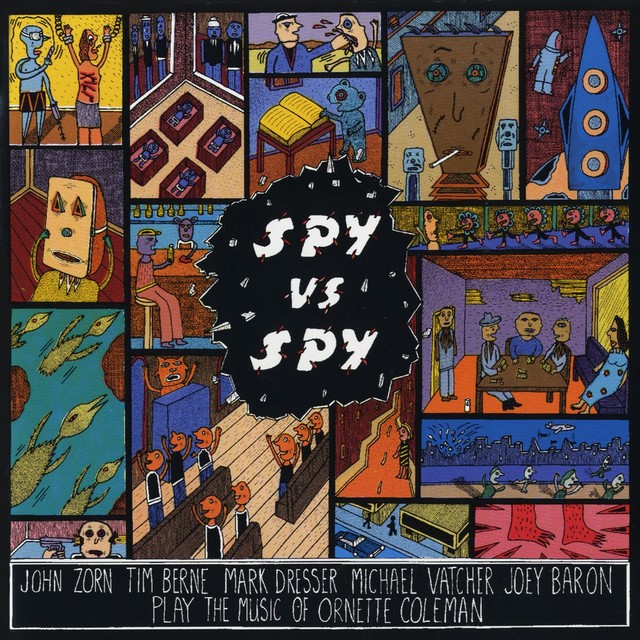
Spy vs Spy: The Music of Ornette Coleman is a 1989 album by American composer and saxophonist/multi-instrumentalist John Zorn, featuring the compositions of Ornette Coleman performed in the brief, intense style of Zorn's hardcore miniatures. The liner notes thank Ornette and Denardo Coleman, Mick Harris of Napalm Death, Ted Epstein of Blind Idiot God, Pil of Lip Cream (a Japanese thrashcore group), The Accused, Craig Flanagan, DRI, CBGB, and "the New York-London-Tokyo Hardcore Triangle". The cover artwork was created by indie comics personality Mark Beyer (of Amy and Jordan fame). The album itself approaches free jazz from the perspective of hardcore punk, particularly taking note of the contemporary innovations of thrashcore and grindcore. Zorn would later pursue these preoccupations in the thrash jazz group Naked City. Like some classic free jazz albums (Free Jazz, Ascension, Archie Shepp's Mama Too Tight), different saxophonists improvise simultaneously in stereo. Tim Berne appears on the left channel, while John Zorn is recorded on the right channel.
 Read more on Wikipedia
Keywords from Reviews
Rating Over Time
Reviews
Listening to this gave me a nostalgic memory of the much loved Commodore 64. Firstly there was a Spy v Spy game that was fun and secondly that distinctive hissing sound when the games were loading was almost as annoying as this album!
I began this album wondering quite how I was supposed to listen to it. John Zorn takes the music of Ornette Coleman, hands it to two saxophonists, two drummers and a bassist, and plays much of it with the speed and aggression of hardcore punk. The result is extraordinarily difficult music, but I soon realised that it wasn’t simply a matter of five musicians making an enormous racket. I could hear the organisation beneath the apparent chaos, even if I couldn’t immediately work out how it functioned. What followed was one of the most interesting listening experiences I’ve had during this project, because the more I understood what I was hearing, the more the album changed for me. There’s a problem with albums where one jazz musician plays the music of another. All too often, they become exercises in respectful archaeology. The musician carefully interprets the original compositions, demonstrates an understanding of their importance, and perhaps adds a few ideas of their own. There’s nothing inherently wrong with that, but it can overlook something fundamental about the original music. Some of these compositions were shocking when they first appeared, and we’ve gradually become so familiar with them that we no longer hear what made them revolutionary. Take Thelonious Monk’s Brilliant Corners. Heard against the jazz of the mid-1950s, parts of it sound like a stubby-fingered man throwing an entire jazz ensemble down a staircase. The rhythms are awkward, the melodies take unexpected turns, and the musicians seem to be negotiating obstacles that nobody had previously thought to put in their way. Yet we’ve had seventy years to become familiar with Monk’s musical language. We recognise the compositions, understand something of their construction, and hear their influence in later jazz. What was once startling has become part of our normal musical vocabulary. Ornette Coleman presented a similarly profound challenge towards the end of the 1950s. His approach to melody, harmony and the freedom of individual musicians upset many established expectations about how jazz should work. But by 1989, when Zorn released Spy vs. Spy, Coleman’s music had been around for thirty years. It was no longer simply the sound of somebody challenging the established order. It had become an important part of jazz history. That creates an interesting problem for anyone attempting to pay tribute to Coleman. How do you communicate something of the original shock when your audience has already absorbed so much of what once made the music difficult? Zorn’s answer, at least as I hear it, is to make the compositions difficult again. Rather than carefully reconstructing Coleman’s musical world, he takes the original material and subjects it to a completely different set of pressures. The influence of thrashcore is obvious in the speed, aggression and brevity of many of the performances, but there’s something more interesting happening beneath that extraordinary assault. The first thing I noticed was that the compositions hadn’t disappeared. On W.R.U., Coleman’s themes remained recognisable even when the playing seemed to be pulling in several directions at once. The same sense of an underlying musical argument emerged elsewhere, including Blues Connotation and C & D. The musicians weren’t simply abandoning the compositions in favour of unrestricted improvisation. They seemed to be taking the musical material apart and putting it back together in a different way. I found myself thinking about the structure of a conventional pop song. Imagine a song consisting of a chorus, followed by a verse, another chorus, another verse, and so on. The different parts are presented one after another, and the listener follows the development through time. Much of jazz operates through a comparable sequence. A theme is established, individual musicians take turns developing it, and eventually the group returns to the theme. Now imagine playing the opening chorus, then playing three different verses simultaneously, before returning to the chorus. Instead of the musical ideas developing one after another, they’re folded together so that several developments happen during the same stretch of time. That’s how a surprising amount of the first side of this album sounds to me. The music is incredibly dense because what might ordinarily occupy several minutes of separate solos has been compressed into a single period of collective activity. But that explanation alone isn’t sufficient. Simply playing four different solos at once would probably produce an almighty mess. What I could hear was something much more organised, with the musicians apparently responding to one another even while pursuing different musical ideas. I began trying to construct a model that would explain those relationships. The simplest way I could imagine it was as a tree. At the bottom sits the bassist, providing a common point of reference. Two branches lead upwards to the drummers, and above each drummer sits a saxophonist. Now imagine that the four musicians above the bass are each developing a separate solo. Instead of those solos following one another, they’re taking place simultaneously. The important feature is that the relationships between the musicians run in both directions. Each saxophonist is influenced by their drummer, but also influences what that drummer plays. The drummer responds to the bassist, who is responding in turn. Meanwhile, the musicians on the two branches are listening to and affecting one another. There are musical relationships running upwards, downwards and across the tree. Each player is developing an individual argument while constantly having that argument changed by the contributions of the others. I have no way of knowing whether Zorn and his musicians actually organised their performances in anything resembling this fashion. I’m not claiming to have discovered their working methods. This is simply the most plausible explanation I can construct for what I’m hearing. It accounts for the remarkable sense of simultaneous independence and cooperation, and for the way the musicians can apparently be doing completely different things without losing their connection to the composition or to one another. That brought me to cubism. In a cubist painting, several different views of an object can be presented together. But it isn’t simply a matter of placing separate views alongside one another. The different views affect how we understand each other and change our understanding of the whole object. The artist creates something that couldn’t be seen from any single position. Zorn’s music seems to achieve something comparable, but with time rather than space. Several different developments of the same composition are presented simultaneously, and their relationships change as the musicians respond to one another. There’s an important difference, of course. In a painting, those relationships have already been worked out by the artist. Here, I hear them apparently being negotiated as the performance unfolds. It’s as though the different views in a cubist painting were continually changing in response to one another while we looked at them. This also means that the process isn’t merely one of compression. The individual musical arguments aren’t necessarily the same arguments they would have been if the musicians had taken turns. Their development is changed by the fact that other musicians are developing different ideas at the same time. The act of putting the music together in this way changes the music itself. It’s an extraordinarily interesting idea, and it explains why I became so determined that this album shouldn’t simply be dismissed as noise. It isn’t noise. Absolutely not. It’s organised along rather hostile premises, but it is organised. The problem with the first side is that the organisation is often almost impossible to follow at the speed at which everything happens. I could hear the themes, identify the different lines and occasionally recognise the musicians coming together, but the next burst of activity would arrive before I’d fully understood the previous one. It was exhausting. I admired the playing and became increasingly interested in the musical ideas, but intellectual interest and musical enjoyment aren’t necessarily the same thing. There were moments when I understood what was happening without particularly wanting to hear any more of it. And then came side two, which changed my experience of the album completely. The remarkable thing about the second side is that Zorn doesn’t abandon the principles established on the first. Instead, the music begins to open out, giving the different ideas more room to develop. The result is not simply easier to follow. In several places, I thought it was absolutely fantastic. Feet Music has an almost rock-based stomp to it at times. For a moment, I wondered whether the musicians had abandoned their complicated approach and settled into something much more conventional. But as the piece developed, it became apparent that the strong rhythmic foundation was simply making the opening theme more obvious. The variations were still being layered over one another, and the musicians were still pursuing their separate but connected musical arguments. The difference was that I now had a much clearer reference point against which to hear them. I thoroughly enjoyed it. Broadway Blues offered something different again. There was a wonderful expansiveness about the performance, a sense that the music had room to stretch out without losing the relationships that held it together. I could hear the individual contributions more clearly and follow their development without having to struggle through the sheer weight of activity. It was becoming possible to enjoy the music on its own terms rather than constantly trying to work out what was going on. Then came Zig Zag, which provided one of my favourite moments of the entire album. Towards the end, the musicians suddenly come together for an astonishing stop-time ending. After so much music in which the players seem to be pursuing separate arguments, the precision of their collective playing is remarkable. It’s the sort of thing you might expect from a tightly rehearsed big band, and it makes the underlying discipline of the performances wonderfully clear. But then, having apparently finished the piece, they go back and play the ending again. It’s the old Count Basie Orchestra trick from April in Paris, where the band reaches its conclusion and then decides to give everybody another helping. The stop-time ending was impressive enough, but that extra lap was delicious. It was also funny, in a wonderfully musical way. After all the apparent disorder, here were five musicians showing that they could come together with absolute precision and then have a bit of fun repeating the trick. More importantly, it made something explicit that I’d been hearing throughout the album. These musicians weren’t struggling to maintain control of their performances. Their ability to pursue separate musical arguments depended upon a tremendous degree of collective understanding. The ending of Zig Zag demonstrated that understanding in a form that was impossible to miss. It also made me reconsider the first side, where the same relationships had been present but much harder to hear. The final track, Mob Job, settled the argument for me. Its slower tempo and greater length allow the saxophonists much more room to develop their ideas, while the bass and drums continue producing a glorious racket underneath them. But the racket is still organised, and the relationships between the musicians are easier to follow because everything is happening at a more manageable pace. The same musical approach that had been almost overwhelming at the beginning of the album was now producing something I found thoroughly enjoyable. Slowing the music down hadn’t made it less interesting or less complex. It had made the complexity easier to hear. The players could develop their ideas more fully, and I had time to appreciate how those ideas changed in response to one another. By the end of Mob Job, I was no longer trying to persuade myself that the album was worth the effort. I was simply enjoying it. There’s a useful distinction here between making music complicated and committing to an idea. During the same week’s listening, I’d been frustrated by Neil Hannon’s A Short Album About Love, where I often felt that the arrangements were supplying a beauty and emotional weight that the underlying songs hadn’t earned. Hannon seemed rather too pleased with himself for dressing up in the grand gestures of singers such as Scott Walker, without always delivering the emotional substance that made Walker’s performances so powerful. I’ve heard Scott Walker, and Hannon is no Scott Walker. Zorn presents almost the opposite problem. His musical idea is so extreme that it risks making the record unlistenable, but he commits to it completely. There’s no sense, to my ears, of an artist merely dressing up in the clothes of a more adventurous musician. The performances follow their chosen approach with extraordinary discipline, even when that approach makes life very difficult for the listener. And on the second side, that commitment produces not just a clever demonstration but some genuinely wonderful music. What I find most satisfying is that the album’s difficulty seems to serve a purpose. Coleman was a revolutionary musician whose work had gradually become familiar. Zorn takes that familiar music and finds a way of making it strange again. The speed and violence of hardcore punk, the overlapping solos, the competing rhythms and the constant changes between the players all contribute to an experience that challenges the listener’s normal expectations. I can’t know whether reproducing something of Coleman’s original shock was precisely what Zorn intended, but it is certainly the effect the album had on me. And judging by some of the reactions I’ve encountered from other listeners, that effect hasn’t entirely worn off in the decades since its release. There’s something rather wonderful about a tribute album that doesn’t simply ask us to admire the original artist. Instead of carefully preserving Coleman’s music as an important historical achievement, Zorn treats it as something that should still be capable of causing trouble. He doesn’t merely reproduce the notes. He finds a way to restore some of the difficulty and surprise that made those notes so important in the first place. This used to be difficult music. John Zorn makes it difficult again. What changed during my listening was not my understanding of the album’s basic approach, but my ability to hear what that approach could achieve. I began by recognising organisation beneath an almost unbearable amount of musical activity. I gradually developed a way of understanding that organisation, through the folding of musical time and the relationships between the musicians. Then the second side allowed me to hear those same principles producing groove, space, humour, precision and genuine pleasure. I wouldn’t pretend that the first side became easy listening, or that I expect to return to it frequently. Its speed and density remain exhausting, and there are limits to how much effort I’m prepared to expend simply to follow a piece of music. But the second side was a revelation, and I adored several of its performances. The album didn’t simply reward the effort I’d put into understanding it. It changed the nature of that effort, until something that had initially seemed almost impossibly difficult became a source of considerable enjoyment. I finished with a much greater appreciation of Coleman’s strength as a composer, Zorn’s determination to do something genuinely different with that material, and the extraordinary collective ability of the musicians involved. Above all, I finished with the sense that I’d heard an album which had challenged me for a reason, and which had eventually justified that challenge. It’s a rare thing to hear a record that makes you work this hard and then rewards you with something as simple as the pleasure of five musicians playing brilliantly together.
I don’t know what rating to give this. It’s so interesting but also almost unlistenable
An album I've never heard, with a bad reputation amongst generator users. But I've liked some other 'unpopular' albums, so not too daunted. I read Wikipedia about the album and a bit about John Zorn. (Detour into the new-to-me idea of musical compositions that are "game pieces", oh wow.) Forewarned and semi-briefed, I start listening. It's so intense from the start, I suspect I may be able to listen to one track at a time and be happily attentive, but not able to listen to it straight through? See how I go. (Disappointed it's not hardcore-with-guitars - had to go back and read again the actual instrumentation here - now I understand how come so much drums - credit to the drummers that they're so in step - SMH at reviews here that mistake free jazz for chaos.) Turns out I listen to the whole album straight through, with enjoyment. They're all intense, definitely not "all the same" or "unrelenting" - and it does get more accessible as it goes on. The word 'violent' (used in the AllMusic review) seems quite inappropriate. I don't know Ornette Coleman well enough to recognise the pieces, I can see that some are quite relatable in their expositions. I'll give this album points for technical skills as well as chutzpah. It seems I find thrash free jazz more accessible than straight free jazz - I expect I will listen to this again. It's not just Very Good, it's (at least) Pretty Wonderful, 9/10.
Oh my. This is one of the best albums I have heard on the list so far. It is definitely an album I should have heard before I died. Jim Zorn decided to take Ornette Coleman and turn him into hardcore music. The twin assault of the saxophones is a bit much at first but it’s so beautiful to really listen when they are playing the same and then differently at the same time. The assault of the double drummers. I find the beauty in heavy music and it’s here. Yes it’s loud and a bit much but if you listen there is something really beautiful being played in both sides. This something you have to listen to instead of putting on in the background and expecting it to play. You have actively listen to hear the beauty under the brutality of the assault.
I actually had so much fun with this album! I hated it at first, it was so abrasive and annoying, but then it just like clicked with me and I understood it? When that happened I spent the rest of the album really enjoying myself. Theres not a single standout piece from it, you just have to listen to the whole thing to really get the full experience from it. It was a great time though, and it makes me feel like Im starting to understand jazz!
I wanted to like this - but really just don't - 1/5
Flaps. 0.5
Jazz played at a million miles an hour. This was just too mental for me to wrap my head around. I did find it interesting though as I'd never heard anything quite like it before.
Not quite my tempo.
:(
medio pesado. ademas lo tuve q escuchar en youtube. tiene buenos momengtos, pero no me genero un deleite
More interesting than 90% of the jazz albums on this list, and more brutal than a lot of the metal albums here too. Free jazz and hardcore is a combo that's hard to make boring. I appreciate that this was on the list because otherwise I'd have no idea stuff like this even existed.
Some people would describe this album as just noise, others will talk about the genius of Zorns chaotic arrangements of ornette colemans music as being a joyful cacophony of sounds that challenge the listener to really get into what is going on underneath…. I agree with the “noise” crowd… i’ve never understood Jazz, i never will if this is among its best offerings.. an album for your dads most pretentious prick of a mate
Music for the mosquitos of NOLA
Oh boy, I had hopes for this album. I thought spy Vs spy might be fun. I was wrong. This was not my type of album at all. Also, Spotify did not have this album and I had to listen to It on YouTube. I'm beginning to think if Spotify does not have the album, I probably won't like it.
This album had me both fascinated and anxious. I can understand why this is on the list, but I'm very on the fence about whether I like this or not, so a 3 it is.
I couldn't finish this album. I'm sure they are having a great time but listening to this made me nauseous.
Bełkot
Can’t work out if I just listened to the same noise over and over again or if there was anything different between the tracks.
An example of the worst kind of jazz, noise jazz. I don't like it in rock, there is no reason jazz would be any better. I suppose at least it's all instruments and not random weird noises. But without melody or any sense of song structure, it flails IMO. Not for me.
I am usually positively surprised by obscure jazz albums no longer available on Spotify, but this was just too much sound for my brain to comprehend. Although I am sure it was immensely impressive musically, I just couldn't find a way to flow with it and enjoy it. I am genuinely sorry!
Good lord what a schizophrenic start. I was not on the right drugs for that Luckily the rest of it mellowed out a bit, but still.
Very chaotic. It's a pretty good album. It's very unique. I don't really know what else to say about this album. It has a very unique sound. I don't know. It was interesting.
Listened on flight home from SFO. Chaotic random and disorienting. I’m sure it’s great to people who are familiar with jazz. I am not one of them and would never again put this on. 1/5
"Right these are the notes John gave us, as soon as we've played them all we can go home, press record and play...... GO !!!" If only they'd paid them by the hour. Missed opportunity.
7/10 (dropped to 3 from 4)
#119 - John Zorn - Spy Vs. Spy - The Music of Ornette Coleman ⭐️ You have GOT to be kidding me right now.
Well that was uncomfortable. I like weird things and I like jazz but this felt like assault, brother. I've been physically abused in the ear. I gave it a fair shake, I can't think of any situation in which this would be in any way appropriate. Brenda says jazz makes her nervous. This would make Brenda have a seizure.
*1989. Jazz. *So much aggressive horn. So annoying. Ahhhhh. RATING - 4/10
There’s a difference between avant garde and dogshit. This is the latter. 0/10
What the actual fuck was this!! 41 minutes of my life wasted on the most unhinged, chaotic, and awful album I've ever heard. A tortuous listen from the jump and the pain never stops. I have nothing good to say about this... NOTHING! Rating: 0/10
Never a good sign when the album isn't on Spotify. This got slightly more tolerable as it went along but yeah I'm going pass, dawg.
This is music for musicians and people steeped in self-loathing.
This was an intense listen, but I'm kinda here for it. Maybe thrash jazz is my thing?
Delightful.
Free jazz might be a little too chaotic for me. Glad I don’t have YouTube Premium because the best part of this was the ad palate cleansers throughout.
i have a lot of john zorn in my collection. masada, electric masada, book of angels, some film and play stuff. dude is prolific at writing and honkin’ on that sax. not an everyday listen but a fun take on ornette coleman’s material.
WTF
Not my vibe
Only available on YouTube.
This album is an interesting take on free jazz with a hardcore punk spin as it was described by Zorn. I would say at times it sounds like organized chaos and other times it was more melodic and tolerable. Overall the album seemed disjointed and more of a jam session that an actual full recording. I give it a 4/10 and that means 2 stars from me.
This gets more hate here than it deserves. It’s a tough listen I’ll give you that and it’s hard to evaluate on a couple casual run throughs. But if you peel back the layers there are some interesting things happening under the noise.
This was brutal. In my experience teaching sixth grade band, sometimes before rehearsal begins you'll have a few wind players competing to make the loudest most obnoxious sound possible with their instrument. There were times that it sounded like the two saxophone players and two drummers were doing precisely that. Ouch.
It feels strange hearing a tribute album with no prior exposure to the artist being honored, making it impossible to examine if it is an affective tribute and leaving it as something that has to be assessed merely in a vacuum, which is only one piece of what is going on here. In that vacuum, this is a pretty interesting, avant-garde smattering of jazz mixed with other musical sensibilities that feels structureless and as if things are just being thrown at the wall with abandon, making it unapologetically unapproachable. This approach has it’s merits, but leaves the first half feeling abrasive and often unenjoyable, for me. The second half, however, is where things come together more, offering many cool moments and fantastic, groovy tracks. These are still the exception rather than the rule. Beneath this blazing, violent collaboration of genres there seems to be something intensely intentional and painstakingly arranged about it. 1 listen Favorite Tracks: Feet Music, Mob Job, Broadway Blues
I would describe this as a chaotic version of musical instrumentstion that I enjoy. I'm hoping that this is organized chaos, though at times I'm not so sure.
I am a newcomer to the world of John Zorn and became aware of him through the Big Ears Festival, where I saw him this past spring. The show I saw was not extremely user-friendly - even considering that it was free jazz improvisation - so I think I need to see more of him. I liked a lot of this but "Enfant" and "Space Church" were difficult listens. Just sounded like noise for most of those tracks. Which may have been the point... Anyway, this is tough to rate for me. Definitely a 2 or a 3. I think I WANT to like it more than I actually do like it.
Interesting jazz album. Chaotic but followable. I enjoyed it.
Youtube link (since it's not available on Spotify): https://www.youtube.com/watch?v=zCHB5LLPQ3s Not stimulating enough. Try scrolling through TikTok's FYP man... smh Lol, I got whiplash on the first beat. It's like Trout Mask in its polyrhythms but with much more skilled jazz playing. This is still really goofy though, like imagine playing Guitar Hero to this 🥀. It's good music to work to but when you have too much, my brain becomes this jazzy chaos. Take in moderation basically (2.5-3).
Hold kæft nu.
*29 Lyden af et biluheld.
Om jeg begriber, hvorfor folk kan lide sådan noget her Det allerbedste er, når der en sjælden gang imellem er snerten af en rytme, der ikke er 13/7-dele, eller selvfølgelig når et nummer slutter. Derudover rykker anden halvdel af pladen det hele væsentligt op. Altså op på minimumskarakteren. Det er den mest stensikre 1'er - ligeså sikker som Hr. Robbie Williams 1.00
Jeg er ikke fan af nogen form for kunst, der udelukkende kigger ind ad og udelukkende tester sine egen grænser. Det bliver navlepillende og låser kunstværket fast i noget der meget nemt bliver et selvreferende ekkokammer. Men det er meget den fornemmelse, jeg sidder med her. Jeg er godt med på, at det kan være vigtigt for at en kunstart kan at udvikle sig, og at det langt hen af vejen også er mig, der ikke kender nok til de kulturelle (og musikalske) koder til at kunne værdsætte eksperimentet ordentligt. Men i sidste ende synes jeg netop, det bliver lidt for tydeligt, at det her primært er et eksperiment - et eksperiment jeg har meget svært ved at vurdere vigtigheden af. Enig med Reimer i at anden halvdel, bliver markant bedre, men ved flere lyt vinder første halvdel også på mig, selvom jeg nærmest var frastødt ved første lyt. Men jeg har selvfølgelig også en forkærlighed for det punkede og - i lidt mindre grad - trashede
Fucking jazz
Awful
0.5
It's like if the end of whiplash was 40 minutes long, holy shit
This *would* be the album to arrive after I've had one of the most overstimulating weeks of my life. this was a cacophonous nightmare, with Broad Way Blues (and debatably Mob Job) being the only one with a semblance of any coordination and tune
There is something about the fusion of free jazz and hardcore that works. The songs are chaotic and violent, but not quite an assault on the ears. I enjoyed this one.
Not streamable
My ears feel assaulted. One of the worst things I've ever had to listen to.
Wild and manic, this is like an aural panic attack. That said, I kinda enjoyed it. The shtick starts to wear thin towards the end and the braying saxes almost made me skip ahead. But I plowed through it and the hyper song structure and logic began to make more sense. This is not music to listen to on a plane.
This has a real 'fuck you' energy to it that I can't help but respect, even if there are points where it makes you want to destroy your ears with a cheese grater.
I consider myself pretty open minded with music. I like experimental stuff, avant-garde stuff. It has its moments, and “Good Old Days” was an enjoyable track. But this was by and large a wall of unpleasant noise
Okay but why couldn't we have gotten any Ornette Coleman regular style
I didn't hate this as much as other people did, but I didn't like it as much as other people did. I see the brilliance, I genuinely enjoyed bits and bobs, but yea -- it's noise. Intentional noise, but noise nonetheless.
god awful, I hate free jazz
Very frantic. Lots of skill obviously but hard to find something to settle into.
This is what taking cocaine through your ears would sound like
Richtig entspannt
Panic attack the album
Jazz music that is literally less accessible. Not to be found on Spotify, though fortunately available on YouTube. Thanks to the ads, the listening experience was stop-and-start.
i'm shocked ornette coleman didn't want john zorn's head on a silver platter after this
Lo de YouTube ye pa morrir
1065 - "No juice box or orange slice for this one. It's the kid you should have cut but kept because of the hot mom. Turns out she's a hot mess and the kid is the reason her day starts with a glass of Chardonnay."
This is like Cowboy Bebop on crack.... I like it!
Halt Free Jazz. Die zweit Hälfti isch strukturierter und i gänglicher
Sounded like a middle school band warming up.
This sounds like a middle school band
Bloody hell this was awful. This sounded like if Dr. Faub told us to all improvise at the same time during middle school band. Half the time the saxophones just sounded like squealing pigs. Truly a dreadful experience.
This gives jazz a horrible name. Nothing but discordant noise-goes between horrible middle school band to sounding like wounded animals. Awful
Couldn't make it all the way through. I know it's an artsy jazz that is meant to be listened to in stereo, probably while smoking clove cigarettes in a dark backroom and discussing Faulkner's grand metaphors or some shit. But I couldn't think with this playing at a relatively low volume. Maybe that's the point? Don't think and just listen? Too high brow for me
Too much for me. I'm sure there's someone out there that can explain why it's culturally and musically important but I am not the intended audience.
My nervous system couldn’t even make it all the way through the first song.
The first song was almost good enough to finish. I imagine the rest of the album is very interesting. Glad for those of you who completed it.
5/5
"Hey, now I know what to play next time I'm hankering for some thrash punk jazz!" -Nobody Ever
Man, fuck this. I'm getting satire or tongue-in-cheek vibes, or maybe a lampoon of free jazz/fusion. I can fully respect commentary and critique of music, especially in the form of music itself, but like, Jesus, could you at least mix this album in a way that lets me hear it properly? Get the fucking reverb off the drums, you idiot. When the part is that busy, it needs to be intelligible so we can appreciate what it's trying to say. Calling this a sonic dumpster fire is a disservice to slums everywhere.
Jazz at it's worst. While I'm certain that the musicians and fans of the art form have a great time with the making of and listening to this album, to me this is barely more than an ego fueled assault to my ears. There are a couple of songs later on that benefit from a slightly more structured approach but not worth the journey to get there. At least it introduces perspective.
Possibly the worst listening experience that I have ever had
You have to be in the right mood, and then this CD is actually pretty cool and special.
Not really for me, torturous at times. Massive massive massive drum sound though which is the main thing I enjoyed. 2.0/5.0 Best Song: Track 3
This isn't a 1 for me only because I like jazz. I am not the kind of experimental taster.
Far out
An album that really benefits from listening with headphones to fully immerse yourself. Really enjoyed this reinterpretation of Ornette Coleman's music, bringing a wild new energy to things. That said Coleman really should be on this list as well.
Loved this album, great piece of Jazz
Everyone's had mindfucks/trips in some regards yeah? PG version or much *darker* versions to each their own. Mine? Going from Miles Davis' "Kind of Blue"...... to this in consecutive days. In that sense, it fits the 1001 albums to listen to before you die criteria, because what's the good without the bad.... or this case, the bizarre? Now, I actually am intrigued in some sense by this, Bizarre doesn't automatically mean horrible, it just means different in a weird way. And to an extent, thats exactly what this take on Jazz is, an absolutely intense and batshit insane take in what is called "Avant-garde jazz" or even Punk Jazz. Now listen, I APPRECIATE THE TALENT, i really do. But in a 1-5 rating, which im doing, i can analyze things every which way imaginable, but the core concept is simple. How enjoyable was the album to listen to and why? This? I'm sorry, but......no, just no. 1/5 PLEASE GIVE ME AN EAR CLEANSER NEXT 1001 ALBUMS GENERATOR DOT COM PLEASE.
Suicide music. People are probably tortured by being forced to listen to this on repeat for days. At times it was so bad it was funny. I never want to hear another saxophone. This is my 487th album and the worse I've listened to.
Noise & Grindcore Jazz dafuq
Meh