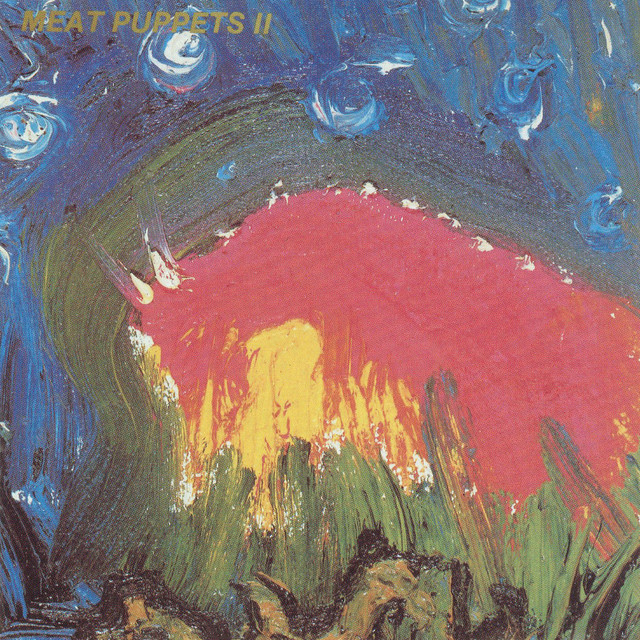
Album Summary
Meat Puppets II is the second album by the Phoenix, Arizona band the Meat Puppets, released in 1984. It is a departure from their self-titled debut album, which consisted largely of noisy hardcore with unintelligible vocals. It covers many genres from country-style rock ("Magic Toy Missing", "Climbing" and Lost") to slow acoustic songs ("Plateau" and "Oh, Me") to psychedelic guitar effects ("Aurora Borealis" and "We’re Here"). The cover art is by Curt Kirkwood and Neal Holliday. Rykodisc reissued the album in 1999 with extra tracks and B-sides, including a cover of the Rolling Stones' Aftermath-era track "What To Do." The Meat Puppets' SST labelmates Minutemen covered "Lost" on the live EP Tour-Spiel and their last studio album, 3-Way Tie (For Last). Three of the album's songs were covered by Nirvana (as the Kirkwood brothers joined them onstage) during their "Unplugged" show for MTV ("Plateau", "Oh, Me", and "Lake of Fire").
 Read more on Wikipedia
Keywords from Reviews
Rating Over Time
Reviews
Although Meat Puppets is a great name for a band, I can't say I enjoyed their music much. There are some decent instrumentals here, notably Aurora Borealis, and favourite vocal tracks included Split Myself In Two and Oh Me, but some of the tracks are too drony, with the 'singing' being both out of tune and sometimes out of time, and we have another album where I wonder if I really needed it in my life. A low 2 stars.
Pleteau on this album made me cry. Man how I love this song. Okay now I'm listening further... This is Nirvana MTV unpluged but original? Yeh I understand why it is here. I really love it.
Quite impressive guitar work and sounds from the cowpunk to the psychedelic to even the rhythm. The vocals are a little tough to take at first. Cobain’s haunted vocal approach brings needed gravitas to the material.
It’s got a slacker rock vibe to it and I think it works. Sure the Nirvana covers are great and all but I really do enjoy the approach of the originals as well, great songwriting. One track I wasn’t previously aware of that I really enjoyed was Climbing, the sincerity of the track, the slacker vocals just work so well on this song. I love when music from decades past gets me thinking about a current day artist I’m into, Climbing had me thinking about This is Lorelei who demonstrates a similar slacker vocal approach. The instrumentals actually stand out as well and provide a bit more than standard filler, there’s some fantastic bass taking place. Grade A album art too! 4 stars
Eh, didn't really connect with this album, they have other songs I like better
Not my thing, but+1 for a creative band name. 2.0
Weird album, but I like it. I thought they were punk, but no, psych rock.
Meat Puppets’ circus inspired lo-fi rock music has a good sense of humour - but they’re no joke. The world would be a poorer place if there were not bands mining such specific avenues of sound akin to Captain Beefheart vein of rock. It's stunning and glimmering through the whole thing. murky noisy guitars with beautiful fuzz. I LOVE how he sings on this, like he's painfully professing everything pouring from his mind. They intentionally sound like they're falling apart. However, from this constant dance on the edge of total chaos, they managed to make some of the most influential altrock there ever was. They kinda fell into a more straight forward banjo style there in the end, but on II, they really made shit real. Super original and awesome and more than just a practice of take-two-genres-and-put-them-together. I would point out though that several interesting 80s punk bands (like Minutemen and Husker Du to name but two) did not benefit from the hype Meat Puppets did thanks to Kurt Cobain.
I'm not 100% sure what to make of this record - it feels very confused. At points there are some super interesting instrumentals and grunge elements that really land well with me. But there's other points that feel way too country and quite frankly, a bit cheesy. In short, love the grungey bits, hate the country bits. A 5/10 overall.
When I saw that my next album was Meat Puppets II, my first thought was, "Oh no, is this going to be another Butthole Surfers situation?" 😂 Fortunately, I was pleasantly surprised! I had heard of the Meat Puppets, but I wasn't familiar with their music. I learned that they were one of the bands that helped lay the groundwork for grunge and alternative rock, which made this an interesting listening experience. For years, I had a running gag on my old Return to the '80s podcast about how much I hated grunge because it killed the music I loved. When grunge took over MTV and radio in the early '90s, I felt like it was being shoved down our throats. I still loved bands like Def Leppard and Bon Jovi, but I largely escaped into country music, listening to artists like Garth Brooks, George Strait, Reba McEntire, and Shania Twain. Over the years, though, I've developed a greater appreciation for grunge. It now brings back memories of my college days. So listening to an album from 1984 that helped influence that movement was particularly interesting. And the album got off to a surprisingly strong start! "Split Myself in Two" immediately grabbed my attention with its driving guitars and raw energy. The singer even reminded me a little of Bon Scott from AC/DC or Marc Storace from Krokus. Then came the country influences. Songs like "Magic Toy Missing" and "Lost" introduced me to the band's unusual blend of punk, country, and psychedelic rock. I enjoyed both the energy and the twangy guitar work. "Plateau" was another highlight. It was mellower and more atmospheric, showing a completely different side of the band. I also particularly enjoyed the guitar playing on "New Gods." What impressed me about the first half was the variety. The Meat Puppets weren't simply repeating the same formula. They were experimenting with different sounds while maintaining their own identity. Unfortunately, the album couldn't sustain that momentum. The second half was a significant letdown. "Oh Me" didn't do much for me, and neither did "Lake of Fire." Interestingly, both songs were later covered by Nirvana, along with "Plateau," during their famous MTV Unplugged performance. Considering my history with Nirvana, I found it pretty funny that I enjoyed "Plateau" but didn't care for the other two! 😂 "I'm a Mindless Idiot" and the remaining tracks didn't improve matters. What had started as a surprisingly enjoyable listening experience gradually lost my interest. By the end, I felt like I had listened to two very different halves of an album. Still, I'm glad I discovered Meat Puppets II. It introduced me to an interesting piece of alternative rock history and gave me a better understanding of some of the musical influences that eventually helped shape grunge. And there's something amusing about the fact that I enjoyed the early work of a band that influenced the very genre I spent years complaining about! Final Verdict: Meat Puppets II was a pleasant surprise that unfortunately ran out of steam. I enjoyed the driving guitars, country influences, and musical variety of the first half, but the weaker second half kept it from earning a higher rating. It's not something I need in my vinyl collection, but I'm glad I gave it a listen. 3 out of 5 stars. No Buy.
3/5.
Marko 4 Sara 3.5
Inget speciellt men ändå en trevlig första lyssning.
Dumt men också medryckande. Är lite provocerad av hur mycket jag gillar detta...
Stark trea, gillade viben.
Cowboy Punk? Hell yeah. Gimme some more.
I have a feeling this wouldn't even have made it in the book if not for the Nirvana Unplugged thing. Regardless it's a fucking awesome album. Minutemen's cover of "Lost" on Three-Way Tie For Last is also badass.
One of the most underrated and important album of the 80s.
Decent album - never heard of them - felt a little grungy in the first few tracks, but also a bit of a country feel later
Didn't expect to like it as much as I did, much more melodic than I thought, also loved the Nirvana original
Famous because of Nirvana, this album features all 3 of the originals that Cobain covered with so much emotion. Patchy but quality cowpunk.
I only know Meat Puppets because of Nirvana. I knew three songs on this album because Nirvana covered them on their Unplugged album - Plateau, Oh, Me, and Lake of Fire. I had only heard Meat Puppets version of Plateau before though. It was nice and short. The singer can’t sing well though.
good instrumental, interesting vocals
Great sound, could do with a stronger vocalist
Bang average. Nothing to see here.
1 minute into the first song, I'm thinking "oh god, there are 18 more of these?!?!" But then it got a lot better somehow.
I'm always kinda fascinated with the bad-on-purpose bands. The ones you can tell are secretly actually very good but are ashamed of this? It's a holdover from early punk which posited that anyone is able to play music and to say otherwise was elitist or something. But then something funny happens when these bad bands play enough gigs and whatnot that they accidentally get good. And then they're like, "shit, boys, what do we do now?" In the 90s even huge bands dabbled in this (most notably Nirvana who also covered three of these songs on their "Unplugged" album). Meat Puppets II is a sort of frustrating listen for a square like me. The moments where they drop the "bad band" act (namely, the instrumental tracks) make this an interesting enough listen that it's not a total write off. And, honestly, the singer has a weird sort of charisma, like bad Kurt Cobain (that, again, Kurt tried to emulate from time to time). So it's not a total write-off but I doubt I'll return to this one.
Smile and on and on and on it goes
חמודים אבל שוב אין לי כוח לזה
Often good, sometimes annoying. The two standout tracks are instrumentals, which says something about the quality of the singing on this.
Actual grungy grunge
Amateurish, avant-garde punk that is surprisingly hard to rate as it is It’s easy to listen to. The Country-infused punk makes for an interesting combination. I’m not sure what’s more surprising: how much I enjoyed this, or how an album I’d never heard of has (rightly) found its way onto so many best-of-the-80s lists. Some tracks tread perilously close to sounding like Benny Hill backing music, but overall, it’s a thoroughly enjoyable listen.
Never heard of these guys. The first song certainly implied this was going somewhere else. But... I dunno where it went. It was an adventure. I just come off 2Pac and in my review I said there wasn't enough variety - the delivery, the beats, all had a staticness to them. This is almost the opposite. It jumps from hardcore to country to alt-indie ballad to grungy instrumental to... If I was to describe this to someone I'd probably say "It's like Neil Young and Ween did a collaboration". Many people might cringe from that. Many might jump at it. Me, being a fan of both of them listened to this and thought "well, it's pretty good but will I come back to it?". Not really sure. Which is probably to say, no. But cue the Leo pointing meme if someone else ever puts it on.
At first seemed like hardcore/punk with country/folk inflection. Then it flipped to country with an alt-rock bent. Then it went leftfield with some jazzy, proggy chord voicings. Some instrumental tracks too. And this crazy collage keeps on coming. Some proto-grunge too? It reminds me of Pixies, even when it goes hardcore x country/folky it's like Pixies' Crackity Jones And then Teenager(s) goes full hardcore at the start Best track - Split Myself in Two, Magic Toy Missing, Plateau, Aurora Borealis 4 stars
Oof. This was a real slog for me. I kind of liked some of the instrumental tunes. Not enough though.
Nothing. -------- Sounds like I would have preferred the debut. I am actually not sure what is going on here for the most part. It feels like a slew of test pieces and a band trying to find their sound. It felt really long, pretty tortuous and mostly irritating. Tuneless vocals, messy song structures and shoddy production. It's piss-poor punk-country. 1*
Verrassend. Coole vocals, onverwachtse country invloed. Bizarre teksten maar leuke sound. Niet veel uitschieters naar boven echter
With the exception of Lake of Fire, which I enjoyed (but Nirvana's version is better), most of this feels like it's noodling around, trying to find a style the band wants. None of it is particularly great. Like a bunch of demos that probably weren't ready to be released yet.
1984 -- 2nd studio album -- cowpunk / psychedelic rock / bluegrass / folk / Americana -- well-received, extremely different from hardcore 1st album; country rock, ballads, psychedelia; '"inchoate blur;" "Western gothic;" "influence of ZZ Top and 'other masters of fried '70s boogie';" "a kind of cultural trash compacter;" "calmly demented country music" (Kurt Loder); "a sun-baked, country-fried, acid-addled cowpunk album that could have come from nowhere else but the Arizona desert." This is another band that I can trace forward to a favorite, the Old 97's. I was NOT excited about something called Meat Puppets but literally in the opening riff I knew I would love it. The vocal is so deranged, but the music is everything I love about where a particular vein of country music ended up. Three tracks in this is 5 stars for me. I've learned that when you lock into listening to so many new albums, you can absolutely just tell immediately. Some, you just know. Others can probably be worked at, studied, paid more mind; but some albums are just a fucking 5.
Really liked some songs, others I really disliked. Solid 3.
3.25
I was unsure this album would measure up as I wasn't feeling the opening track, but it's impressive that my mind was almost changed by the end. While not as astonishing as the string of 4 star and above albums I've been getting lately, this was still an interesting journey into the minds of the "Meat Puppets" and their fun brand of chaos! Never heard of the cowpunk genre before this and it sounded exactly like how I thought it would (complimentary), though I'm not sure it's my cup of tea.
My meat, puppet. Feel it man.
I like when they play hardcore and country
I came to this album knowing three of its songs, although I didn’t know the album itself at all. Plateau, Oh, Me and Lake of Fire were familiar from Nirvana’s Unplugged in New York, where Kurt Cobain had invited the Kirkwood brothers to participate. I’d always liked those performances, but they hadn’t prepared me for the extraordinary musical world from which the songs had emerged. By the end of this record, I understood Cobain’s fascination considerably better, and I’d discovered something that I suspect will be accompanying me for a very long time. My first impression was of something I could only describe as cowpunk. Curt Kirkwood’s guitar seemed to be attacking traditional American country music with the physical ferocity of hardcore punk, while his voice operated somewhere near the limits of its capabilities. I was immediately reminded of Jack White, not simply in the guitar playing but in the vocal abandon. Both singers have a willingness to push their voices into territory where control seems precarious, allowing strain and ugliness to become part of the expressive language. But Split Myself in Two also introduced the first of the album’s strange little narratives. A mysterious visitor arrives, produces cards, appears to tell fortunes and departs with the suggestion of an unexplained debt. It has the structure of an old folk tale in which somebody has entered into an obligation without understanding its terms. There’s something of Rumpelstiltskin about it, although the story never settles sufficiently to become an identifiable allegory. Kirkwood simply tells it as though there’s nothing remotely peculiar about any of this. The instrumental Magic Toy Missing made me think of the Long Ryders touring with Hüsker Dü. I mean this quite specifically. The Long Ryders were exploring the American country-rock tradition, particularly the musical territory opened up by the Byrds as they moved from The Notorious Byrd Brothers towards Sweetheart of the Rodeo. Their approach was essentially one of continuation and revival. The Meat Puppets seemed to be conducting an entirely different experiment: what happens to country music when you subject it to the pressures of hardcore? I found myself quite amused that I was making these distinctions at all. A year ago, I doubt I’d have been discussing the developmental stages of the Byrds’ country-rock vocabulary with anything approaching this precision. One of the pleasures of listening through this enormous collection of albums has been finding that musical relationships I once recognised only vaguely have become increasingly intelligible. What struck me about Magic Toy Missing was that the playing sounded barely, barely, barely capable of hanging together, yet was evidently competent. This wasn’t simply a band of punks making a terrible racket with instruments they couldn’t control. There was considerable dexterity beneath the apparent disorder. The phrase that came to mind was that they were giving country music the speed of bluegrass but the pressure of amphetamines. That distinction between speed and pressure became important. Bluegrass musicians can play at extraordinary velocities while retaining an almost weightless fluency. The Meat Puppets make similar velocities sound desperate, as though the music is trying to escape from itself. On Lost, this became even more apparent. The song begins relatively comfortably, with a lovely country twang, but gradually develops a peculiar nervous urgency. Initially I thought this was largely a consequence of Kirkwood’s singing, which occasionally reminded me of Peter Perrett of the Only Ones. Both possess that thin, nasal, slightly distressed vocal quality, although Perrett often sounds positively languid by comparison. As Lost progressed, however, I began hearing the relationship differently. The rhythm section seemed to want to run away with the song, imposing a mounting pressure to which Kirkwood’s voice responded with increasing anxiety. The band supplied the pressure; the singer supplied the neurosis. I had found a new genre: cowpunk neurosis. That description seemed satisfactory until Plateau began dismantling it. Here the music relaxes considerably. The country-punk assault gives way to something more spacious and melodic, although Kirkwood’s upper register still produces that unmistakable whining instability. The voice, it became apparent, didn’t require an accelerating rhythm section to sound anxious. Its precariousness could survive in a comparatively relaxed musical environment. More interestingly, I began hearing an unmistakable antecedent of Pavement. There was something in the melodic phrasing, the slightly ramshackle guitar sound and the apparent disregard for conventional prettiness that anticipated Stephen Malkmus. Where Malkmus often sounds arch or detached, however, Kirkwood seems more exposed and bewildered. The lyrics of Plateau are another peculiar excursion into magical realism. People climb towards an apparently significant destination, encounter a series of inexplicable objects and presences, and discover that the summit offers no obvious revelation. The song seems to be constructing a philosophical parable, but refuses to provide an identifiable moral. Even the possibility of another plateau becomes ambiguous: perhaps the next destination is somewhere else, or perhaps it’s precisely where the climbers already are. Then, towards the end, something wonderful happens. The guitars suddenly open into a shimmering, expansive coda, with what sounds like chorus or phasing creating an extraordinary sense of musical space. After all that uncertainty, the arrangement feels almost like the opening of the mind. The lyrics decline to provide a revelation, but the music momentarily supplies the sensation of one. Aurora Borealis took that expansiveness somewhere even more interesting. At first I heard a lovely piece of angular jangle pop, but the angularity wasn’t rhythmic. Quite the opposite: the music flowed beautifully. It was rhythmically smooth but harmonically angular. This distinction turned out to be central to my understanding of the album. Kirkwood has a remarkable facility for introducing chords that contradict the tonal expectations established by the bass and preceding harmony. A progression might imply a minor chord, but he’ll introduce its major equivalent instead, producing an unexpected chromatic colour. The individual chords can be perfectly consonant, yet their relationships create a distinctly uncanny sensation. Working through the harmony by ear, I arrived at a passage that appeared to move through D-flat, E-flat, A major, back to E-flat, then G-flat, F minor and D-flat. If that transcription is correct, the movement from E-flat to A is particularly startling: a tritone relationship between the chord roots, embedded within an otherwise fluent progression. The unexpected G-flat adds another strange harmonic colour before the music finds its way home. The effect is neither conventional dissonance nor rhythmic disruption. The harmonic floor shifts. There’s something unexpectedly spectral about the music, as though a familiar landscape has suddenly been illuminated from an impossible direction. I was beginning to hear a form of psychedelia generated substantially through composition rather than studio effects. The chord relationships themselves were producing the disorientation. This was immensely enjoyable, and it also challenged my earlier impression that the band’s principal talent lay in creating the sensation of barely controlled instrumental chaos. We’re Here reinforced the discovery. Here I couldn’t hear an ounce of country rock. Instead, the song inhabited that second vocabulary I’d begun associating with Pavement: strange harmonic movement, an oddly detached or wayward vocal melody, and a world of surreal imagery presented with complete matter-of-factness. The lyrics describe a restless night in which sounds, thoughts and physical surroundings lose their conventional boundaries. Walls become something like waterfalls of consciousness, unseen presences inhabit domestic space, and the repeated assertion of being here becomes increasingly ambiguous. Who exactly is here, and what do they want? The song never explains. Again, the musical neurosis isn’t necessarily the consequence of frantic playing. It’s embedded in unsettled harmony. The rhythm can remain coherent while the tonal world becomes increasingly unreliable. It’s a peculiar sort of spectral harmonic psychedelia, simultaneously melodic and disorientating. By this stage I’d begun imagining that the Meat Puppets possessed two musical vocabularies: the frantic country-punk of the opening tracks, and this harmonically wayward, proto-Pavement guitar music. Climbing demonstrated that the distinction wasn’t nearly so tidy. The song returns to recognisable country-rock territory, sometimes recovering the frantic propulsion of the opening numbers, but Kirkwood initially sings in his lower register with a rambling, conversational delivery that strongly anticipates Malkmus. The lyrics wander through impossible geography and mundane domestic concerns, again treating surrealism as an ordinary condition of existence. There are moments when Kirkwood appears almost wilfully unwilling to harmonise with his own band. Towards the end of a refrain, he simply strolls off the prevailing harmony, descending into what I can only describe as couldn’t-care-less dissonance. It doesn’t sound like an unfortunate missed note so much as a singer who considers the musical framework beneath him to be an entirely optional arrangement. Occasionally the instruments behave similarly. A line wanders outside the expected scale, imposing a fresh instability on music that might otherwise proceed quite comfortably. They’re rhythmically together, but not necessarily interested in being harmonically agreeable. It was here that I began thinking of the album as anti-performative. By this I don’t mean that the musicians lack technical ability, or even that their eccentricities are necessarily unintentional. We’d already heard ample evidence of instrumental sophistication. Rather, there seems to be an indifference to the conventional signals of musical accomplishment. Kirkwood doesn’t appear particularly bothered whether his voice sounds attractive, authoritative or even properly in tune. The instrumentalists don’t feel obliged to demonstrate mastery by maintaining predictable harmonic relationships. There’s no sense of virtuosity being presented for admiration. The musicians appear content to make the sounds they want to make, however awkward those sounds might be. And this is a rather more sophisticated proposition than simply celebrating musical ineptitude. You can hear people who know exactly what they’re doing choosing not to make their competence the subject of the performance. Of course, some of this apparent negligence may itself be carefully constructed. That possibility becomes important later in the album. Climbing also revived the strange narrative quality of Split Myself in Two. It felt almost like a sequel, returning to impossible landscapes, peculiar obligations and questions of identity that never quite resolve. This impression strengthened with New Gods, which sounded to me like a musical panic attack. The rhythm section again seemed determined to run away with the composition, Kirkwood’s vocal was caught in the resulting turmoil, and the lyrics introduced another baffling encounter involving an unexplained debt, this time in the incongruous surroundings of a Mexican restaurant. I suddenly found myself wondering whether the mysterious man with the cards from Split Myself in Two was somehow haunting the narrator throughout the album. The debt had never been settled. Perhaps these repeated encounters were different manifestations of the same underlying nightmare. I wouldn’t claim the record establishes a literal narrative connection, but the recurrence is intriguing. There’s a persistent sense of strange bargains, obscure obligations and other people possessing knowledge that the narrator doesn’t. The mundane and supernatural continually intrude upon one another. When Oh, Me arrived, I was back on familiar territory, at least in terms of the song itself. But by now the preceding tracks had given me an entirely new context in which to understand it. I’d been searching for several minutes for a musical comparison that would explain something deeper than the obvious similarities to Pavement or Jack White. Eventually it arrived: Daniel Johnston. The Meat Puppets and Johnston share something that isn’t principally a matter of musical style. There’s a similar sense of uncertain, low-status instability: an apparent vulnerability in the act of presenting one’s music, as though neither performer feels the conventional obligation to establish authority over the listener. But the real connection goes deeper. Both seem possessed by a compulsive need to present their strange little world. That was the moment at which much of the album fell into place for me. There are musicians who deliberately cultivate eccentricity. Their work announces its strangeness, sometimes inviting the audience to admire the ingenuity of the departure from convention. The Meat Puppets don’t strike me that way at all. Nor, in his very different fashion, does Daniel Johnston. There’s no sense of these people sitting down and wondering how strange they can possibly be. Instead, it feels as though the strangeness is spilling out regardless. Their worlds exist, and the music is how those worlds become available to everyone else. That’s an artistic pressure to which I respond very strongly. I don’t mean that I can establish the musicians’ actual intentions or psychological processes from their recordings. What matters is the impression created by the work: its lack of explanatory winks, the absence of a reassuring distinction between serious expression and eccentric performance, and the conviction with which completely inexplicable material is presented. That affinity helped me understand Cobain’s attraction to the Meat Puppets, and indeed to Johnston. It’s not that the three artists are particularly alike musically. They share, in different ways, an ability to make music that seems compelled by an internal necessity rather than shaped primarily around an audience’s expectations. Lake of Fire brought me back to my original Jack White comparison, although now the resemblance concerned something other than frantic guitars and overextended vocals. Kirkwood again sings in that strained upper register, but the song draws on the grotesque religious imagery of American folk tradition. Damnation, sinners, hellfire and bizarre vernacular details coexist in what I can only call American Gothic strange. This isn’t quite cowpunk, and it isn’t really conventional country gospel either. It occupies a peculiar territory between folk mythology, black comedy and genuine unease. There’s a similar fascination with the unruly possibilities of traditional American music in Jack White’s later work: old forms are treated not as historical artefacts but as something volatile, available for complete reinvention. Again, Kirkwood refuses to tell us whether his extraordinary images are meant to be funny, frightening or serious. They can apparently be all three without requiring any adjustment in delivery. The third instrumental, I’m a Mindless Idiot, introduced another of my favourite artistic reference points: Ivor Cutler. The title immediately reminded me of Cutler’s I Got No Common Sense, with its perfectly matter-of-fact proposal to spread one’s brains across a table and poke them about with a fork. Cutler could make the most outrageous proposition sound like a reasonable contribution to ordinary conversation. His absurdity often had the precision of a small philosophical demonstration, delivered by somebody who saw no reason to explain why it might be peculiar. The Meat Puppets’ instrumental sounded initially like a piece of indie bluegrass, with a fairly straightforward and harmonically unremarkable theme. Then, at the moment where I expected a conventional dominant-seventh movement and resolution, the composition suddenly wandered away into a succession of harmonic absurdities. It was like listening to somebody telling an anecdote who, just as they approached the point of the story, remembered something else entirely and embarked upon a lengthy digression. Eventually they returned to the original subject as though nothing had happened. This was extraordinarily funny, and the title made it funnier. I’m a mindless idiot. I’m the sort of person who can’t even maintain a proper harmonic sequence. But the placement of the digression is the giveaway. It’s funny precisely because it interrupts an established expectation of harmonic closure. The listener has been led towards a perfectly conventional resolution, which is then withheld while the composition goes on its little side quest. There’s remarkable musical intelligence involved in making something sound quite so absent-minded. This brought another dimension to my earlier idea of anti-performance. The Meat Puppets can be extremely clever without wanting to sound clever. Even a conspicuous piece of compositional wit is presented under a title that implies incompetence. The music doesn’t seek approval for its ingenuity. It simply gets on with being ridiculous. And finally, The Whistling Song. The album closes with another piece of Kirkwood’s peculiar domestic supernaturalism. A mysterious presence appears as a shadow, a broken bird, something associated with the heart, hovering improbably within an ordinary living room. There are feathers, a descent to the floor, and the familiar absence of any reliable explanation. The two vocal sections are separated by a slightly rambling whistle solo, an almost childlike intervention that seems perfectly appropriate in this strange little universe. Even when the music abandons words, it refuses to behave conventionally. Kirkwood’s singing returns to that unstable upper register, but the accompaniment suggested yet another comparison: The Fall. There’s something in the steady instrumental chug that recalls a relatively subdued version of Mark E. Smith’s band. But the difference between the two singers is almost comically revealing. Smith so often sounds permanently affronted by the world. The railway timetables don’t work, the factories are behaving suspiciously, and the entire apparatus of British existence has become an elaborate affront to his intelligence and patience. His response is to complain, accuse and investigate. Kirkwood seems permanently slightly lost in the world. Where Smith is indignant, Kirkwood is bewildered. The universe might be inexplicable, but he doesn’t necessarily appear to regard that as anybody’s fault. Strange things happen. He reports them. Occasionally he whistles. It seemed an entirely appropriate way for the record to finish. What makes Meat Puppets II such a remarkable discovery for me is how thoroughly it resists the simple explanation I initially tried to impose upon it. I began by hearing country music under the pressure of hardcore, and that remains a perfectly reasonable description of part of the album. But the record gradually revealed a much broader musical intelligence: shimmering psychedelic expansiveness, remarkably wayward harmony, deliberately frustrated resolutions, American Gothic storytelling, surrealist comedy and an expressive personality that seemed almost constitutionally incapable of behaving itself. The Pavement comparison became increasingly persuasive as the album progressed, not simply because of Kirkwood’s resemblance to Stephen Malkmus but because of the underlying musical choices: the harmonic sidesteps, the rambling melodic lines, the casual treatment of surreal imagery and the refusal to correct everything that conventional musicianship might regard as a blemish. Yet even that comparison eventually proved insufficient. The Daniel Johnston connection was the deeper recognition, because it helped explain the distinction between appreciating this record’s ingenuity and actually feeling attached to the world it creates. The technical construction is frequently remarkable. But the accomplishment lies in making that construction feel secondary to something more urgent: the apparent necessity of getting this extraordinary private imagination out into the world. And I loved the experience of discovering it. There was a growing delight as each track exposed another aspect of the band’s personality, another unexpected musical decision, another connection I hadn’t anticipated. It was intellectually fascinating, certainly, but far more importantly it was entertaining, funny, occasionally beautiful, frequently unsettling and wonderfully alive. I came to this album knowing only the songs Nirvana had introduced me to. I left feeling that those three songs were merely familiar landmarks in a musical landscape I hadn’t previously realised existed. What an extraordinary little world to discover. And how glad I am that I finally found my way into it.
Just sounds like a bunch of unfinished demos. Probably only on here because Nirvana did a few of these songs on their unplugged album. (Much better than the originals, I might add) I don't mind stuff being a bit rough around the edges, but at least try, please.
18/10/2026 After reading other reviews, it turns out I also only really know this band due to Nirvana unplugged. This isn't the worst thing I've listened to, I was hoping for something more. Spotify listeners: 367.6k
Again, side A is much better than side B. 3 firsts songs are really interesting, but it is a different kind of album for me. 6 out of 10
Good stuff. No real complaints
The only bad part about this album is that it tricks you into thinking every Meat Puppets album will sound this good. But this is why you move onto The Feelies
Very rough around the edges but I had a good time listening to this. It's music that never fully commits to what you think it might. It never goes far enough down one street to call it rock or grunge or alternative. It just kind of is.
This is real proto-grunge and sometimes goes in to a weird country/bluegrass direction which isn't terrible, just strange. You can see why Kurt Cobain liked these guys so much and covered their songs; the somewhat questionable talent of the singer mimics Kurt's guitar playing. Undeniably good plan, charmingly bad execution. The only songs I was familiar were the Nirvana covers, but even those are different enough that they sounded like new songs here. The rest of them, which is the majority of the album, are a cross between hardcore, folk, country, and rock. It's weird, it's like they didn't quite decide on what kind of album to make. There are even a bunch of instrumentals which are pretty good. "I'm a mindless idiot" was my favorite one of those and the title made me laugh. It’s a bit too disjointed for me to really enjoy but it had some excellent songs.
Hey, it's the "Where do bad folks go when they die?" album. I was first exposed to that song through this list, being covered by Nirvana on their live album, though I've recently been pulling the Meat Puppets original through the YouTube music auto recommendation system. It's a pretty good tune - I have no objections to it. Hopefully the remaining songs will be of a similar quality. I think it stands to reason that Meat Puppets are a proto-alt rock/grunge act when looking at that year of release, so I might as well just get into this album. Here goooes. Cowpunk/psych rock/bluegrass/folk/Americana. Well, I was dead wrong with my prediction. I thought this album was pretty alright. This brand of demented, off-kilter country music is beginning to grow on me, and I'm into the amateurish, bleating Wayne Coyne vocals as well. Musically speaking, this album is quite difficult to put in a box. There's a wide variety of styles and moods on this album, with many blowing by in under two minutes. Generally speaking, the frenetic guitars and drums are the best features of these songs. The guitarwork is particularly commendable in how versatile it is, effortlessly alternating between an intense and easygoing tempo as well as a crunchy and deep sound. My only real gripe is that this album doesn't quite cater to my music-listening sensibilities in ways that other albums do. Other than that, I didn't mind listening to this album and am open to revisiting it later down the line. Book time. Three of the songs from this album were covered by Nirvana in their live performance. I wonder what the third song is. "Oh, Me", apparently. The album is "...a beatific mix of country, punk, and psychedelia" and "...more accurately reflect[s] their desert heritage and hippy-era influences." When compared to Nirvana's live covers of the songs featured on this album, the book remarks that the originals "...exude an otherwordly aura that was understandably absent on Nirvana's MTV studio takes." The frontman's guitar-playing technique is described by the book as "supreme" and "revelatory". The band's follow-up to this album was also good. Wikipedia says this album marked a pivot in the group's sound. Curt and Cris Kirkwood contributed acoustic guitars to Nirvana's covers of the songs. Widely loved by critics, though the album doesn't appear to have charted anywhere. Yeah, I'm in this album's corner as both a unique and competent listen. I cosign this inclusion.
I knew them from the Nirvana unplugged record, mainly with Plateau and Lake of Fire but I've been surprised by how unprofessional they sound
Started off how I was expecting, at a frenetic pace but turned into something else, a surprising eclectic collection of songs. Not a bad way to spend half an hour.
One of the most punk things you can do is to take a genre that’s not yours and turn it into punk. That’s exactly what Meat Puppets did with the song Lost, which is an interesting hillbilly punk song. The following song, Plateau, sounds like it could’ve been on a Wilco album about decade and a half later. You can also hear an heavy influence in later grunge bands. I was surprised when I heard Oh Me, best know for me from Nirvana Unplugged album, and Lakes of Fire, also covered by Nirvana. And Split Myself into felt like it was straight out of CBGB’s in the late 1970s. I did like that despite punk anthems like Teenagers, they also had dynamic “ballads” and meledic arrangements throughout. I also appreciated the historical roots of this album but admittedly his voice was a bit grating after a while. I could listen to this again….
Random thoughts: * Kurt Cobain covered 3 songs in 1994 from an album released in 1984, which is why I'm now listening to said album in 2026. * Obviously this album is on this list because of its influence on Kurt Cobain/Nirvana. * I knew Lake of Fire was one of the covers and was waiting for that one. I thought Plateau sounded cool and then later realized this was also one of the Nirvana covers. * This album reminded me a lot of the Minutemen. Probably the punk and country influences. But this album wasn't as good as the Minutemen. * I get why this one is on the list but this one didn't quite hit for me and is overrated based on their most famous fan.
Just another mediocre rock album, though I did quite like Aurora Borealis
Just brilliant. Its weird, its raw, but its also really approachable and kind of endearing in a lot of songs. Which is a strange way to describe punk or hardcore, which is definitely where this originates. But they're doing something that no one else was really doing. Yes, cowpunk has been around since the 70s (Straycats, Social D, etc) but they're kind of coming at this with an element of hardcore and psychdelia. Really good and interesting musicianship. Sometimes it feels like the Violent Femmes, sometimes Osees. Its no wonder why Kurt Cobain loved this band. I knew going in, I would like it. Oh, Me; Plateau and Lake of Fire are some of my favorite covers that Nirvana ever did. So it was really fun to jam out again to the originals. I didn't expect to love the rest of the album like I did. This is really cool. I'm loving this.
These short songs are dissonant little mouthfuls of music. The lead singer's voice is grating, but I must admit it fits the songs well. The instrumentals are fantastic on most of these tracks, and there's a really nice variety. I can see why this one is so divisive, and I started off the album very apprehensive, but it won me over with the country-like punk rock psychedelia. I started writing this review fully intending to give this album three stars, but as I write out my thoughts and listen back through the music, I am realizing that I actually like this quite a bit. Favorite tracks: "Aurora Borealis," "Lake of Fire"
naw
Not very memorable
Meh, at least it was short.
Did not enjoy
Honestly I wouldn’t listen to any of these again but at least the instruments and vocals were fine
Would this have been here but for Kurt Cobain…? Impossible to say really, but I am pleased it is. As I am not the biggest fan of Nirvana Unplugged, I will defer to those who do love it to decide whether Cobain sung them better, but listening now to the original, I found his version respectful but not necessarily superior. Elsewhere, I really enjoyed the mix on offer here, including instrumental interludes. Overall, good enough to make me want to explore more.
Great to listen to such an influential album to nirvana
First listen. What an awful vocalist, I love it. I thought I’d hate this after the opening track. Then, the rest of the album surprised me.
I had a cd of No Joke! in high school so I was expecting this album to sound like that. Same band, completely different sound. No Joke! is pretty straight forward alt rock. This was alt country before alt country, proto-alt country? Or is that too much. Either way this album was way ahead of its time and a joy to listen to.
Well this album is awesome. I hadn’t really heard of them until we did the Nirvana unplugged album which had the two covers from this album, not shocking Kurt Cobain had good taste. Will come back to this again.
3.5 little bit of this, a little bit of that, and a hell of a lot of noodling. I have listened to this album a few times before, mostly due to unplugged but I got a bit more out of this listen than I have previous. Im rounding up, just because its a fun one
на этом альбоме группы Meat Puppets находятся 3 оригинала песен, на которые Nirvana сделала каверы и эти каверы мои самые любимые. в оригинале я конечно же слышал их и раньше, тогда я и познакомился с группой впервые. сейчас я вновь прослушал этот альбом и какой же он классный! этот сырой, можно сказать прото-гранж звук, не надоедающие своим однообразием треки и пофигистическая манера исполнения в сумме звучат прикольно. а оригинальные треки каверов звучат ничуть не хуже версий Кобейна. из минусов: местами гитарные партии прям очень плохие... но я закрою на это глаза и сделаю поблажку только потому что таких моментов не так уж и много (ЛОЛ) моя оценка: 5/5
Some good moments on here but unfortunately Kurt Cobain did everything better in the MTV unplugged.
Some really eclectic, experimental, and interesting things going on instrumentally, especially with the guitars. Unfortunately the vocals are so grating and painfully out of tune that the instrumental songs are the highlights
I was wondering if we'd get any Meat Puppets in this collection, so it's nice to get a small dose here (aside from their semi-guest appearance on Nirvana's "Unplugged" album). I own several of their albums (four, to be precise), but all from a later period than this one, so most of this album was new to me. It's interesting to hear them still figuring out what sound they wanted to focus on, and you can hear echoes of some tracks like the trio "Magic toy missing"/"Lost"/"Plateau", as well as "Climbing" and "Lake of fire" on albums a decade or more later. My favorites were probably "Plateau" and the ultimate Curt Kirkwood screech on "Lake of fire", but overall I was kind of disappointed that this was our Meat Puppets sampler--you can hear what they were capable of, but they weren't quite there yet, and a lot of the tracks seem like variants of each other than the juicy Meat Puppetry to come. I still think fondly of listening to to "Forbidden Places" on a crappy knockoff Walkman as I skied the equally crappy Southern California snow on Mt. Baldy.
New to me. I like their sound; music is stronger most of the time than the lyrics, but together it's a lot like Donny and Marie Osmond: a little bit country and a little bit rock 'n roll (with a little bit of motown in their soul). But with ANGER!!!
That three of the songs are covered by Nirvana on their seminal MTV unplugged album should mean that this is a classic in my eyes and ears. Those songs are brilliant here but overall it's a clunky collection on first approach, especially on tracks like "Aurora" where there's interesting guitar work going on but the drumming is dull as dishwater, and this just happens too often. The stunning thing is when this album is from - 1984, which marks it as being as influential and defining as the Nirvana reference suggests. This raging may well change in the future.
thought i’d like this much less than i did. the instrumental stuff i definitely preferred and wasn’t mind blowing but pretty good!
Instrumentals were solid. Vocals were….bad.
really interesting album, lot's of interesting styles mushed together. loved the compositions of the songs, the jamming was nice. the vocals were pretty much the only thing that was a miss here.
Nirvana influence Plateu Oh me Lake of fire I`m not here
This is a wee bit of a hidden gem. Was slightly put off by the band's name, perfunctory album title and naive cover art if I'm honest - but this is very listenable. Kind of low-fi alt country in places, kind of speedy rockabilly in others, a wee bit hardcore around the edges. Kurt Cobain must have been a fan as a couple of these tracks are familiar from Nirvana's Unplugged record. I feel like this may have also provided some inspiration to the excellent British sarcasto-rock outfit Ten Benson?
Getting a singer that can actually sing would be a great help.
A ragtag collection of tunes, part-punk, part-country and every now and then outright brilliant
Can't believe that I hadn't heard this album. I can see why Kurt Cobain/Nirvana covered it, they must have been a big influence on them. It's not perfect, but it's definitely worth a listen. I would have never guessed that this was released in '84.
If it weren’t for Cobain, most of us would never have heard their unique brand of PNW folk punk which would have been a shame. Only a handful pf tracks are really great (mostly the ones Nirvana covered) but they’re way worth the listen.
Had never listened to them as I was intimidated, thinking of them like a hardcore, rough influence of Nirvana. Surprisingly accessible, combining multiple influences.
Imagine someone who couldn't read music or play an instrument had to make a group of musicians play like a band they had no knowledge of. Today's attempt is The Violent Femmes. And they didn't succeed.
I've already been exposed to quite a few of these songs through Nirvana, so it's cool to hear where they came from originally. But beyond that, this albums isn't anything too special to be honest. I like the very gritty approach to their style of folk rock, which I think actually really suits the very fast pacing on the album with each song being so short. There really isn't much to it outside of that, I was expecting a bit more but I guess having already heard some of this album be performed by Nirvana on arguably the greatest live album of all time, it was never really going to live up to that.
Heard it before. I do really love the songs that Nirvana covered at their Unplugged concert. Not too sure if the rest really caught my attention but I guess it was ok 2/5
I thought this was a triple blind, but I had actually heard “Plateau” before… Overall a solid album, not really my taste. It sort of felt “grungy” meets “hootenanny” in a way that was unexpected.
This was cool to hear such a big inspiration from Kurt Cobain. Nirvana has covered a couple of these songs and you can hear meat puppets influence in Nirvamas original songs
Pleasantly surprised by this
Tää oli hyvä levy! Tiesin bändin nimeltä, mutta ei oo hirveästi tullut kuunneltua. Tiesin Nirvanan coverit ennestään. Tää jää varmasti kuunteluun ja täytyy kuunnella bändin muutakin tuotantoa.
Raw, messy, and fun… I love it
I am surprised to have found some really nice songs in this album, and a very nice jam feeling, as well as some really good parts. There are surely some different influences, and, yet if I am not very surprised or convinced by some, surely this album has some treasures. And, overall, it feels very cohesive and pleasant, with some pretty interesting layers too. So, even if I am not a big fan of this album, nor have I actually liked everything in here (some songs just feel pretty insipid), I must say I am slightly surprised to have ended up liking it, enjoying it. That is surely interesting, and surely somehow fun.
I can hear so many different bands that came after. Definitely one of those gap bands between styles.
A really interesting and diverse album. They don’t seem to make a single song for anyone other than themselves.
loved it, reminded me of like ween, Connor oberst, and Liz phair at points.
The Meat Puppets aren’t really in my usual rotation but they should be since they have some great songs. I often forget that these songs didn’t originally belong to Nirvana. Admittedly the covers might be a little better but the originals hold up on their own. Favorite track: Oh, Me 3.5/5