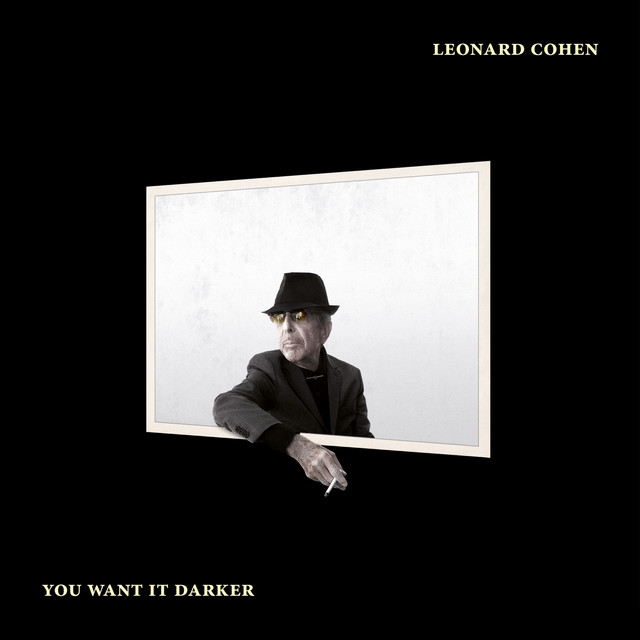
You Want It Darker by Leonard Cohen

You Want It Darker

Leonard Cohen

3.32
Rating
25084
Votes
1
9%
2
16%
3
28%
4
30%
5
17%
Distribution

Album Summary

You Want It Darker is the fourteenth studio album by Canadian singer-songwriter Leonard Cohen, released on October 21, 2016, by Columbia Records, 17 days before Cohen's death. The album was created towards the end of his life and focuses on death, God, and humor. It was released to critical acclaim. The title track was awarded a Grammy Award for Best Rock Performance in January 2018. It was Cohen's last album released during his lifetime and was followed by the posthumous album Thanks for the Dance in November 2019.

Wikipedia Read more on Wikipedia

Rating Over Time

Per Year Cumulative

Reviews

Sort by: Popular Date Random
Rating: All 5★ 4★ 3★ 2★ 1★
Length: All Short Long
Jul 01 2021 Author
5
“You Want It Darker” by Leonard Cohen (2016) If you want to hear music written, sung, and recorded by an 82-year-old Canadian Jew sitting in his living (dying) room crippled by fractures in his spine and counting the few painful moments he has left, then this album is for you. And if you don’t want to hear music like that, then shame on you and this album is for you anyway. The expression “You want it darker” is typically what a lover might say to his beloved at the outset of their lovemaking—his accommodation to her sensitivity as he presents himself to her in the darker-ness and says with his mind and body, “Here I am”. For Cohen, this image serves as a prayer to God. Cohen is dying, and God wants it darker. It’s a touching reversal of the God/man Lover/beloved metaphor, and the poet/prophet pulls it of with beauty and horror. This is going to hurt. Death is like lovemaking, and Cohen is ready. “Hineni” (Hebrew for “Here I am”), he says, in resignation to the supreme Will, and with the courage of the prophet (Isaiah 6:8), he faces, embraces the agony. If there’s to be a lullaby, it’s a “lullaby for suffering”. It doesn’t get any darker than that. Cohen wishes there was a “Treaty” between God’s love and his own (There is one [Jeremiah 31:31-14], but I’m not sure Cohen signed it—there are hopeful hints in “Seemed a Better Way”, as he advises himself, “I better lift this glass of blood”, but “not today”). At least he takes it seriously. “My ‘don’t’ was saying ‘do’”, he complains of the temptation contest, but he is quitting the game (“Leaving the Table”) anyhow. And through it all, God’s love has made it real (“If I Didn’t Have Your Love“). Cohen is setting out on the road to death, but he’s “Traveling Light”. His parting advice on his way out the door (to his heart, but more importantly, to you, in case you’re not getting it), is that you should “Steer Your Way” one year/month/day/thought at a time. The outro of the closing track reprises “Treaty” with compelling mystery: “We were broken then but now we're borderline”. So where will you (we? me?) be tomorrow? His voice has been reduced, through age and pain, to whispers punctuated by well pitched basso profondo. But he retains his famous timbre, which compellingly invites the listener to consider, to ponder, to figure it out. It beckons, and you’d better not decline. It’s not just excellent poetry—it’s poetry that grabs you and shakes you a bit. It goes beyond—all the way to the declarative prophetic focus on the past and present in the face of an unknown future. Prophets were generally and unjustly disregarded. Here is your opportunity to rectify. There are negative things to say about this album. But not by me. Leonard Cohen died three weeks after its release. 5/5
Mar 09 2021 Author
4
Are you depressed because of a global pandemic? Don't worry! Leonard Cohen latest album will help you jump off a cliff!
Jun 10 2021 Author
5
INT. Abandoned Cathedral, 5:30 A.M. A thin ray of light shines on an organist wearing black robes with a Grey stole. He appears to have been awake all night. It is apparent he is playing what appear to be the final chords in a grand symphony. I love this very much.
Jun 20 2023 Author
1
Read poetry over music. Meh.
Dec 03 2021 Author
5
I put on this album weeks after struggling to connect with Leonard Cohen’s third album, "Songs of Love and Hate." I expected a similar experience here. "You Want It Darker" grabbed me from the first notes of the choir with its incredible bass line, the lyrics and vocal performance. The song takes us into a holy space as it unfolds as a prayer. A prayer that critically interrogates the very roots of the religious traditions it references. "Treaty" is heartbreaking. Haunting lyrics, incredible arrangements and an emotional delivery perfectly capturing my disillusionment with Christianity and religion. ‘I do not care who takes this bloody hill. I’m angry and I’m tired all the time. I wish there was a treaty, I wish there was a treaty, between your love and mine.’ "On the Level” explores the emotions of letting go. 'They ought to give my heart a medal for lettin' go of you.' The piano… beautiful. The back up singers… angelic. Cohen… perfect. 'I'm old and I've had to settle on a different point of view. I was fighting with temptation but I didn't want to win, A man like me don't like to see temptation caving in.' Cohen has put words to feelings I've begun to have in a way that I could never hope to do. "Leaving the Table" digs deep into a break up: drifting apart ('I don't know the people in your picture frame'), regret/resentment ('If I ever loved you it's a cryin' shame'), resignation ('You don't need to surrender, I'm not taking aim'). Deep within the darkness "If I Didn't Have Your Love" unfolds into a startlingly beautiful love song. This album may be dark but like the rest of the album it is far from cynical. These songs flow with the undercurrents of a mature, deep love. "Traveling Light" pairs incredible mandolins and strings along with the electric piano while the lyrics tell of shedding parts of our lives as we approach its end. Cohen's exploration of religion in "It Seemed the Better Way” hit me in a deeply personal way. After spending a lifetime losing my religion this album has made me reflect on my religious journey more deeply than ever before. ‘Sounded like the truth, but it’s not the truth today. I better hold my tongue. I better take my place. Lift this glass of blood. Try to say the grace.' In "Steer Your Way" Cohen captures other aspects of my own journey as I steer away from so many of my beliefs, foundations, and trust in the world. He offers no replacement but hearing this song gives me strange comfort. 'Steer your heart past the truth that you believed in yesterday, such as fundamental goodness and the wisdom of the way.' Damn. "String Reprise/Treaty" is largely an instrumental string piece with Cohen reprising “Treaty” at the very end. After the last note faded I sat in silence for several minutes grieving Leonard Cohen's passing from this world just a few weeks after this album’s release... and rejoicing that Cohen left this incredible gift. Where last month I struggled to relate to a young Leonard Cohen, I felt an instant deep connection to him here at the end of his life. This album lead me into some very dark personal places - but Cohen's warmth and humanity never left me feeling alone. So rarely have I encountered an artifact of a life that had such a seismic effect on me. Leonard Cohen was right… I do want it darker.
Feb 22 2021 Author
5
Okay, honestly? This was absolutely gorgeous. One of the 5 star surprises of this whole listening process. I expected to be turned off, since Leonard Cohen's voice is an acquired taste in my opinion, but this was melodically so beautiful. Like, it was an EXPERIENCE.
Oct 04 2023 Author
2
With all due respect, Mr Cohen…I am a New York Giants fan in October of 2023. It could not possibly get any darker than it already is. Edit, May 2025: Fuck me, the 2024 season was even worse. Edit 2, November 2025: A glimmer of hope with Dart and Skattebo quickly dissipated by Skattebo’s injury and an absolutely abysmal defense led by DC Shane Bowen. Fire the coaching staff.
Feb 11 2021 Author
1
Useless cunt
Nov 25 2022 Author
3
Blackstar but for depressed cowboys Best: Title track, Travelling Light, Steer Your Way
Sep 30 2022 Author
5
Creamed my jeans over this
Mar 02 2021 Author
3
Interesting, but I can't see actually listening to it repeatedly
Jan 01 2022 Author
5
Holy smokes, that voice was out of nowhere. Having only been familiar with his 'Hallelujah' I was not expecting that entrance. He just strolled right in and without effort commanded attention. Entire album reads like a letter or a prayer; struggles with aging and religion; an older man haunted by his past, now staring into the void of what's next. Very sombre, melancholic, personal and thoughtful. The lyrics are absolutely littered Judeo-Christian themes and religious references, which continues into the musical structure itself with inescapable hints of gospel, choral, chanting and traditional 'Jewish' sounding melodies. I couldn't help notice the similarities with David Bowies 'Blackstar'. Both albums wholly referencing mortality; both albums released the same year, the year of their deaths. This doesn't diminish either album, they're both unique masterpieces in my opinion, just a curiosity.
May 07 2021 Author
2
I know people think the "sad old man" routine is deep, but it bores me. I don't even think I liked Johnny Cash's version of it, and I genuinely like Cash. Cohen is just like an older generation's Nick Cave - style over substance, impresses hipsters. There were moments of vague coolness but mostly this was a chore. I was bored by the second song. 2/5.
Mar 31 2025 Author
5
I’m in awe. Words cannot describe the album experience I just had. I sobbed when I finished listening. Tears literally fell from my eyes. Leonard Cohen does not miss, even at 82. Especially not at 82. I think this is actually my favorite album I have had the privilege of listening to so far on this list. What a stunning and just perspective altering work of art.
Jun 09 2021 Author
5
absolutely incredible album, really enjoyable listen and definitely lives up to it's title. Treaty is a particular highlight
Apr 05 2022 Author
2
It's like a cross-between Tom Waits and David Carradine in Kill Bill and so laid back he's basically horizontal. I understand he was in a lot of pain and near the end and that this like his spoken-word poetry but his early stuff is so much more worth listening to. I felt guilty in giving a low score so listen to it again. It does get better and maybe it's a mood thing so one night I'll play it again and get more out of it. Weirdly the attempt to jazz it up with gospel singers and organs has the opposite effect- surely it would be better more stark?
Mar 30 2023 Author
1
First track ok. The rest of it an endless boring dirge.
Jun 13 2021 Author
5
Beautiful. What an incredible voice. You Want it Darker is such a tune, love that bass line. Treaty and Reprise/ Treaty are heartbreakingly beautiful. What an album to leave the world with
Dec 10 2024 Author
3
In 2016, an in influential music legend with a career spanning 6 decades recorded a dark, brooding lament on his own mortality. He released it shortly before passing to great sorrow. Everyone was shocked. Grief poured in from all across the world, with many declaring the latest album to be one of his greatest ever and a fitting tribute to an incredible career. If I had a nickel for every time that happened, I'd have two nickels... which isn't a lot, but it's weird that it happened twice. Right?
Jul 15 2024 Author
2
I don’t want it any darker Leonard I assure you. This album sounds like the track list about a Disney movie where the villain turns out to be the good guy, his voice isn’t doing him any favors here. Im impressed he’s been making music for so long, but this is my second album of his on the list so far and you can tell the drop off in ability- tough to do the singer song writer thing when you know…can’t sing anymore.
Jul 02 2024 Author
2
This ain't it for me. He didn't even really sing, it was closer to reading poems to soft background music. The instrumentals are fine I guess, but I can't see myself relistening to a single song of this. This is a deep cut arthouse type of album.
Aug 04 2022 Author
5
i had previously listened to "i'm your man," cohen's 1988 album, as part of this project. it became one of my favorite albums, and i realized this album will become the same halfway through my first listen. cohen's lyrics are just as beautiful, thought provoking, heart wrenching as before. so many songs focus on death and come across as authentic. he wears his heart on his sleeve. you feel his pain ("i'm angry and tired all the time") and acceptance (i'm ready, my lord") as he finds himself closer to death. i was struck by how simple "traveling light" was, yet his meaning is clear ("i'm running late/they'll close the bar/i used to play/one mean guitar"). i loved each line in this lyrics, honestly. there's a thread of religion throughout the album. "make it darker" contained hymns and jewish imagery, and "treaty" was about his relationship with (and love for) his god, among others. for someone as spiritual as cohen, incorporating this into his album while nearing the end of his life must have brought him some level of comfort. his voice is deeper on this album, lending to a further emphasis on death. his tenor had always created the focus on his lyrics but more so here. there's minimal background accompaniment; while beautiful, its simplicity allows the focus to be on the lyrics. and somehow, the violins sound like they're crying. the "string reprise" section was unparalleled in its beauty. he's still with his usual folk sound, but there are some blues sounds as well. this remarkable album is meant to break you. it's dark and deep, and it can be rough. it's beautiful and truly a piece of art.
May 25 2021 Author
5
Yes. The first time I heard this album, it hit me hard. Instantly my favourite Cohen album. Exhaustion at the end of life is not something I feel, but the basic feeling of just being exhausted by everything, that I get. This has some of Cohen’s best lyrics. “I struggled with some demons; they were middle-class and tame.” 27/10 album. Favourite track: “Steer Your Way”
Jun 10 2021 Author
5
Rarely do I even give much thought to lyrics in an album, but this one earns its 5 on the lyrics alone. The beautiful sparse instrumentation and haunting voice Leonard brings are just icing on the cake.
Mar 08 2021 Author
5
Blues/lyrical with instrumental/tango. Cynical retrospective love/sex lyrics with heavy biblical themes at beg and end of album. Growl-y bass. Sounds like Hades in Hadestown. Listened to while working out, which, surprisingly, worked.
Apr 13 2021 Author
5
One of his best. It's amazing that an artist can be this strong at the end of his career. Album gives me chills.
Apr 08 2021 Author
5
That was spectacular, I bloody loved it. I only really knew Leonard Cohen's 'hits' but this album was amazing. And released just 3 months before he died.
Sep 18 2021 Author
3
Le fait que cet album soit posthume m'a mis extrêmement mal à l'aise pendant toute la durée de l'écoute. J'avais en effet la certitude que Léonard Cohen allait décéder d'un moment à l'autre. Ceci explique la frayeur que j'ai pu ressentir au long du dernier morceau lors duquel la voix de Leonard Cohen est absente des deux premières minutes. "Il est mort... Il est très probablement mort..." pensai-je tout bas. Soudain, alors que j'avais perdu tout espoir, la voix du chanteur s'éleva pour grommeler ses idioties habituelles: "I wish there was nianiania". Quel soulagement...
Jun 16 2023 Author
2
His voice is still great, but the lyrics sound like the work of a bored pensioner. Not for me
Mar 11 2025 Author
1
не
Oct 29 2021 Author
5
Is this a good Leonard Cohen entry point? I bet it is
May 11 2021 Author
5
This very much could've just gotten me interested in Leonard Cohen. I've never listened to him before, but hearing Hallelujah in many soundtracks was annoying. I really loved title track You Want It Darker, Travelling Light and Steer Your Way.
Feb 06 2021 Author
5
Said some interesting things, and didn't overstay its welcome. Liked it enough that I want to relisten to it and think it over more
Jun 25 2024 Author
3
Gravelly, like pouring whisky directly into my ears. Would say I appreciated it, rather than loved it.
Jun 22 2024 Author
3
Had his Songs of Love And Hate just recently, as my introduction to the work of Leonard Cohen. Which I was very thankful for. Sublime. This one? Yes but no. I'm not a lyrics person so I'm left with this pastiche of some Eastern European circa jazz blues soundtrack - oh, so grave! - for a deep voice. I have no desire to disrepect this, but... except for the title song and "Steer Your Way" this just isn't giving me a lot, musically.
Aug 07 2025 Author
1
Edgelord tryhard.
Jun 20 2025 Author
1
I went into this thinking I would give the artist a second chance. Sadly he still insists on being Leonard Cohen.
Aug 29 2025 Author
5
It never got dark enough for me Leonard. I think this is the 3rd or 4th Cohen album I've gotten and I like it best so far. Leonard's voice has aged well and I enjoy the lyrical content. Coming to grips with your own mortality is always sobering. When you get to a certain age and realize that at best it's already half over, it's a bit of a fuckaroo. Inevitable facts of life.
Aug 27 2025 Author
5
Made me cry and touched my heart. Loved it, wonderful and pure art!
Aug 27 2025 Author
5
familiar with and like two of Cohen's older albums, so i'm excited to listen to this! don't think i know anything from it. edit: this was awesome. cohen's voice has matured so much, and i especially loved the somber-esque mood to the storytelling he was portraying. this was a great album.
Aug 24 2025 Author
5
Yeah this was amazing.
Jun 25 2025 Author
5
This is the type of album I'm here for. This was something totally unique and different to my usual music taste. I was completely grabbed by the unique vocals and pulled in with the emotional lyrics. This will be one of my new albums to listen to late at night when my soul needs something to hold onto.
Dec 31 2024 Author
5
You Want It Darker - I’ll show you darker! I’ve never really listened to Leonard Cohen much but boy have I been missing out. The album explores all the usual themes of a man at the end of his life, reflecting on it with these dark and religious undertones and feelings that comes easy with Cohens baritone, and help solidify that grizzled old man aesthetic of the album. Motifs and themes pop back up through the album which is a nice touch and helps unify the album. The backing tracks are simple, and normally I May hold it against a lesser album but here it really helps thematically with that twilight years feel, and it’s exacerbated by the fact that Cohen died not long after this. Favorite - You Want It Darker
Sep 06 2024 Author
5
Leonard Cohen who is one of the greatest poets to ever walk on this earth who mainly started making music because releasing his text on their own wasn't lucrative came to age. His debut in '67 was released when he was 33 and when this album hit the shelfs a couple months after David Bowie passed away, he was 82. And like with Bowies final album, this also talks a lot about his own death as he also died a few days after this album released. The title track 'You Want It Darker' starts the album off with the best song already. It combines Art Pop, Jewish Music, Gothic Country and many weird and dark references to him and his religion in sometimes a Spoken Word style. The song features organs and very present keyboard bass and it all just feels dark and like he is making his own funerals requiem. It feels like Mozart all over again but instead of writing sheets full of classical music he wrote sheets full of magical and depp poetry. Yeah, the song's perfect and easily one of my all-time favourite Cohen songs. 'Treaty' goes a more Piano Blues way and feels a lot like something you'd hear on a Cohen x Tom Waits x Nick Cave collaboration and as I love all these artists, I love this song. It's very low-key but you can feel how he's not just trying to sing the words, he is adding so much emotional weight into them that the song turns out being very heavy on you. It isn't perfect, sadly, but it is incredible through and through especially the lyrics are just amazing and it mainly comes down to the instrumental side of the song that do harm it a little bit too much to be considered perfect. The Soft Rock guitar on 'On the Level' adds to the Piano Blues but I am really not a fan of how the backing vocals are used here. They don't fit at all. He should've just hummed them himself as this would've added a darker and more emotional twist. This just makes the song feel basic and uninteresing. It turns it just good and not great or incredible. Luckily, 'Leaving the Table' saves it a little by mixing his Folk style with a little bit of Country in a very slow and lonely way that turns the song into a very emotional and hard hitting song and one of the saddest songs on the album. This song literally made me cry which already makes it perfect. It's how he should've made most of the album. Just raw and emotional with a very open talk about Death. The more uplifiting sounding 'If I Didn't Have Your Love' adds a little bit of Soul into the Blues style. It isn't really that interesting when compared to other songs on the album but it's still pretty nice and the chorus is at least one big highlight. I also think that this wasn't the best choice to end the albums first half with as it is a less dark and moody track and it would've worked better at another place. The few flamenco influences on 'Traveling Light' work weirdly well with the dark themes and I am just surprised of how he came up with this idea of adding flamenco guitar into the mix. The slight Blues parts are also pretty nice in combination and the backing vocals work so well. I absolutely love how this song shapes up and plays with the music in it by adding more and more detail. The lyrics are just absolutely on point, like always and Cohen performs them with a wit that I am not used to but see it working so well. That all combines into just another perfect song. The Spoken Word aspect of 'It Seemed the Better Way' adds to the atmosphere that this song was going for. It feels nocturnal and full of mystery with the percussion that feels like out of a soundtrack for a jungle at night. The song is fantastic and just incredible even if I would've wished for a little more detail to be added because the organ and string parts aren't doing just enough for me. The Country influences return on 'Steer Your Way' which features not only a very detailed production and some of Cohens best lyrics but also a beautiful performance from him. It is genuinely a wonderful song in every detail that you could imagine and a real highlight from the album. 'String Reprise / Treaty' ends the album with mainly just strings at the start. They go on in a way that feels like someone's passed away (or is going to hehehe). This feels like it was a melody played on the Titanic as it sunk. After a while it goes back to 'Treaty' from the start with similar lyrics but performed pretty differently on top of the strings. It is the best possible way Cohen could've ended this album and his career. It is a great song even if I would've wished for the strings to go on for a little shorter. favourites: You Want It Darker, Leaving the Table, Steer Your Way, Traveling Light, Treaty least favourites: On the Level, If I Didn't Have Your Love Rating: light 9 https://rateyourmusic.com/~Emil_ph for more ratings, reviews and takes
Jul 09 2024 Author
5
The less said the better about a man who has said so much. I would rather let him do the talking. The quiet power of the album is undeniable. While I wouldn't call this album joyous - there is plenty of light amidst the shadows. The production is minimal but sublime - matching the tone of the music. Single violins and subtle choirs add beauty. It's only with the final reprise that the true sadness comes and you feel the full weight of a life fading.
Jun 23 2024 Author
5
I love Leonard Cohen, but this is my first time listening to this album. Beautiful and heartbreaking, especially with the knowledge that he died so soon after. R.I.P. to an absolute legend.
Feb 12 2024 Author
5
Wow. Cohen's voice is haunting. This gives me chills. What a beautiful way to deal with pain and say good bye to the world.
Apr 13 2022 Author
5
The title track is on one of my favorite playlists I made and to which I listen with some frequency. What incredible texture and flow. And the rest of the album is a work of poetic beauty and intrigue. I love it.
Mar 12 2022 Author
5
An album that stops you in your tracks, the penultimate album from Leonard Cohen is the sound of an artist bidding farewell but driven to continue making music and art and is a privilege to listen to. The wisdom, the insight, the emotion all strike you to the core. Not a note is wasted. The music is perfectly pitched to support the breathy, quiet vocal. A heroic effort and one for the ages. (An alternative take from my daughter: ‘Kind of sounds like Lego Batman’)
Feb 25 2022 Author
5
Gonna get 5 stars. Leonard Cohen is brilliant
Feb 11 2022 Author
5
Excellent!
Feb 09 2022 Author
5
Loved this one. I was supposed to be working while I had this on but his voice kept making me stop and actually *listen* to the songs. The Wikipedia article was an interesting read too -- I ended up going to the Wikipedia page about Leonard Cohen as well and learned that my album for today has a link to my album from yesterday: a song on Nirvana's "In Utero" album references Leonard Cohen. 10/10 to the music, 3/10 to my own productivity.
Feb 07 2022 Author
5
A lot better than I was expecting
Feb 03 2022 Author
5
Only Leonard (and Bob) could make an album so current without referencing modern events in the slightest. Draws upon archetypes and metaphor to perfectly critique the human condition and the role of society. Cohen's last album and maybe his best.
Jan 30 2022 Author
5
Excellent, loved the gravelly voice, You Want it Darker was my favorite song
Jan 30 2022 Author
5
Masterpiece. This is the perfect album to test out a brand new pair of speakers.
Jan 26 2022 Author
5
Oh that was superb. First listen just floored me. An easy 5/5.
Jan 06 2022 Author
5
Beautiful final album from a beautiful poet.
Oct 29 2021 Author
5
Holy hell. The power in this album, just in the first song, is haunting.
Oct 21 2021 Author
5
That voice. THAT VOICE. Fave track - The title track is absolutely badass. "Traveling Light" takes second place...
Sep 01 2021 Author
5
- first Cohen I've heard and blown away - strong cohesive direction but doesn't overstay it's theme - variety but also very powerful.
Aug 20 2021 Author
5
It's interesting hearing this compared to Songs of Leonard Cohen. His voice is like whiskey over gravel here in the best of ways. The production is so much more elaborate and fantastic too. Love the lyrical themes of struggling with religion and aging.
Aug 17 2021 Author
5
This absolutely blew me away. What took me so long?!
Aug 02 2021 Author
5
THIS IS THE LEONARD COHEN I WAS LOOKING FOR! Incredible. This guy is f***in' cool!
May 20 2021 Author
5
This is Leonard Cohen at his gravelliest. The sense of pathos in every song bears the weight of a long, full life.
Mar 16 2021 Author
5
An incredible listen. Really bowled over by it from start to finish. Fully felt the weight of a man facing the end. Superb.
Feb 07 2021 Author
5
Quality album written by a dude who knew he was dying. Sad and awesome at the same time.
Feb 06 2021 Author
5
good! Great songwriting and really intense themes. it’s an interesting listening experience bc everything is so overt and lyric focused without being too in your face or being at the expense of the music. 4.5 very good and I’ll probably listen again but nothing really floored me
May 03 2021 Author
5
One of the greatest poet/lyricists of all time.
Apr 23 2021 Author
5
This album warranted you kit-out your headphones to maximum bass, for his vocals alone. Very much enjoyed to slow sultry tones of a man on the way out
Apr 08 2021 Author
5
What a voice, what great lyrics. The last strings track was beautiful
Feb 20 2021 Author
5
He saves his best fo last, great album. Montreal's greatest export!!
Nov 10 2025 Author
4
Wow, darker it is. This is the sound of a man close to the end of his life, and he knows it. Clearly, he was in a lot of pain, but there is joy and quiet celebration here too. The production is understated and sympathetic (not universal amongst Cohen's albums, so very welcome here). I hear a lot of metaphors about war and conflict in here, but often with a quiet resolution through diplomacy, treaty, spycraft and quiet agency. It is impossible to separate this from the circumstances of its recording and release, 17 days before his death, putting it with Warren Zevon's The Wind, Bowie's Black Star, and Johnny Cash's final albums in a small group of albums that face imminent mortality with acceptance and grace.
May 17 2025 Author
4
Who wants what darker?
Dec 31 2024 Author
4
An excellent album, made more poignant by the fact that it was his last album released before he died (prehumously?) Leonard Cohen has always struck me as an unhappy dude, trying to find peace in religion or a near religious fervor of love & coitus, and ultimately stuggling with how both are deeply human. What I love in 'You Want it Darker" is how the love of his muse, his troubled mentor (whom he later describes as a 'filthy beggar, guessing), and the capital G God are intertwined almost inseparably. The OG Tortured poet. Fav: Treaty, for the verse "I heard the snake was baffled by his sin... The poison enters everything". I fear I still don't quite get the titular track, You Want It Darker, which I am assuming is on me considering it is the most well known of the album.
Dec 16 2024 Author
4
Eerie, gorgeous background strings and soft vocals. Cohen dramatically speak-sings the majority of this album and that approach lends itself perfectly to the album's title. I didn't realize it but I DO want it darker, at least for this listening experience. I want to curl into a fleece-ensconced ball and listen to this again on decent headphones.
Sep 23 2024 Author
4
Was listening to this album on the elliptical when some asshole drove his car through my front door and started seducing my wife. All I really know of Cohen is Hallelujah, that he was with Joni Mitchell for a bit, and that he influenced a ton of today’s songwriters - Isakov and the National for sure. The title track is incredible - will definitely be coming back to it. Overall, this is more poetry set over music. I went back and listened to a bit of Cohen’s old stuff and this album does seem to have more musical structure and movement than some of this earlier tracks. Not that one can compare, but thought this album was much more memorable than Bowie’s later-life albums. Kind of the perfect album for a foggy September weekend in San Francisco.
Jun 26 2024 Author
4
Truly a breathtaking record. In the final days or his life Leonard put together this collection of beautiful songs bursting with tragedy and accepting of the fate of death. This album really is a masterpiece in complementing instrumentals with lyrics/vocals, as both are stunning. 8/10
Mar 13 2025 Author
3
It’s poetry disguised as song. The spoken word smoking guy over laments has never been my favorite genre and this didn’t do much to change that opinion. The lyrics are good at least; Cohen has always been a better writer than performer. It’s fine. I’m sure it’s miraculous to some people but not me.
Jul 15 2024 Author
3
Alright I must admit I was blown away on the first song, his voice is so aged and sinister. I do think that effect overstays it’s welcome. But I appreciate an album from someone who isn’t in the prime years of their life, even if there should be many albums from the mid-2010’s on this list instead
Apr 25 2026 Author
2
Leonard Cohen doing a Louis Armstrong impression - sweet. Joking aside, the voice is super distracting from otherwise beautiful songs. Someone get this chap a lozenge
Jan 13 2026 Author
2
It was a vibe but I got really tired of it after a few songs
Aug 14 2025 Author
2
The authors of this list stan hard for Cohen. He's a great poet and writes some captivating songs, but a performer he is not. I always feel his music is best left in the hands of more capable artists, like Jeff Buckley and Rufus Wainwright (Hallelujah), Nick Cave (I'm Your Man), Beck (Master Song), Glen Hansard (Who By Fire), just to name a few. This album is no different. It's full of well written poems with great arrangements and tiresome spoken word vocals that will lull you to sleep. A depressing album through and through.
Apr 11 2025 Author
2
Not sure what I was listening to.
Mar 15 2025 Author
2
Oh great, another entry in the “old man sing-talks poetry about life and God immediately before dying” category. I can appreciate the artistry (and definitely prefer his earlier work), but don’t think a second listen is ever likely… 2⭐️
Mar 15 2025 Author
2
I couldn't find anything good going for it, it was a snoozefest from start to finish.
Mar 11 2025 Author
2
Enough with the Leonard Cohen. It’s just not worthy of multiple albums on this list. Much less 3 or 4
Jun 24 2025 Author
1
Pre-listening thoughts: oh… Post/during listening thoughts: yeah this was exactly what I expected. If you thought Leonard Cohen was already incoherently mumbling over his songs in the 60s, oh boy, you got a storm coming. I actually vehemently dislike this album. I think Leonard Cohen is the most overrated singer (if you can call him that) ever. Maybe on par with Lou Reed. There’s a spectrum of men that don’t really sing and it runs from Bob Dylan to Tom Waits, and this album certainly falls more on the Tom Waits end. It was like going to a poetry slam but some old ass man with dementia didn’t have anything prepared so he just started mumbling into the mic. But pair that with instrumentals that are so nice it makes you even more upset when he starts “singing”. Fuck this album 1/10 DID I NEED TO HEAR THIS BEFORE I DIE: NO Fav tracks: n/a Least fav tracks: any where he opens his mouth
Jun 11 2025 Author
1
The most boring voice ever. Hated it, except for the first track
Jun 06 2025 Author
1
Well... if I'm being absolutely honest... I hated this. While I AM thankful that it took little more than half an hour of my life, even THAT seemed too long for what this is. Maybe if it were consolidated into a single track (which, considering its monotony, it essentially is), and then shortened to a reasonable length, I could appreciate it as an artistic statement. But the novelization of what should have been no more than a sonnet really drags the experience out and down.
Feb 13 2022 Author
1
Overrated. For people who like poems more than they like music. Can't sing at all - there comes a point at which not being able to carry a tune is an actual problem when it comes to calling yourself a musician. I like the title tune kinda sorta - thanks to the actual singers in the background. Basically, I don't want to listen to Grandpa croak at me.
Mar 09 2021 Author
1
Leonard Cohen is always fake and gay
Apr 25 2026 Author
5
It was a bit weak at first but I ended up really liking it. I am glad I listened to this, I've been wanting to listen to some Leonard Cohen for awhile. Although considering his buddist and jewish ties I am kinda surprised at all the allusions to chirstianity, especially since he never converted to christianity as far as I'm aware.
Apr 23 2026 Author
5
I fear I have to give this 5 stars. Haunting. Everything that a songwriter should be.
Apr 23 2026 Author
5
This was so dark and so fucking cool. I had his other album a couple of weeks ago and wasn’t all that impressed. This is the reason I started 1001 albums. Getting ready to order the white version on vinyl I liked this so much.
Apr 21 2026 Author
5
This was amazing. Like the most beautiful parts of Tom waits songs, both pretty and harsh at the same time. Really moving lyrics, very easy to like songs with really sparse but warm instrumentation. This will be something I listen to again for a long time
Apr 19 2026 Author
5
magnificently dark and poetic
Apr 18 2026 Author
5
4.5 (5) Haunting. Has anyone else in their 80’s recorded ever something this significant? (36:09, 9 tracks, 14th album, 2016), Folk / Singer-Songwriter. The ledger is closed. There is no better way to end a career—or a life—than this. Leonard Cohen didn’t just write an album; he finalized his estate, reconciled his debts with the Divine, and checked out on his own terms. You Want It Darker is not "folk"; it is the sound of a man looking at the abyss and deciding it’s time to stop fighting the gravity. Leonard dies three weeks after this album was released. So on first listen a “3”; 6 listens later a “4”, 6 more “5”. I’m not sure I’ve ever listened more times than this soundtrack (except albums I owned previously.) I hiked in 33 degree “feels like” (actual 50 degrees Fahrenheit for three+ hours – shirtless.) This album spoke to that. Controlled survival on the trail—cold, exposed, focused, and steady. Cohen, as a "low-frequency hum" a calm, stoic mind. The "Zen" of Mortality: he "owns" the end of his life. That isn't depressing; it is radical acceptance. When you are hiking shirtless at 33° (feels like) in Northeast Kane County IL, you are consciously choosing to embrace the "darkness" (the cold, the physical struggle) rather than running from it. The music isn't "dark"—it’s honest. Released October 21, 2016, just 17 days before Cohen’s death, the album is widely recognized as a funeral shroud draped in sound. At 82, Cohen was suffering from severe mobility issues—fractures in his spine and other complications—that essentially confined him to his home in Mid-Wilshire, Los Angeles. He wasn't touring; he was narrowing his world to a single room. The thematic arc is singular: death, God, and the humor inherent in being human. It is not a lament; it is a final, cold-eyed assessment of a life lived in service to beauty and brokenness. The recording process was born of necessity and intimacy. Because Cohen could not travel to a studio, the studio came to him—or rather, the files did. His son, Adam Cohen, produced the record, and the living room became the booth. Using a modified medical chair, Cohen recorded vocals that sound less like singing and more like a confession whispered into a microphone at 3:00 AM. He sent the tracks digitally to collaborators. The minimal, haunting arrangements—including the presence of the Shaar Hashomayim Choir from his childhood synagogue—were added remotely. It is perhaps the most "digitally connected" recording of his career, despite being the work of a man completely isolated by his physical decay. To understand Leonard Cohen is to understand a man who spent his entire life trying to reconcile the sacred with the profane. He was not a rock star; he was a monk who happened to be seduced by the melody. Here is the ledger on a man who refused to be categorized. The Young Man: The Poet of Westmount Born in 1934 in the wealthy, English-speaking enclave of Westmount, Quebec, young Leonard was not the tortured soul you might imagine. He was a middle-class kid from a respectable Jewish family. His father died when Leonard was nine, an event that etched a permanent sense of transience into his psyche. He wasn't an aspiring "singer." He was a poet. Before he ever strummed a guitar on a stage, he was publishing books of poetry and a novel, Beautiful Losers (1966). In his twenties, he sought refuge on the Greek island of Hydra. This was the "young man": a restless intellectual, living in a sun-drenched exile, trying to convince himself that he could make a living solely through the pen. He was struggling—financially desperate, artistically singular—before he realized that poetry without a melody reached only a few people. He moved to New York in his thirties, a geriatric age to launch a music career in the sixties, and began the work of turning his poems into song. Who He Was: The "Thinking Man’s" Mystic Cohen was a man of radical contradictions. He was a devoutly trained Jew who spent years living as an ordained Zen monk at the Mt. Baldy Zen Center. He was a notorious womanizer who wrote with the tenderness of a devotional saint. He was essentially an archivist of human failure. While his peers in the 60s were writing about revolution, peace, and flower power, Cohen was writing about his own bedroom, his own depression, and his own moral compromises. He didn't offer a vision of a better world; he offered an honest assessment of the broken one we actually live in. He was "important" not because he was a technical virtuoso, but because of his linguistic economy. • Precision: He would spend years—sometimes decades—perfecting a single verse. He did not write "songs"; he wrote scripture. • Vulnerability: He popularized the idea that being miserable was not a pathology, but a requirement for true emotional depth. • The Voice: He didn't have a singer's range; he had a bass-baritone that sounded like it had been dragged through gravel and fine wine. It communicated authority. When Cohen spoke, you listened, because it sounded like he had checked his facts with the Devil himself. Why He Remains Essential Most songwriters are products of their time. They are tied to the fashion of their decade. Cohen is timeless because he bypassed the "fashion" entirely. • The Secular Hymn: He wrote songs like "Hallelujah" that bridge the gap between a broken love affair and religious transcendence. He understood that love is not a gentle thing; it is a war. • The Anti-Hero: He was the patron saint of the "Thinking Man." He gave permission to his listeners to be weak, to be horny, to be confused, and to be cynical, all while maintaining a rigid, almost terrifying level of dignity. • The Long Game: He proved that a career isn't a sprint. He was writing some of his best material in his 70s and 80s, long after the industry had stopped expecting anything from him. He was a man who looked at the mirror and didn't blink. That is a rare commodity in art, and that is why his records still occupy shelf space in the collections of serious people. Track 1: You Want It Darker The Lyrics: If you are the dealer, I'm out of the game If you are the healer, it means I'm broken and lame If thine is the glory then mine must be the shame You want it darker We kill the flame Magnified, sanctified, be thy holy name Vilified, crucified, in the human frame A million candles burning for the help that never came You want it darker Hineni, hineni I'm ready, my lord The Meaning: This is the final "Hineni"—the Hebrew for "Here I am," the response of Abraham to God’s call. Cohen is not pleading; he is surrendering. He acknowledges the absurdity of the deal: the "dealer" holds all the cards, and the "healer" only has work to do because the subject is broken. It is a bleak rejection of the romanticized afterlife. He’s tired of the candles, tired of the hope, and finally, he’s ready to step into the dark. The title track from Leonard Cohen’s final album, released just weeks before his death in 2016. The song is widely viewed as a confrontational dialogue with God, where Cohen grapples with human suffering, organized religion, and his own impending mortality. "You want it darker, we kill the flame": This central refrain suggests a bleak relationship between the divine and humanity. One common reading is that if God—as the creator of a world full of suffering—wants more "darkness," humanity is all too willing to "kill the flame" of life and hope through war and violence. "Hineni, hineni / I'm ready, my Lord": "Hineni" is Hebrew for "Here I am". In the Torah, this is Abraham’s response to God when asked to sacrifice his son, Isaac. By using this phrase, Cohen signals a posture of total surrender and spiritual readiness as he faces his final days. "If you are the dealer, I'm out of the game": Cohen uses gambling metaphors to describe the power imbalance between God and man. If God "deals" a life of suffering and death, the only choice left for the human "player" is to eventually leave the game. "Magnified, sanctified, be thy holy name": These are English translations of the opening lines of the Kaddish, the Jewish prayer for the dead. Cohen juxtaposes this sacred praise with "Vilified, crucified in the human frame," highlighting the contrast between divine glory and the brutal reality of human existence. The song explores the "God Paradox"—how a supposedly loving deity can allow immense historical atrocities, such as the Holocaust (alluded to by "a million candles burning for the help that never came"). Acceptance of Death: Unlike the defiant tone of some of his earlier work, this song reflects a somber, authentic peace with the end. Critique of Religion: Some lines target how organized religion is often used to justify "murder and to maim Track 2: Treaty This is my favorite track on the album, I miss you ******* “I've seen your pills, I've seen your drinks I've seen your books, I've seen your sinks I've seen your wives, I've seen your lies I've seen your children, I've seen your eyes I'm only one, I'm only one I'm only one, I'm only one. I wish there was a treaty we could sign I wish there was a treaty, between your love and mine” The negotiation phase. Cohen is auditing the relationships he’s had—the "wives," the "lies," the "sinks." He’s looking for a ceasefire between the human ego and the divine. He realizes that he is fundamentally alone ("I'm only one"), and the treaty he seeks isn't a peace treaty for the world, but a release from the cycle of longing and resentment he’s maintained for eighty years. In Leonard Cohen's work—specifically the song "Treaty" from his final album—the term refers to a desired peace agreement or reconciliation between two mismatched "loves" or "wills". The song explores several layers of this "treaty": The primary metaphor frames a failing relationship as a war zone where both sides are exhausted. Cohen describes the lovers as "rival nations" with different laws of reality. A weary desire to end the fighting, regardless of who "wins" ("I do not care who takes this bloody hill"). He apologizes for the "ghost" he made his partner become, suggesting he never fully saw her as a real person. Given the album's spiritual focus, many interpret the treaty as an attempt to reconcile with God. Cohen seeks a "treaty" between his own will and the divine will, which often feels distant or incomprehensible. The lyrics reference the Jubilee (a year of debt forgiveness and freedom in ancient Judaism) and the Covenant between God and Israel. Ultimately, the song suggests this treaty is impossible to sign while alive; the "loves" are too different to ever fully meet. As Cohen was nearing the end of his life, "Treaty" is also seen as a quiet negotiation with his own mortality. The lines about the snake shedding its skin to "find the snake within" symbolize a brutal, skinless rebirth or the stripping away of the self as one approaches death. The song captures a sense of total fatigue, where the struggle for meaning is replaced by a simple wish for the "fighting" (the suffering of life) to finally stop. Goodbye *******, I wish there was more I could say. Track 3: On the Level- A sly, almost cheeky reflection on temptation. Cohen admits he wasn't always the saint people projected onto him. He didn't want to win the battles with his own desires; he just wanted to be "on the level"—to be honest about his corruption. It’s a classic Cohen pivot: admitting he was a cad while sounding like a priest. "On the Level" refers to a state of brutal honesty and spiritual surrender near the end of life. While the phrase usually means being fair or truthful, Cohen uses it to describe reaching a level plane where he can no longer be tempted or deceived. The song is about outliving the "fire" of youth and sexual desire. Cohen suggests that because he is old and facing death, he is finally "on the level"—no longer tilted or swayed by the intensity of passion. Key Lyric: "I’m old and I’m lookin' at you / And I’m on the level" He can finally look at a past lover or the world without the "fever" that used to cloud his judgment. Cohen plays with the idea that to be "on the level" with God or the universe, he had to give up his own will. He mentions "turning his back on the devil" and "turning his back on the angel," suggesting he is moving beyond the dualities of good and evil into a state of pure, flat reality. Cohen admits he "lived his life in moments" but now must face the "whole thing" as he prepares for what comes next. The "Level" is a significant symbol in Freemasonry, representing equality and the idea that we are all traveling on the "level of time" toward the same end. For Cohen, it represents: Equality in Death: No matter how famous or "low" he was, everyone ends up on the same level ground. Spiritual Maturity: He is no longer "falling" or "climbing"; he has arrived at a place of stillness. Like much of the You Want It Darker album, this song feels like a final report to a higher power. Being "on the level" means he is presenting his life exactly as it was—no excuses, no metaphors, just the plain truth before the end. Track 4: Leaving the Table The Meaning: The gambling metaphor is exhausted. He’s not waiting for a better hand anymore. He acknowledges he’s "not needing" the things that once fueled his life: the women, the wine, the applause. He’s detached. He’s "leaving the table" not because he won, but because the game is finished. Perhaps the most direct song on the album about voluntary withdrawal from life. While other songs wrestle with God or old flames, this one is a weary, graceful admission that he is finished with the "game" of existence. The "table" is a metaphor for the world’s offerings—romance, fame, pleasure, and struggle. To "leave the table" means he no longer has an appetite for these things. "I don't need a lover, no, no, the wretched beast is tame": He is declaring that the physical and emotional cravings (the "beast") that drove his life and poetry for decades have finally died down. "I'm leaving the table, I'm out of the game": He is no longer competing for relevance or affection. He is checking out of the human "casino." The song captures the specific exhaustion of a man who knows his body is failing. "I’m slowing down the pace": This is a literal reference to his declining health. He is no longer rushing toward anything; he is settling into the stillness of his final days. "I don't need a witness": Unlike his earlier years where he bared his soul for an audience, he now seeks a private, quiet exit. He doesn't need the world to validate his departure. There is a unique civility to the song. Leaving a table is a social gesture; it’s what you do at the end of a meal when you are full. Cohen isn't raging against the dying of the light; he is simply stating that he has had enough. Just as in the title track ("If you are the dealer, I'm out of the game"), he acknowledges that life is a gamble he is no longer interested in playing. While "On the Level" is about being honest about his state, "Leaving the Table" is about the action of departing. He has reached the level ground, and now he is simply walking away from the party. Track 5: If I Didn’t Have Your Love The Meaning: This track could be read as a love song to a woman, or to God, or to the very concept of love itself. It’s the "What if?" track. If he hadn't had the capacity to feel—to be hurt, to be wrecked—would the world have been "too thin" to endure? He’s affirming that his suffering was the price of admission for living. A meditation on the foundational power of love as the force that sustains reality itself. The central message is that without love, the world doesn't just become sad—it becomes unreal. Cohen suggests that love is the "proof" or condition that allows the universe to exist in a meaningful way. Cosmic Desolation: Cohen uses apocalyptic imagery—a sun without light, stars "unpinned" from the sky, and seas turned to sand—to describe the state of a life without his beloved. These metaphors reflect an internal "psychological end-time" where the speaker’s senses would effectively shut down.A "Celestial" Devotion: The song's arrangement, featuring an organ and the Montreal Synagogue Choir, blurs the lines between romantic and religious devotion. The lyrics "lift the veil and see your face" evoke a sense of revelation, implying the beloved provides access to a hidden, divine dimension of life. Gratitude Amidst Mortality: Recorded while Cohen was in significant physical pain near the end of his life, the song is viewed as a statement of limitless gratitude toward those closest to him, likely his family and lifelong friends. "Stars... all unpinned" A universe emptied of its basic laws and structure. "Nothing left that you could feel" A state of emotional anesthesia or total numbness. "No one that you hurt could ever heal" A world without the possibility of mercy, repair, or forgiveness. The song ultimately suggests that reality is relational; it is something confirmed and made "real" through the presence and witness of another person’s love. Track 6: Traveling Light The Meaning: He’s discarding the baggage. This is the moment of transition. He’s not the man he was in the 60s or 70s. He acknowledges his "nightmare" is ending. He’s leaving the "old ways" behind. It’s a rhythmic, almost defiant acceptance of becoming a ghost. Ir serves as a companion to "If I Didn’t Have Your Love." While the previous song explores the presence of love, this track is about the final release of all earthly burdens and attachments as one nears the end of life. The repeated use of "au revoir" indicates a practiced, almost ritualistic goodbye. Cohen is checking out of the "bar" of life, acknowledging that he is "running late". The song marks the end of his public and personal personas—the "one mean guitar" he used to play is now a thing of the past. He is shedding the identity built around "the me and you," moving toward a purely solitary state. The "Fallen Star": This metaphor refers to a beloved or a muse (often thought to be Marianne Ihlen) who was once a guiding light but has now "fallen," signaling that the time for romantic or physical attachment has passed. For Cohen, traveling light means letting go of "desires, passion, and anger". It is a state of peace found by unpinning oneself from the world's emotional and physical demands. The track features a Greek bouzouki, a nod to the island of Hydra where Cohen lived with Marianne in the 1960s. This musical choice brings his life full circle, connecting his final "traveling" to the place where his journey as a world-renowned poet and singer truly began. Once more, I’m traveling light *******. The music video for "Traveling Light," released posthumously in February 2017, was directed by Sammy Slabbinck with the "excellent guidance" of Cohen's son, Adam Cohen. It serves as a memorial retrospective, blending archival footage with previously unreleased personal moments. The video opens with a poignant scene of Cohen sitting on his Los Angeles balcony, smoking a cigarette. He delivers a line that defines the video's tone of "sly, funny" acceptance: "I feel a lot stronger, but I'm actually a lot weaker". The visual is a "meticulous montage" that splices together footage from various eras—ranging from his stoic performances in the 1990s to his "exalted" world tours from 2008–2015. This serves to collapse time, showing the "iconic Cohen" at different stages of his spiritual and artistic journey. The balcony footage used in the opening is the same shot featured on the album cover of You Want It Darker. While the album cover was framed in black, the video shows the original version: sun-drenched, with cars and plants in the background, grounding the "final farewell" in a very human, everyday reality. Director Sammy Slabbinck, known for his work as a collage artist, used overlapping imagery to align with the "melancholy poetry" of the track. This technique visually mirrors the song's theme of "unburdening" and "shedding layers". The video does not just signal an ending; it portrays a conscious choice of acceptance. By mixing recent footage of an aged Cohen with archival shots of his younger self, the video illustrates his "peace reach[ed] first of all with himself" as he prepares for a "perpetually unknown" road. Track 7: It Seemed the Better Way A retrospective on ideology and pathfinding. "It sounded like the truth, but it's not the truth today." He’s looking at the politics, the religion, the moral frameworks he once navigated. They were all just provisional truths. He’s "lifting his glass of blood," accepting that all his choices were just "better ways" to get through the night, not absolute answers. A somber reflection on the fading of spiritual certainty and the obsolescence of once-comforting religious teachings. The central refrain—"Sounded like the truth / Seemed the better way / But it's not the truth today"—suggests that certain moral or religious principles, while persuasive in the past, no longer hold up against the harsh "rigors of real life" or the speaker's own late-life experiences. Cohen explicitly references the Christian ideal of non-resistance with the line, "Now it’s much too late to turn the other cheek". Analysts suggest this indicates a shift from youthful idealism to a hardened reality where mercy feels like an unavailable luxury or even a form of complicity. The lyrics describe a speaker who was moved emotionally—first by talk of "love" and then "death"—before being bound morally. Cohen wonders if he was truly following a divine truth or simply moved by the "rhetoric" and "plausibility" of a convincing sermon. By the final stanza, the speaker adopts a position of silent submission: "I better hold my tongue / I better take my place". This implies a loss of faith that nonetheless ends in ritual—the "glass of blood" and "saying the grace"—serving as a ceremonial closure to a spiritual journey. Like the title track, this song features the Shaar Hashomayim Synagogue Choir. Their presence provides a haunting, institutional weight to Cohen's personal doubts, contrasting his individual disillusionment with the eternal sound of communal prayer. Some interpretations link the song to Cohen's relationship with his Zen master, Roshi, suggesting the "him" in the lyrics might refer to a specific spiritual teacher whose guidance eventually felt insufficient or compromised. The track is often viewed as one of Cohen's most bleak and honest assessments of faith, portraying a world where spiritual "comforts of the past" are no longer accessible. Track 8: Steer Your Way A command to the listener. If you’re going to be here, in this world, this is how you do it. "Steer your way through the pain that is sure to come." It’s an instruction manual for the bereaved. He knows he’s going, but he’s leaving the map behind for those of us still stuck in the wreckage. A "survival ethic" for navigating a world where sacred truths have crumbled and been replaced by consumerism and pain. It serves as an instruction to live by constant "steering" rather than settling for easy, pre-packaged beliefs. Cohen urges the listener to "steer your way" through the "ruins of the Altar and the Mall," placing traditional spirituality and modern materialism side-by-side as damaged structures that no longer offer true guidance. The song demands a painful shedding of self-comforting narratives. Cohen explicitly mentions steering past "Fundamental Goodness" and the "Wisdom of the Way," suggesting these ideals may be naive or "stale" in the face of life's harsh realities. Cohen identifies pain as something "far more real than you," an ultimate force that "smashed the cosmic model". He admits that this level of suffering makes traditional theology almost irrelevant, whether "there be a God or not". The lyric "As he died to make men holy, let us die to make things cheap" is a biting subversion of "The Battle Hymn of the Republic". It critiques a culture that has traded the sacred concept of sacrifice for the pursuit of cheap labor and consumer goods. The repetition of "Year by year, month by month, day by day, thought by thought" frames integrity not as a single grand act, but as a constant, granular process of moral correction. Many see it as Cohen's "final mic drop" regarding the failure of organized religion and human nature. The mention of the "Mea Culpa which you probably forgot" serves as a reminder that we are all responsible for the state of the world, even if we choose to ignore our complicity. The final stanza's reference to "the one who was never equal to the task" and "knows he will be shot" is often interpreted as Cohen's humble acceptance of his own inadequacy and mortality, choosing to stand with those who are judged rather than those who judge. Track 9: String Reprise / Treaty There are no lyrics here—just the music, a sweeping, cinematic instrumental that reprises the melody of the second track. It’s the closing credits. The argument is over. The ink is dry on the treaty. The silence at the end is the only appropriate response. All lyrics are written by Leonard Cohen. 1. "You Want It Darker" 4:44 2. "Treaty" 4:02 3. "On the Level" 3:27 4. "Leaving the Table" 3:47 5. "If I Didn't Have Your Love" 3:35 6. "Traveling Light" 4:22 7. "It Seemed the Better Way" 4:21 8. "Steer Your Way" 4:23 9. "String Reprise / Treaty" 3:26 Total length: 36:09
Apr 17 2026 Author
5
Ok.. THIS is much better Cohen than our first round with him in this list.
Apr 16 2026 Author
5
def check out more