Album Summary
The Gilded Palace of Sin is the first album by the country rock group the Flying Burrito Brothers, released on February 6, 1969. It continued Gram Parsons' and Chris Hillman's work in modern country music, fusing traditional sources like folk and country with other forms of popular music like gospel, soul, and psychedelic rock. Although it was not a commercial success, peaking at #164 on the Billboard 200, The Gilded Palace of Sin has been widely regarded as an important album in 1970s rock. It was included in Robert Christgau's "Basic Record Library" of 1950s and 1960s recordings, published in Christgau's Record Guide: Rock Albums of the Seventies (1981). It is also listed at number 192 in Rolling Stone magazine's 500 Greatest Albums of All Time in the 2012 edition and number 462 in the 2020 edition.
 Read more on Wikipedia
Keywords from Reviews
Rating Over Time
Reviews
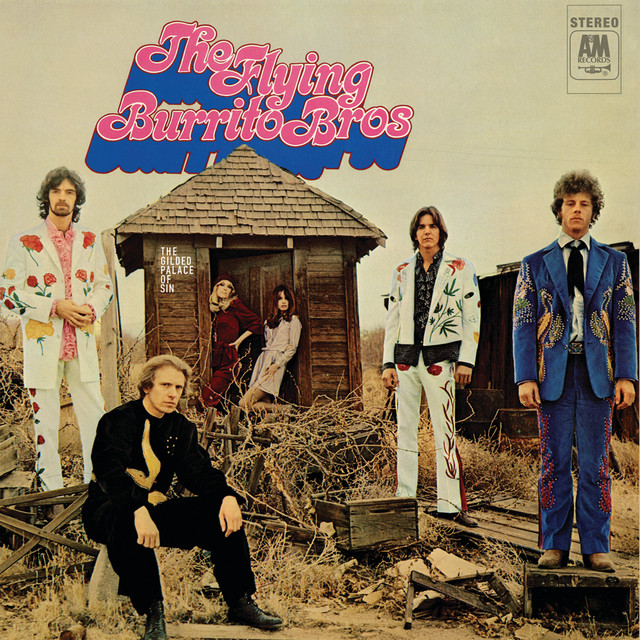
Gram Parsons’ Nudie suit may be the perfect visual explanation of _The Gilded Palace of Sin_. At first glance it is exactly the right garment: immaculate Western tailoring, recognisably part of the country tradition, correct in cut and construction. Then you notice the marijuana leaves, pills and naked women embroidered into it. Superficially the clothes are right. They are also very wrong. That contradiction runs through the album. What Parsons and the Flying Burrito Brothers seem to be doing is not escaping country music, nor simply adding rock instrumentation to it, but testing how much country can contain. The forms are often remarkably traditional: close harmony, pedal steel, waltzes, heartbreak songs, spoken morality tales, hymnal cadences. What gets placed inside those forms belongs to a much murkier late-60s world of draft resistance, drugs, sexual ambiguity, motorcycles, damaged relationships, psychedelia and Californian counterculture. The sentiments are rock. The treatment is country. I did not understand that immediately. “Christine’s Tune” initially sounded almost like a slightly lower-key Buck Owens record: economical, tidy, recognisably country. Then Sneaky Pete Kleinow’s fuzzed pedal steel appeared and seemed to belong to another song entirely. It was not simply an unusual solo or a rock effect pasted over a country arrangement. For a few seconds it changed the perceptual conditions of the record. The song carried on behaving normally, but the room around it altered. My first thought was that somebody had slipped the session some mescaline. That fuzzed steel keeps returning, particularly effectively on “Wheels”, where it becomes almost spooky. I started thinking of it as a clockmelter. The pedal steel already has the ability to bend pitch and suspend notes in a way few instruments can; put it through fuzz and suddenly it seems capable of softening the edges of time itself. The song does not become psychedelic in any conventional stylistic sense. It simply starts hallucinating. That distinction matters. Psychedelia here is not a checklist of Mellotron, backwards tape and studio trickery. It is a change in perception. Familiar objects begin behaving strangely. The same slightly displaced quality appears elsewhere without fuzz. On “Sin City” the vocals sit strangely forward while everything around them seems drenched in space. The singers are close enough to touch while the room behind them feels enormous. The keys also sound faintly wrong for orthodox Nashville, woozy enough that I found myself unexpectedly thinking of Father John Misty’s _I Love You, Honeybear_: familiar American forms rendered just theatrical and unstable enough to become uncanny. Gradually I realised that this feeling of displacement was not incidental. Traditional country meets taintedness. The forms may be clean, but the world inhabiting them is not. “My Uncle” makes the cultural collision particularly explicit. It is a fantastic, economical little country song about avoiding the draft. Nothing in the musical grammar sounds especially rebellious. The rebellion is in what the grammar has been asked to say. Again, it is the Nudie suit: absolutely correct construction, entirely incorrect message. That appears to be central to Parsons’ idea of Cosmic American Music. Before hearing this album, the phrase could easily sound like the sort of grand theory musicians devise after several joints and an excessively long conversation. Here it becomes audible. Parsons does not seem to believe country, soul, rock, gospel and psychedelia need to be merged into a tasteful new genre. He seems more interested in discovering what happens when they occupy the same room while retaining their identities. The two soul covers are essential to that. “Do Right Woman” may be the most outrageous experiment on the album. The Burritos take a sexually assertive song written from a woman’s point of view and perform it in immaculate male country harmony, with David Crosby floating around the upper reaches. The effect caught me completely off guard. I kept thinking of the scene in _Anchorman_ where the men suddenly, and for no obvious reason, burst into beautifully arranged “Afternoon Delight”. I felt comically mugged. Yet calling it a joke is clearly inadequate. The performance is affectionate, musically serious and genuinely committed. They are not standing outside the song laughing at it. They are taking a proper tilt at it. The humour comes from the sheer audacity of the experiment: can this female-voiced Memphis soul song be transplanted into this very male country setting and survive? It does. That was an important distinction. They are not joking about the song. They are enjoying the outrageousness of the experiment. “The Dark End of the Street” is more elusive. Its world of secrecy, forbidden love and people who cannot acknowledge each other in daylight inevitably carries broader American cultural associations. I found myself thinking of interracial couples and the enormous historical taboo surrounding those relationships. But the Burritos’ treatment feels complicated and knowing enough that forcing the song into a single interpretation would diminish it. One of the pleasures of this album is that it repeatedly invites explanation and then retains some murk. “Juanita” does something similar through form. It is a country waltz, one of the most reassuringly traditional structures imaginable, yet everything inside it seems hazy and unstable. Drugs, emotional confusion, memory and dependence gather around a melody whose three-beat sway ought to make things feel settled. Instead the floor is level while the room tilts. Then the album suddenly becomes painfully direct. “Hot Burrito #1” stopped me because halfway through I realised that I knew it. Elvis Costello recorded it as “I’m Your Toy” on _Almost Blue_, an album I have considerable affection for, so the recognition arrived backwards: not “here is a famous Gram Parsons song”, but “Christ, this is that Costello song”. Hearing Parsons’ original changed it. The lyric is extraordinarily frank about dependence and humiliation. There is very little masculine self-protection: no retreat into anger, stoicism or swagger. You have hurt me, I know I have been replaced, and I still want you. Parsons’ vocal is fragile enough to make that confession sound as though it still costs him something to say it. He does not perform heartbreak from a safe distance. The voice sounds as if it might actually fail under the weight of the admission. It is beautiful precisely because there is so little armour. “Hot Burrito #2” then turns the larger musical argument into something almost impossible to miss. Country instrumentation and harmony, soul-level emotional exposure and disruptive rock texture all inhabit the same song. None is reduced to flavouring. Nothing has been smoothed into generic Americana. The elements remain sufficiently distinct to rub against one another, and that friction becomes the sound. That, for me, was Exhibit A for Cosmic American Music. The record had begun as an intriguing collection of apparent incongruities. By this point those incongruities had started explaining themselves. Even “Wheels”, with its motorbike imagery, fits. It approaches the motorcycle not simply as machinery but as freedom, escape and something close to transcendence. The fuzzed steel suddenly seems less like psychedelic decoration and more like the machine itself invading the hymn. Again, something rooted in the counterculture has entered an orthodox country form without requiring the form to surrender. The closing “Hippie Boy” makes Parsons’ larger ambition almost explicit. Spoken-word country pieces often mimic the sermon. They present an exemplary story, deploy the narrator’s moral authority and move towards some lesson about drink, death, family, faith or proper behaviour. My own association with that tradition is Ferlin Husky’s spectacularly tasteless “The Drunken Driver”, the sort of record in which catastrophe is piled upon catastrophe until the listener is bludgeoned into moral improvement. “Hippie Boy” borrows that machinery and puts something very different inside it. The country sermon becomes a parable about the counterculture and straight America attempting to recognise each other as human beings. Suddenly the two elements of Parsons’ music are not merely being fused; they are talking to one another. That clarified something I had been circling throughout the album. Parsons seems to want to use country as a bridge. He is not treating the tradition as something embarrassing that needs modernising, nor as a costume to be worn ironically. He appears to value country precisely because its familiar forms can carry unfamiliar material. The medium itself becomes a way of speaking across a cultural division. It would be too simple to turn this into the story of Parsons the visionary surrounded by disciples. The Burritos were a band, and the personalities inside it clearly mattered. Sneaky Pete’s extraordinary approach to pedal steel is not some abstract manifestation of Parsons’ philosophy; it is the work of a specific musician doing peculiar and inventive things. Chris Hillman’s musical pragmatism and deep grounding in the material are equally important. Parsons may have supplied the spangly-eyed idealism, but the album succeeds because other people gave that idealism form, discipline and resistance. Still, the idealism matters. At the very end of “Hippie Boy”, the record resolves into “Peace in the Valley”. For a moment, the old country hymn and the countercultural dream become the same thing. That ending retrospectively altered the whole album for me. _The Gilded Palace of Sin_ contains draft dodging, drugs, broken relationships, cultural hostility, emotional humiliation and periodic disturbances in musical reality. It knows the world is fractured. Its answer is not to pretend those fractures disappear. Instead, for a few seconds, Parsons seems to imagine that music might allow the pieces to coexist. For a moment, he sees a better world. I began the album puzzled. The fuzzed steel seemed to interrupt otherwise conventional country songs. The soul covers seemed simultaneously serious and hilarious. The songs kept wearing traditional forms while carrying culturally inappropriate contents. By the end I realised that none of those things needed explaining away. They were the explanation. Cosmic American Music turns out not to be a smooth fusion of styles but an argument that these apparently separate traditions already belong to one another, and that country might be broad enough to carry all of them. The album does not resolve every tension it creates, and I am glad it does not. The tensions are where its life is. More importantly, having reached the end, I wanted to hear it again. The oddness that initially kept me at a slight distance had become the thing drawing me back. _The Gilded Palace of Sin_ did something I particularly value in an album: it puzzled me, then gradually taught me how to hear it.
Some southwest folk country. Not my thing.
Crop circle
There was a lot of great bands coming out of Laural canyon around this time. This wasn’t one of them !
Feels like this band did everything in their power NOT to be succesful and still ended up on this list with a mediocre country spongebob-vibey album. Decent quality but not a fan. Very basic, boring composition and indistinguishable from other american folk bands from that era.
This album screams Country- Rock. It sounds really good for a joke band. The albums used catchy melodies and I really liked it. It was definitely worth the listen. Amazing!
Country music. Not bad for country music, some songs I even liked.
It couldn't live up to its name, but it was pretty good for 1969 hippie country
Giving it an extra star for the name.
Country music sucks
Good. 5/5
Pure torture! This album is about as country sounding as it could be.
Not a fan, just a bit cringe really. Don't really understand who this is for or why it exists.
This is one of my all-time favourite albums. Not flawless but it's still getting 5*.
1969 -- debut, graham parsons of the byrds and chris hillman (both left the byrds in 1968) -- country rock -- not a commercial success; "modern country music, fusing traditional styles such as folk and country with other forms of popular music including gospel, soul, and psychedelic rock;" "important in the development in 1970s rock;" also harmonizing attempting to pull in things like Everly Bros and Otis Redding (country + soul); "Gram Parsons was passionate about country music's simple poetry. He was equally passionate about rock music. At a time when they were poles apart, he alone thought they belonged together;" "the two R&B standards covered on the album, 'Dark End of the Street' and 'Do Right Woman', are examples of a country-soul fusion that Parsons would often refer to as 'cosmic American music.'" Bob Dylan loved this album. "Picks up where Sweetheart of the Rodeo leaves off." It's reminding me a LOT of ken bethea doing "coahuila" and all of murray hammond's contributions to the old 97's discography. ok yeah the rest of the wiki: "However, its impact on popular music has grown over the years, influencing, for example, the Eagles. During the 1980s, the New Traditionalist movement in mainstream country music was influenced by The Gilded Palace of Sin, with artists such as Travis Tritt, Vince Gill, Alan Jackson, Clint Black and Randy Travis. Today, The Gilded Palace of Sin continues to influence the alternative country movement, often referred to as "alt-country." Bands like Uncle Tupelo, Wilco, Son Volt, Whiskeytown, and the Jayhawks, as well as such musicians as Dwight Yoakam, Lucinda Williams, Emmylou Harris (Parsons' one-time singing partner), and Steve Earle all have recorded music that bears traces of The Gilded Palace of Sin. Non-country artists like Elvis Costello have cited the album as a particular favorite, with Costello covering several cuts during his career; similarly, Dinosaur Jr. covered the song "Hot Burrito #2" on its album Green Mind. In the liner notes for the 1997 reissue, Sid Griffin wrote that while Gilded Palace only sold 50,000 copies, '...like the first album by the Velvet Underground, it would seem everyone of those 50,000 went out and formed a band inspired by what they'd heard.'" this is important to me insofar as it illustrates the DNA from which the old 97's and alternative country music were born. the saloon-style piano is a vibe. I added it to my albums, I enjoy it, I like where the sound traveled in the proceeding musical landscape. I may not throw it on all the time but it is definitely in the world of additional listens for me.
⚪️ moderately BANGS. I like them as a country/Americana group, but I wish they went maybe 10% more hippie with it. Favorite tracks: Wheels My Uncle Hot Burrito #2
Not my thing.
It's so strange to hear this band playing "Do Right Woman." The organ parts on some of these songs make it seem to me more like country-soul than country-rock.
The most interesting thing about this band is their name. Clearly the list creator shared my affinity for a honky tonk waltz, but there is nothing special about this iteration of that genre. There are a couple tracks that speak to the social milieu of the time like the anti war/draft number My Uncle and Hippie Boy which is about hippies I guess. It’s fine. There is some decent mandolin/ukelele playing to spice things up a little but nothing really special.
Chris Hillman left The Byrds to carry on the country rock thingamajig in a series of bands, starting with the charmingly named FBB. This album has a great title, but that's the only thing about it that's great. Solid / competent playing, non-good vocals, ordinary songs -- at times, highly dated. It's ok. Eh. Now that I've actually (finally) listened to some of the Hillman country-rock projects that I only read about in my youth, I'm increasingly mystified as to why record executives kept releasing these albums, and why the Rolling Stone Record Guide documented every step of this bland, boring journey.
Started out with super high hopes. Being a big Emmylou fan I'd always loved her songs with Gram Parsons. This band is often mentioned as a legendary mythical group that burned brightly and briefly. Also, in college a friend from below the Mason Dixon line gave me a mixed tape as part of her determined effort to get all of us northeasterners to appreciate country music. Or at least to acknowledge country's influence on so many of the bands we liked. (At the time I was pretty anti-country, like so many cool kids of that era. To be fair, the horrors of mainstream 80s/90s country music made that attitude somewhat inevitable.) I swore that "Hot Burrito #1" was on that tape, and I really liked it. However, I also remembered that song being an instrumental, so I definitely do not know what I am talking about. Basically this was disappointing. Nothing on here really grabbed me, and I like other people's versions of almost all the songs on here. It's obviously not bad but it didn't do anything for me. Now I just need to remember what WAS that instrumental that Kirsten put on that tape....
No. Just…no. I really wanna know how this album made it on this list.
Funny name. Not bad music.
It’s fine, but the most interesting thing about an album should not be the name of the band.
Pretty damn good.
hmmm Rock Country is how this is categorized. We'll see how long I can hang. Oh boy, this is rough. Sorry guys. 1 star. Okay I'll be generous and say 2
It's nice. Had to research the significance. We're so saturated with this style to date that it's hard to put this and its innovations in the context of the time. 3.5/5. Raising to 4.
Bacana
It starts off so promisingly with Christine's Tune! And then it largely tails off into fairly ordinary country rock. There's a nice twang to the guitars and the harmonies are always enjoyable but it lost all its tempo and excitement for me very early on. There's enough to enjoy a cursory listen but I won't seek it out again, and I'd lean towards Chris Hillman's contributions to The Byrds and Manassas over this one.
Valitettavasti on myönnettävä että tykkään kantrista enemmän kuin haluaisin. Tällä levyllä on sanoituksia jotka ei ihan iske itseen, mutta muuten musiikki on hyvää.
My fatass only hears burrito
Fiti viņiem ir forši, mūzika gan nē :/
Pretty charming for what it is, which is a hippy country western album. I liked The Dark End Of The Street and Juanita, and the hot burrito songs weren't that bad either. Just felt like a lot of the same in a genre I'm not that big into.
I almost disqualified this album from the band's name alone. I've always found the food-based names of the 60s a sort of weird trend (Vanilla Fudge? Strawberry Alarm Clock? Probably a lot more that I'm missing.) That tangent aside, I was expecting something slightly more psychedelic than this, just based on this album's incredible title. There's smatterings of what would eventually become known as "cosmic country," country's answer to psychedelia, but it's still in the very early stages here. I must admit, this list does a very good job of introducing new listeners to the albums that signal the start of a new genre, rather than showing the album that supposedly "perfected" the sound. It invites more exploration and engagement with the genre in question, in my experience. I guess it figures this would be the origin point of cosmic country since Gram Parsons is among the many musicians that play on this album. You would never know it from how stripped down and minimalist many of the songs are. Parsons is second from the right on the album cover in case you were curious which one he was. This is a decent album with some decent performances, full of wide-ranging harmonies that really shine on the more mid-tempo songs. The instrumentation has some tiny hints of being off-kilter, hence the cosmic designation, but otherwise, most of these songs are played like a train on a track - in other words, as straight and undeviating as possible. The psychedelic moments definitely stick out considering how mellow and unobtrusive everything else is, so I definitely see where Gene Clark's No Other got its sound. Key Tracks: Christine's Tune, Sin City, Dark End of the Street, Wheels
It’s a good album, solid structure, classic rock in its core. No song stands out for me.
This album really surprised me. I was expecting something dull and instead got some really interesting ideas sprinkled all throughout. Highlights for me were the fascinating Do Right Woman cover and the bass blast on Wheels. Bwaaaaaaaaaaaaaaa. (That's the bass blast on Wheels. Isn't it great?)
Would have not assumed this genre based on that band name
ion like country
traust
reallyrylly bad countryhippwashsisdho?
fun album
Lead guitar work this good shouldn’t be wasted on music this lame.
I'm not a huge fan of country but correct me if I'm wrong, this seems pretty mediocre to me 😐
Country! It's not for everyone!
All I could think of was dancing and eating burritos
First of all, the band name AND the album name do not match the sound of this band, perhaps just highlighting how desensitized we are these days? Either way this album does not draw the imagery of sin or flying burritos. Also, excuse me but is this where “do right woman” AND “dark end of the street” come from originally because i did not expect to find not one but 2 tracks on this album known to me due to my life long love of the soundtrack to The Commitments and Andrew Strong (movie is great too). Otherwise, it’s a bit too grandma country for me. I get it was the 60’s but if that was my era I would be listening to the Allman Bro’s, Led Zeppelin etc over this. Would I buy this record if I saw it in the $5 bargain bin - no, especially when I have the Commitments soundtrack
I don’t see what’s special or influential here. A standard 1980s country sound. The covers of great songs did not reinterpret them for me. A 2.
Surprisingly dreary. I have heard this before and enjoyed it then, but today it all sounds whiny and dreary, especially the mawkish Hippie Boy 2 stars - one of which is for the wonderful Nudie suits on the cover
This album is really pleasant to listen to, and nice too. However, it does not move me in any way. The songs sound very classy, in a good sense, but they just are not much powerful, neither musically talking nor lyrically speaking. So, I do not know how to feel about it. It is not an exciting record. Sure, some songs are really good, and one of them is the last track, but it is not a very memorable album. Yet it is enjoyable. And, as I said, with some pretty solid tracks. So, it is good. Just I have not been much of a fan of this record.
I hate the band name because it’s trying too hard to be different and funny, but unfortunately the music is pretty good, so I can’t rate it low
A good time was had by all. 9 keepers in 11 (81%). Math says 5 stars. Liminal, to be sure. Will review upon higher n.
Garbage ass cry in your beer music. Awful then, awful now, awful forever. Unlistenable
Instrumentally and vocally, this is way too country for me.
Sweet, but incredibly generic
A classic, and arguably the first "country rock" album. Awesome!
65
This album was saved by hot burrito. Everything else is mid or straight buns
First time listen. Loved the first track and thought if it carries on like this I've found a new classic, but then it went to mid-tempo country rock which was not as good. The odd good track after that, do it was okay without making want to play it again soon.
Again not the best work of an excellent artist. Two or three great songs but a fair amount of filler. The production sounds tinny and far away and distracts from the performances.
I've honestly never heard of them but clearly some classics and very talented, though not my style.
Classics, but I almost never hear the originals. Pre-Emmylou Gram gets overlooked.
🍄🌯🛞☮️✌️
Dunno much about country music but this just sounds like country. It’s not bad, I imagine it influences acts like The Eagles.
Some nice well written songs on this debut album. The singing is a bit tangy almost as if they are over countrifing it.
Jako sladak album, za odmoriti mozak i zaboraviti na nacizam nas svagdašnji. 4/5, 8/10
not bad country album
I think I'm starting to sound like a broken record but as I've said before, I'm not too keen on country. This was okay. The rock influences made it more enjoyable than most. 6/10
271. ok
That was an unisual album but I really enjoyed it, in the end hippies doing country music is quite fun and quite cringy as well. The name of the band is one of funniest names Ivse seen, and the storytelling on the lyrics are quite simple but straightfoward, the instrumental is quite rich with lots of twangs that can be tiresome at some point. But, honestly, I bet we all heard it all before but for the 60's it might be quite innovative. 3/5 Fun and light album and Juanita is quite good
1,5
Country music :/
Was hoping for something incredible
My burrito isn't spicy enough! 🥲
The flying lap steel brothers
I quite liked this particularly the more psychedelic parts. Definitely worth a listen
Ta bien, disfrutable. El nombre prometía locura pero bueno. Sape
nice enough
I discovered this band and album about ten years ago while exploring the catalog of Gram Parsons and I loved it. Listening to it again yesterday I can still hear what I loved but it didn't quite hit me the same way as it did back then. I'd give this 3.5 to 3.75 stars. Not quite 4.
i've said in a previous review that an album seemed as though it was made in a lab to appeal to me, and it just fell flat and didn't at all. today i have had the exact opposite experience. i have up until now avoided some of the byrds' stuff and anything that the flying burrito brothers did because i assumed that when people talked about them making great country music, it was akin to when people call the eagles (*spit*) country rock. but no. all this time i could have been listening to gram parsons and chris hillman making updated (at the time) versions of a kind of country music i like a lot (the bakersfield sound) in the most respectful way possible, including some of the best steel guitar work i've heard outside of buck owens' band. a steel guitar that is tuned lower than most and sometimes put through a fuzzbox from what i can tell. beautiful harmonies and not a tongue in any cheek to be found, these guys genuinely love this music even though they probably didn't grow up with it. i can probably live without "hippie boy," the last track. it's a little hokey in the way stuff from 1969 can be. nevertheless, this is a 5/5 for me and went into my music library and now i have to go listen to a bunch of other stuff
Ehh, just another psych album from the 60s that are include on this list. The only real twist it has from other similar albums is that it's more country-oriented, for better or for worse. Honestly the vibe of this album wasn't too bad compared to some other country albums, but I feel you what you find with this album is done better by others on the list. Like for country rock Harvest (by Neil Young) I believe is one that simply does it better. Conclusions: Other albums do this style better on this list, though it's still a fine album. Highlight Song/s: "Dark End of the Street"
Boys band retro, un peu style Beattles en moins énergique. Ca s’écoute bien, mais sans effet waouh. 5 ou 6/10
I really enjoyed this and virtually anything involving Gram Parsons.
It's fine
Nothing to really dislike. But nothing to really love either. Fine enough.
Yeah naw
Not quite my flavour
Didn't know what to expect. Very fun listen
Назва топ і класний одяг. Christine’s tune класна пісня, сподобалася.
This is #day746 of my #1001albumsyoumusthearbeforeyoudie challenge, and… how about yet another country rock record? Well, given the year of release, it at least has some of that late-'60s haze I'm kind of after when it comes to music from this era. Otherwise, this is a 2 out of 5. Looking forward to #day747.
fav songs: do right woman twang, warm, dusty 40/100
Country style, but still worth a listen
*1969. *Almost Hank Williams style country, but without all the nitty gritty, which is what makes it good. *Not offensively bad, but would just never listen to this again, and can't imagine there's a big crowd lining up for this one. *Almost gave an extra star for naming songs "Hot Burrito 1" and "Hot Burrito #2", but was not feeling particularly generous today. RATING - 5/10
too much trash ass country on this list
Liked this way more than I thought I would. Great songwriting, guitar mixing and harmonies.
I’ll hand it to ‘em, I genuinely wasn’t expecting “Hot Burrito #1” and “Hot Burrito #2” to be the two best songs on here
Fine, but completely forgettable.
The first thing that struck me about this album was a moment in the opening track “Christine’s Tune” when the pedal steel guitar is suddenly affected by a sticky fuzz tone. It's a striking noise to hear in what, on the surface, sounds like a fairly traditional country song. But it turns out that there's nothing particularly traditional or standard about these country tunes. I had heard of, but knew nothing about, Gram Parsons before today. What an interesting discovery. Moments like these are what this project is all about. Turns out Parsons has had a significant impact on music, and not just with The Flying Burrito Brothers (also, what a great band name!). He did a short stint with The Byrds and essentially drove the entire musical direction of the album he featured on. He became good friends with Keith Richards and was a big factor in that country streak in early-70s Stones: Beggars Banquet, Let It Bleed, Sticky Fingers, and Exile on Main St. This is country music made earnestly by late-60s L.A. hippies. You can hear that in the looseness, the soul influence, the drug references, and especially in “Sneaky Pete” Kleinow’s pedal steel, which at times sounds almost psychedelic. I didn't really know what to think of this when I heard it first, but it took very little time to grow on me. Some of the highlights include a very different take on an Aretha Franklin classic, another cover “The Dark End of the Street”, and my personal favourite, the unfortunately named “Hot Burrito #2”. Parsons' voice is full of sincerity which makes this work so well. His vocal performance on “Hot Burrito #1” is particularly special. I'm not a huge fan of country music, but I'd happily listen to Parsons’ version of it. 3.5 stars.
Do right woman and Dark End of the Street are some mainstays I played in my cover bands, saw through the Commitments. I see more now what Jake and Elwood were talking about where the blues and country music are joined at the hip. Nudie suits on the album cover! I love that story. I'll give this a 4 because I really want to relisten to this some day.
I know it's older but the mastering of this feels off. This isn't a masterpiece but it is interesting and has some decent instrumental complexity. One of those where if I hadn't ever heard music this would blow me away but having heard a lot, I hear a lot of other bands doing the same elements better.
I keep reading this was a very influential album on where country music would end up and for that, I don't like it. For what it is I don't mind it. The audio engineering seems a bit off.